Posted by
 Charles Mungoshi eulogises rural life in this deceptively simple poem from Zimbabwe
“Reading [Mungoshi] feels like having a conversation with an old friend, he writes as one would speak… the simplicity in his work has to be one of the greatest aspects of his pen”
Rutendo Chichaya, Zimbabwean writer and book reviewer
Charles Mungoshi was a forester before he became a poet. Born in rural Zimbabwe, 1947, he was raised in a farming family and became a Forestry Commission researcher early in his career. His writing cleaves close to the landscape: you can sense from the titles of his poems and novels how much he draws from the land, nature, and the living world around him: ‘After the Rain’, ‘In the Wilderness’, Coming of the Dry Season (1972), The Setting Sun and the Rolling World (1987) all promise human stories and dramas determined in no small part by the rhythms and rules of the landscape and seasons. He wrote in both English and Shona, producing poems, fiction, and children’s stories influenced by Zimbabwe’s oral and folk traditions of storytelling. You can feel those influences (rural life, Zimbabwe’s magnificent landscape, the challenges and joy of forestry work) tugging like an unseen current under the surface of Before the Sun. Beginning in the glorious predawn light just before the sun crests the horizon, a boy has a job to do. Young, but on the cusp of manhood, he’s got responsibilities of his own, and throws himself into chopping firewood with gusto and happy concentration. Wanting to be done in time for the day ahead, the boy focuses on his task, taking pleasure in the honesty of simple physical work, and in the breakfast he can share once his chores are done:
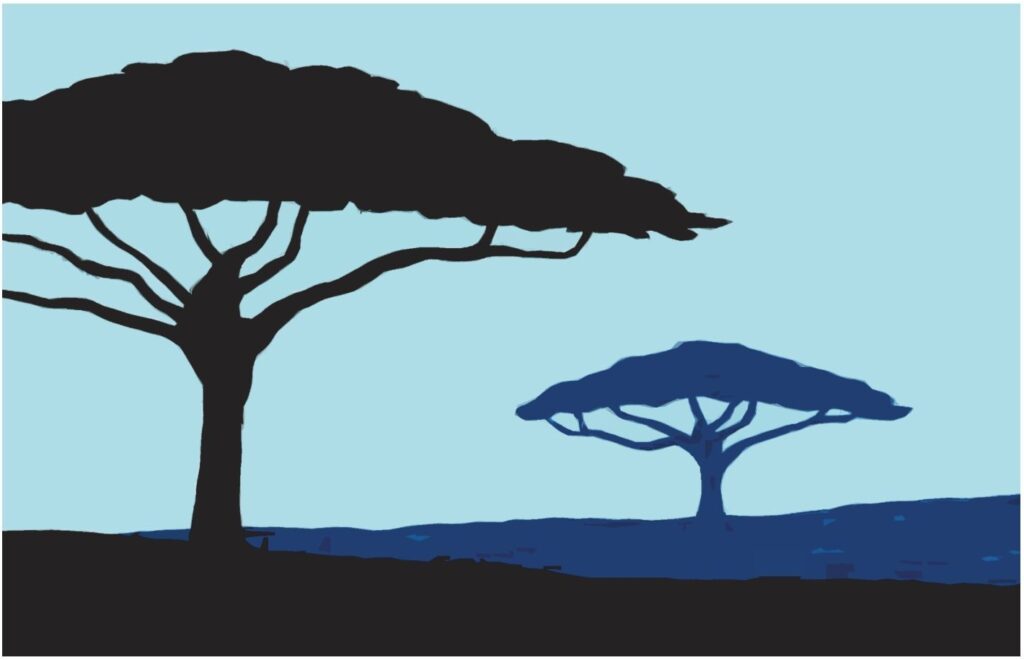
Intense blue morning
promising early heat
and later in the afternoon
heavy rain.

The bright chips
fly from the sharp axe
for some distance through the air
arc,
and eternities later,
settle down in showers
on the dewy grass.

It is a big log:
but when you are fourteen
big logs
are what you want.

The wood gives off
a sweet nose-cleaning odour
which (unlike sawdust)
doesn’t make one sneeze.

It sends up a thin spiral
of smoke which later straightens
and flutes out
to the distant sky: a signal
of some sort,
or a sacrificial prayer.

The wood hisses,
the sparks fly.

And when the sun
finally shows up
in the East like some
latecomer to a feast
I have got two cobs of maize
ready for it.

I tell the sun to come share
with me the roasted maize
and the sun just winks
like a grown-up.

So I go ahead, taking big
alternate bites:
one for the sun,
one for me.
This one for the sun,
this one for me:
till the cobs
are just two little skeletons
in the sun.
Having written works for children, Mungoshi is used to bridging the divide between the adult and childish worlds. There’s certainly something playful about Before the Sun, the ambiguous images, shifts in tone, occasional darker expression, that creates the sense of the author playing with the symbolism of the scene, and playing with his readers too. As a fourteen-year-old boy, his subject is on the cusp of adulthood, with one foot in the childish world of fun and games (one for the sun, one for me) and one foot in the world of adult responsibility. At this age he’s eager to push forward in life, but he hasn’t completely sloughed off his childish demeanour. The result is an appealing mix of innocence and experience. The boy is wise to the part he’s meant to play: for example, he works assiduously, is respectful to his elders, and seems aware of more serious times to come. Yet he also takes pleasure in the experiences of the moment. He revels in the task of cutting up a big log, choreographing a magical scene from a simple, everyday chore. Whether chopping wood, cooking maize, or eating a simple breakfast, the boy finds the joy and fun in life. He’s got a ‘seize the day’ attitude that’s easy to warm to and lets us read Before the Sun as a carpe diem poem: one that exhorts readers to make the most of life and, while respecting the opportunities and responsibilities that come our way, still find time to connect with and appreciate our immediate surroundings.

The poem begins in the still moments before the sun breaks over the horizon. Night has fled and the sky is an intense blue. In setting the scene, Mungoshi strips his opening lines of all extraneous words: compare the feeling of ‘It was an intense blue morning’ with Intense blue morning to get a sense of what I mean. He writes lines of three or four words (the longest line is only seven words), using short words of only two or one syllable (the latter called monosyllables: bright chips fly from the sharp axe, for instance) to create small, spare verses. Even at a glance, the impression of stark, bare simplicity is formed by the shape of the words on the page. Spatial form (how words are arranged in small, focused verses, not cluttering up the white background of the page) creates a sense of stillness and focus: the boy is attuned to the landscape and can sense early heat and later in the afternoon heavy rain. While it feels like he’s living in the moment, nevertheless he’s mature enough to anticipate challenges that lie ahead. Extraneousness is stripped away by the spare, focused language. This is the reality of living life close to the land. The boy doesn’t overcomplicate things: for instance, in this verse, the sun is due to rise soon… so he should finish his chores before it gets too hot. As the poem unfolds, this sense of the boy intimately understanding the world around him, and working in harmony with the natural landscape, will only grow stronger.
In a way, Mungoshi’s descriptions of the landscape function as pathetic fallacy for the boy himself. This is a technique by which descriptions of the surrounding environment (usually the weather, seasons, or natural landscape) echo the emotional concerns of the human characters in a story or poem. The intense blue morning visually echoes the boy’s character: he’s still, focused, and prepared. The hints of instability to come later in the day are symbolic of a boy’s journey through life: early heat suggests the stronger emotions of a young man, while heavy rain implies challenges and hardships he’s yet to face. While these remain in the future, nevertheless, now is the best time to get prepared. If you know the heat is going to make physical work unbearable, best get it over and done with, right? What’s more admirable is the boy doesn’t let future anxiety spoil the present moment. In the second verse, he takes his sharp axe to the challenge of cutting wood with gusto and relish. Sharp describes the vicious blade of the axe, but, like intense, the word transfers its meaning to the boy as well, suggesting he’s sharply focused on the job at hand; more, he prepared his axe for this moment beforehand. The pleasure he takes in his work is reflected in the shower of bright chips that fly from the edge of his axe. It’s a stunning visual image, sparkling and cinematic: it seems to play out in slow motion, an effect heightened by wide assonant sounds (bright, fly, through, sharp, air, arc) slowing the pace of the lines like a film played at half-speed. Time almost freezes as flying debris cascades in the air, tracing an arc shape that sits on a line of its own, where, for a moment, the poem simply halts, freeze-frame. This moment feels ripe with meaning, the arc symbolic of a lifetime, past-present-future all mapped out in a beautiful visual tableau. Eternities later (this phrase winds time back up, but slowly, stretching out the moment, the long word eternities being a noteworthy exception to the poem’s usual monosyllabic language) the flying chips finally settle down in showers on the dewy grass. Even as the flurry of action ends, fizzy sibilance animates the resting imagery, wood-chip shrapnel quivering with a latent energy that suggests the released potential of the boy: this is pathetic fallacy at its most subtle and potent. Importantly, the poem’s imagery doesn’t present the boy’s actions as a disturbance to the day’s natural rhythms: when the chips land on the ground around the boy, they do so softly (settle down is a delicate phrase) and blend harmoniously with the dewy grass, the word showers letting the chips fall like raindrops themselves. A child of the landscape (remember how he could sense the coming rain?) the boy’s actions are a part of – rather than an antagonist to – the unfolding day.
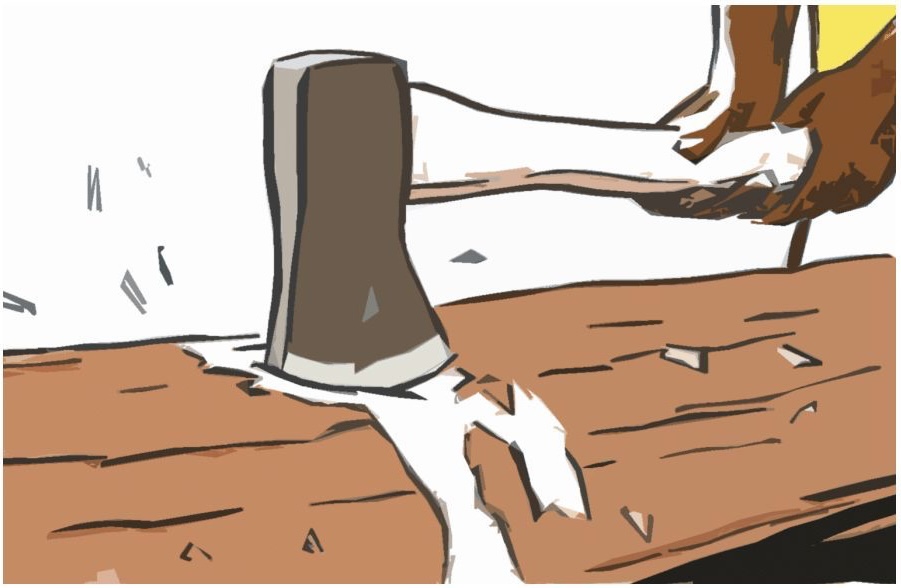
Once the sparkling scene has settled to stillness, Mungoshi breaks the narrative flow of the story to deliver a small aside: It is a big log, he tells us. It’s here we learn the boy’s age, which allows us to read the poem as an extended metaphor for growing up. Through the symbolism of a rite-of-passage initiation, chopping the big log (repeated for emphasis) is like a threshold test the boy must pass to be accepted as a man. His approach to the test speaks for his readiness: with commendable attitude, he doesn’t procrastinate or balk at the size of the task. When you are fourteen big logs are what you want he calmly says. Returned to the characteristic simple monosyllables (big log, when, what, want) of much of the poem, this statement is declarative and certain. Yet his tone isn’t braggartly or boastful; he’s simply stating his willingness to take on whatever life might throw at him. He keeps his axe sharp, suggesting he’s internalised the rhythms of rural life and is ready for more responsibility. Mirroring his subject’s understated humility, the simplicity of the poem belies its effectiveness: soft W alliteration combines with gutturals (big log) and dentals that clip words off short and sharp (when, what, want) to convey determination and readiness, a strong steel frame disguised under a soft outer layer.

The subsequent three verses, slightly unexpectedly, linger on the chopped wood rather than the boy. If you’ll permit me to use a cinematic cliche again, the action of making a fire happens ‘off-screen’. While not explicitly described, nevertheless a few lines later the fire’s crackling away, wood hisses and sparks fly. The sound is rewarding, comforting, and a little liberatory: lively onomatopoeia (hisses) and imagery of sparks flying convey ideas of released energy or potential, once again associating with the boy in a way that blurs the line between symbolism and pathetic fallacy. We discover the boy’s hands-on approach delivering its own rewards when the wood gives off a sweet nose-cleaning odour… unlike sawdust. This olfactory image (an image that appeals to our sense of smell) bears a little thought. There may have been quicker, more efficient ways to cut the log: the boy used an axe rather than a saw. But sometimes doing things the hard way gets better results: if he’d cut the log differently, the dust might make one sneeze, spoiling the moment, which is comfortable, welcoming and inviting. Again, this detail suggests how the boy is attuned to his surroundings, knowing either instinctively or through experience how best to use the materials of his life. The sense of boy and nature working together continues through the faint personification of the fire. Once lit, the fire sends up a thin spiral of smoke in tendrils resembling a long finger unfolding in the sky, beckoning distant others to come. The verb phrase flutes out combines a musical impression with the meaning of flutes from geology, which are the shapes carved in the earth by flowing water. Used also in art and architecture to describe a sculpted flowing shape, this choice of word (diction) suggests all these associations at the same time, according the smoke agency and aesthetics while keeping it firmly a part of the world’s natural rhythms and expressions. Mungoshi calls it a signal of some sort, remaining intentionally vague and trusting symbolism to do the work of storytelling. He helps us by crafting sibilance (sends, spiral, smoke, straightens, flutes, sky, signal of some sort, sacrificial) that sounds like a voice at the edge of hearing, a whispered message carried by the wind. Or a sacrificial prayer brings a note of seriousness into the poem, as if the boy has had to make a difficult choice. But I don’t read this as overly sinister. At some point, all of us must leave our childhoods behind and take our first steps into a more serious, adult world. Sacrifice – such as the leaving behind of childish notions and ways of behaving– is a necessary part of the process, and its sadness can be acknowledged at the same time as one of life’s important milestones is celebrated.

Time passes, backed by the comforting sounds of the fire spitting and crackling away, before the sun… rises in the East, bringing the early heat promised at the start of the poem. Personified as a kind of wise elder figure, the sun is who the boy has been waiting for, the recipient of his smoke signal messages. Once again, the boy’s mature preparedness and forethought are on display: he anticipated the sun’s arrival and cooked two cobs of maize ready for it. In the context of being a Zimbabwean poem, cobs of maize take on deeper meanings and associations. A staple food in Mungoshi’s homeland, maize symbolises nourishment, community, and the boy’s appreciation of his simple, rural life. His actions are respectful, he offers to share… the roasted maize as if the sun is an honoured guest to his initiation feast. The interaction has the feel of participating in a ritual, hinting at a significance to the morning’s routine that belies the poem’s simplicity. Like a youngster straining at the leash that holds him back, there’s just the smallest note of impatience in his voice: he uses the phrase finally shows up and a simile like a latecomer, as if he’s eager to get on with things and doesn’t want to be held back anymore. However, I put this down to the forgivable impatience of youth. I’m reminded of Yoda’s admonishment to Luke Skywalker on Dagobah: ‘always thinking of the future are you.’ The sun doesn’t seem offended either; he just winks like a grown up conspiratorially, giving the boy permission to go ahead without him, as if saying; ‘you passed the test, you’re ready now, enjoy your breakfast.’ The boy’s newfound sense of self-assurance is subtly conveyed by a change away from the passive tense of the earlier verses (where chips flew from the log, the cut wood gave off its own odour, the fire sent up smoke signals almost independently). It felt a bit like the boy was a passenger in his own story, acting out the ritual part he was expected to play. Now, Mungoshi shifts to the active tense and the boy’s voice gains clarity: I have got two cobs… I tell the sun to come share… I go ahead… Subtly, through I + verb patterns, Mungoshi creates the sense that the boy has grown into his confidence, is taking control, making decisions, and starting to steer his own course through life. (Do you share my suspicion that the writer was once this confident, eager boy himself?)
The poem ends with a playful-yet-meaningful scene where the boy mimes the action of sharing food with the sun, his esteemed guest. It’s a lovely little vignette reminding us that, while he has the eagerness and physical aptitude of a young man, in some ways he still sees the world through a boy’s eyes. He takes big alternate bites (repetition of the word big not only describes his copious appetite – well earned after the morning’s hard work – but also hearkens back to the description of the big log, suggesting the boy’s internalised the lessons gained through completing a difficult challenge) and repeats one for the sun, one for me in a singsong way that blurs the line between childhood game and a ritual sharing of food. This last is symbolic not only in Zimbabwe, but across many cultures, where sharing food with others implies respect, hospitality, community, and friendship. The broad M and N nasals of the game blend with wider assonance (particularly longer O in so I go, one for the sun, one for me, two, skeletons) of the final verse to create euphony, ending the poem on a comfortable, rich blanket of sound, like the boy stretching back onto a mound of grass. He’s comfortable in his own world, the return to simple monosyllabic language and childlike repetition evoking the easy satisfaction of a fourteen year old boy who’s completed his morning chores, eaten his breakfast, and is well set up for the day ahead. While he’s not quite a child anymore, he’s also not quite a man yet, although the way he’s been presented here bodes well for his future.
However, just before the end, Mungoshi complicates the restful imagery by weaving a more challenging metaphor into the soft tapestry of the scene. As the boy finishes his meal, the inedible cob cores are transformed briefly into two little skeletons. On one hand, the image of bones shows us that the boy ate every morsel, letting nothing go to waste, another way of implying his humility and gratitude for what nature provides. On the other hand, it’s a jolting reminder that, while the boy’s still young and near the beginning of his life’s journey, there will be other, more testing ‘waystations’ for him to pass. A surprisingly harsh word that cuts across the boy’s calm repose and the warmth of the sunlit scene, skeletons links him to death that ultimately waits at the end of every life. It may also be a subtle reminder of the hardness of rural life; thanks to his forethought and preparation, the boy was prepared for the challenges of this day… but there may be tougher times ahead for him to face.

Suggested poems for comparison:
- After the Rain by Charles Mungoshi
After a week or so of continuous rain, a bird crashes into a wall and breaks its wing. It lies on the pavement, ignored by passersby, until a kindly beggar takes up the bird. Another Mungoshi poem full of his mysterious pathetic fallacy and symbolism.
- Farmhand by James K. Baxter
A great contrast with Before the Sun as the boy in this poem from New Zealand struggles with his own rite of passage, unable to overcome his fear and nervousness at a moonlit barn dance.
- In Mrs Tilscher’s Class by Carol Ann Duffy
Another poem set on the cusp of adolescence, the dangers and fears of the adult world are powerfully implied by the final image of the sky breaking open into a thunderstorm.
Additional Resources
If you are teaching or studying Before the Sun at school or college, or if you simply enjoyed this analysis of the poem and would like to discover more, you might like to purchase our bespoke study bundle for this poem. It costs only £2.50 and includes:
- Study questions with guidance on how to answer in full paragraphs.
- A continuation exercise to help you practise analytical writing.
- An interactive and editable powerpoint, giving line-by-line analysis of all the poetic and technical features of the poem.
- An in-depth worksheet with a focus on explaining the figurative imagery and symbolism of the poem.
- A fun crossword quiz, perfect for a starter activity, revision or a recap – now with answers provided separately.
- A four-page activity booklet that can be printed and folded into a handout – ideal for self study or revision.
- 4 practice Essay Questions – and one complete Model Essay for you to use as a style guide.
And… discuss!
Did you enjoy this explanation of Mungoshi’s playful poem? Do you think the boy and the writer are one and the same? What did you make of the poem’s hints of darkness, such as the skeletal cobs left baking in the sun? Why not share your ideas, ask a question, or leave a comment for others to read below.