Posted by
 Who is really being appreciated in this famously tender poem by William Shakespeare?

“To come, as a commentator, on this – the most familiar of poems – is both a balm and a test: what remains to be said?”
Helen Venler, The Art of Shakespeare’s Sonnets
I’m betting you’ve heard of the writer of today’s poem! Arguably more well-known for plays like Romeo and Juliet and A Midsummer Nights’ Dream, William Shakespeare was also a prolific sonneteer, writing 154 sonnets over the course of his life (1564 – 1616). In an incredible 126 of these, the subject of praise is the same: a mysterious figure scholars call ‘Fair Youth’. While he’s not directly named in Sonnet 18, nevertheless, Fair Youth is the subject of this sonnet too. He’s believed to be based on a historical person, but it’s not clear who. Possibly, he was a young nobleman who gave Shakespeare his financial and artistic patronage. In this poem, Shakespeare lavishes praise on Fair Youth for his beauty and constancy, which outmatches the summer, the sun and stars, and ultimately even death itself:
Shall I compare thee to a summer’s day?
Thou art more lovely and more temperate:
Rough winds do shake the darling buds of May,
And summer’s lease hath all too short a date;
Sometime too hot the eye of heaven shines,
And often is his gold complexion dimm’d;
And every fair from fair sometime declines,
By chance or nature’s changing course untrimm’d;
But thy eternal summer shall not fade,
Nor lose possession of that fair thou ow’st;
Nor shall death brag thou wander’st in his shade,
When in eternal lines to time thou grow’st:
     So long as men can breathe or eyes can see,
     So long lives this, and this gives life to thee.
The sonnet begins as a traditional love poem using a well-worn comparison that most people can probably recite from heart: Shall I compare thee to a summer’s day? This line is one of the most famous in all of poetry; it’s frequently recited, repeated, parodied, and even satirised. The line itself has come to symbolise romantic love and admiration. By choosing a ‘summer’s day’ as his point of comparison, Shakespeare summons images of warmth, vitality, brightness and easy pleasure – all qualities that transfer to thee, the subject of the poem’s affection. The question is rhetorical, it’s not meant to be answered, but to set up the contemplation that leads into the sonnet’s argument. Many sonnets – by Shakespeare and others – follow a similar structure. The first lines establish the premise, and the rest of the poem delivers the argument. In this case, Shakespeare will go on to argue that the beloved subject of his poem actually surpasses the beauty of a perfect summer’s day. Therefore, the next line completes the famous couplet: thou art (meaning ‘you are’) more lovely and more temperate.
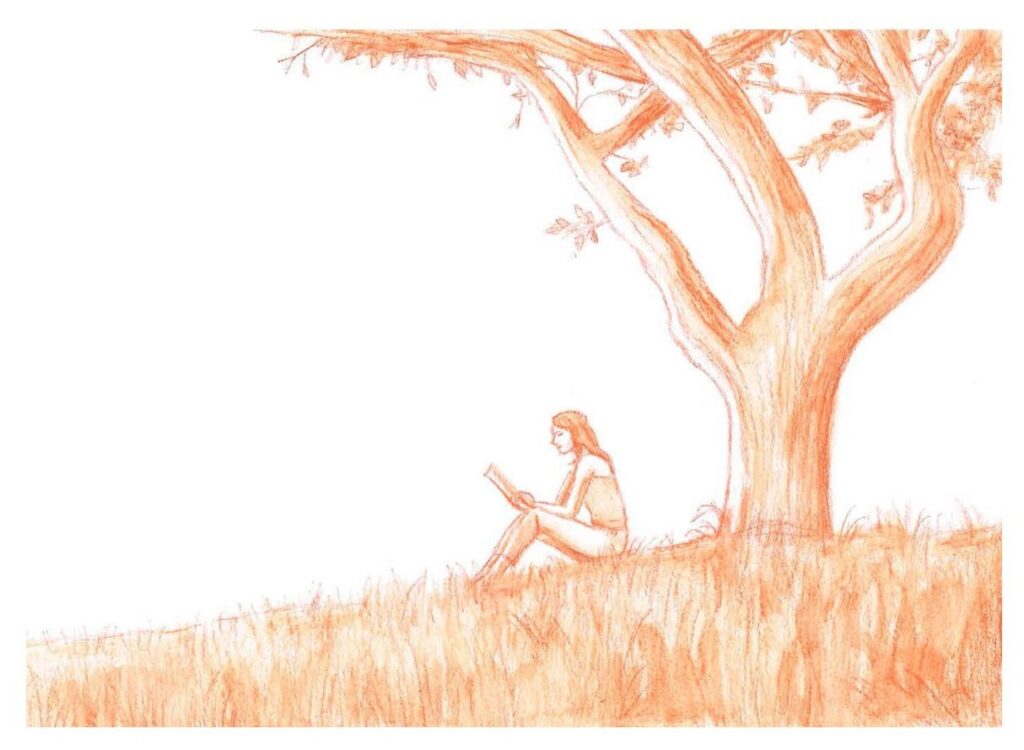
It’s a bold claim, and one that needs justifying. So let’s consider some of the reasons Shakespeare presents in support of his argument that even a gorgeous sunny summer’s day (a rarity in England, I can assure you!) is not as lovely as Fair Youth. The word temperate relates to the climate, meaning ‘of mild temperature’, and the poem transfers this characteristic to its subject, suggesting that Fair Youth shows moderation and self-restraint, inner qualities of character as well as the ‘loveliness’ associated with physical beauty. It’s not that a summer’s day isn’t beautiful; it’s that the beauty of summer is unstable, the fair-weather, sunshine, and warmth is too changeable. Indeed, British weather is famously fickle, and summer is often marred by blustery winds. The phrase darling buds of May is another famous line that has passed into the popular lexicon. In this image of an idealised summer, buds of May stand for youth, the new life of spring, the vitality of nature. But they are shaken by a rough wind that destabilises the calm equilibrium of the poem and proves that, what we think of as constant and enduring is, in fact, fragile and unstable. By comparison with the temperate mildness of Fair Youth, a summer’s day – no matter how cosy and warm it might be in the moment – is just too unpredictable and the easy times simply won’t last long. This changeability and brevity is explained further at the end of the first quatrain (unit of four lines): summer’s lease hath all too short a date. Here, Shakespeare chooses a curiously legal word, lease, used in the signing of contracts and the renting of property, as if the summer has agreed to dwell for a short, specified time, before returning its borrowed place to its rightful owner. The word effectively conveys the poem’s theme; summer’s beauty is temporary (too short) and the skies will soon darken into Autumn rains and winter cold.
Even before the rough winds arrive, while summer still reigns supreme, changeability and unpredictability is baked in to the experience. Occasionally, it becomes too hot for those used to milder climes. Shakespeare describes a scorching, unbearable sun using a metaphor, the eye of heaven shines, that elevates the sun to an ideal of nature’s power. Imagining the sun as a single golden eye-in-the-sky gives it a godlike aspect as it gazes divinely down upon the mortal realm. But even this, the ultimate symbol of nature, is unstable. In the very next line, the godlike aspect is reduced: often is his gold complexion dimm’d. Now, Shakespeare personifies the sun as more human than divine, giving him a face (complexion) that, while at its zenith shines with a gold glow, is eventually dimm’d (by scudding clouds, perhaps, or by the turning of summer to autumn). Personification makes the sonnet’s argument more sensible: picturing the sun as another man allows the comparison with Fair Youth to be borne. The reader can envision two handsome young gentlemen standing side by side, both beautiful to behold, but one bearing an inconsistency and instability that the other doesn’t carry. By contrast to the changing sun, Fair Youth is constant, the word temperate implying a mildness of character that is self-restrained, not changeable like the summer weather but calm in his habits. The second line’s construction uses the repetition of more… more… exclaiming Fair Youth’s superiority and reasserting his constancy. No matter how perfectly beautiful a summer’s day might seem, its transience makes it an inferior comparison to the sonnet’s human subject.
As a master sonneteer (yes, that’s really what writers of sonnets are called) Shakespeare uses every argumentative trick in his poetic book to convey the sense of a short summer’s brief impermanence. For instance, in the line we discussed earlier (summer’s lease hath all too short a date) the line is composed almost entirely of monosyllables, and the words are shortened further using a pattern of clipped dental D and T sounds: too short a date. Words are cut off sharp, just as summer will all too soon be spoiled by rough winter winds. Elsewhere, sounds that summon the quintessential laidback feel of a lazy summer’s day are humming nasals (the letters M and N that appear in words like summer, more, temperate, sometime, dimm’d, and untrimm’d). Combined with a soft, whispering sibilance (the letters S and SH), the sonic blend evokes not only summer’s beauty but also its transience. Soft consonance (repeated consonant sounds) easily drifts and fades in the air – just hear those swoony of nasals and fragile fricatives in the line: every fair from fair sometime declines… Barely any hard sounds prop up the lines to give the images solidity. Assonance has a role to play here as well. Listen to the rich, round O sounds combining with wide vowel sounds in Shall I compare thee to a summer’s day… and Sometime too hot the eye of heaven shines… and how that collapses into a shorter, quicker I sound audible in: often is his gold complexion dimm’d. All through the poem you can trace the same movement of stronger, more stable sounds contracting into quicker, weaker, less stable patterns.
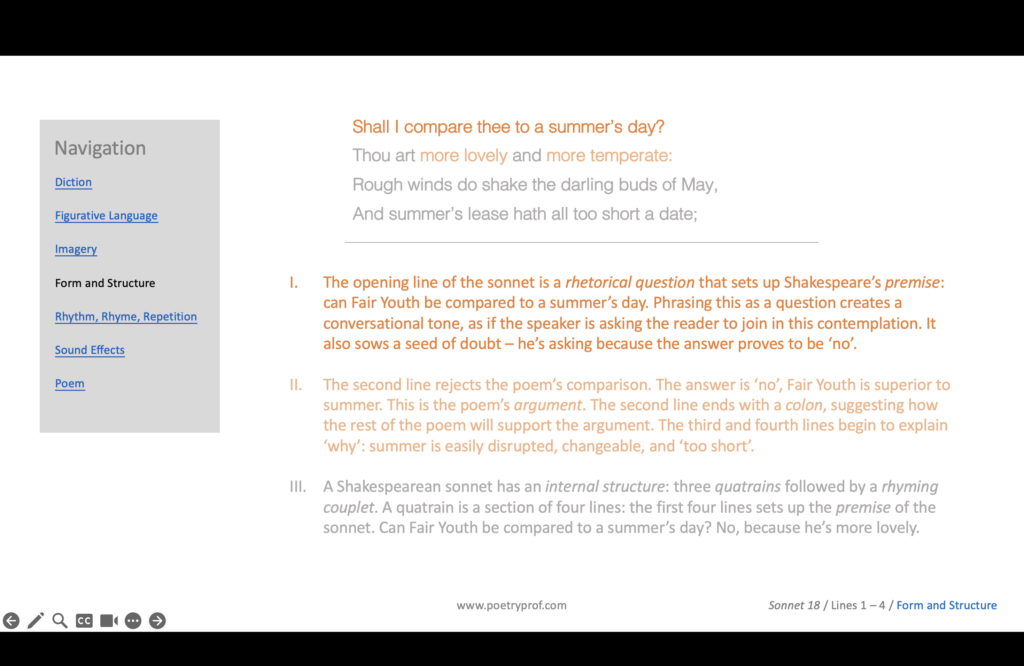
The comparison between Fair Youth’s perfection and the imperfect beauty of a summer’s day is further supported by the formal elements of a sonnet, which is the ideal vessel for drawing contrasts. A sonnet’s traditional fourteen lines are divided into two sections: the initial eight lines called the octave and the following six lines called the sestet. You don’t have to be a skilled mathematician to see that the octave is easily divisible into four and two, creating a natural framework for side-by-side comparison. All of Shakespeare’s sonnets were written in iambic pentameter, a regular pattern of paired syllables, one weak, one strong (this measure is the famous iamb) that creates the characteristic flowing de-dum, de-dum rhythm of Shakespeare’s best-known works; in Sonnet 18, the regularity of the two-syllable iambic rhythm carries the poem’s central argument: that the passage of time will eventually wear way all of nature’s beauty. More, certain words that carry important meanings are highlighted by the strong beats. Look at how the visual imagery of light (shine, gold, heaven, summer) clashes against words such as dimm’d and declines. Shakespeare always arranged the rhyme scheme of his sonnets in the same ABAB, CDCD, EFEF, GG pattern, which further underscores these contrasts. Rhyming words have a reflecting effect: for instance, the word shines rhymes with the word declines creating a natural opposition: the first word is visually bold, while the second word visibly and audibly fades away. As the octave nears completion, the reader realises that everything in the natural world carries the same transience: every fair from fair sometimes declines. Whether spoiled by accident (chance) or allowed to live out its natural span of time, nevertheless nature’s changing course – winter always follows summer, flowers wilt, youth fades – guarantees that no matter how beautiful something appears to be in the moment, all beauty will inevitably age, wither and die. Shakespeare ends the octave with the word untrimm’d, a nautical term applied when the sails of a ship have not been properly adjusted. A reader attuned to this figurative language can imagine the course of nature in the pomp of its beauty, ‘trimmed’ with sails gloriously aloft. Shakespeare’s choice of word untrimm’d lets us picture the opposite; a ship with sails furled, unable to follow the ideal course it might like to take. It perfectly illustrates his argument that everything in nature – flowers, the sun, youth, beauty, the seasons – are subject to forces greater than themselves: chance, fate, the grinding passage of time. Therefore, everything must inevitably wither and fade away.
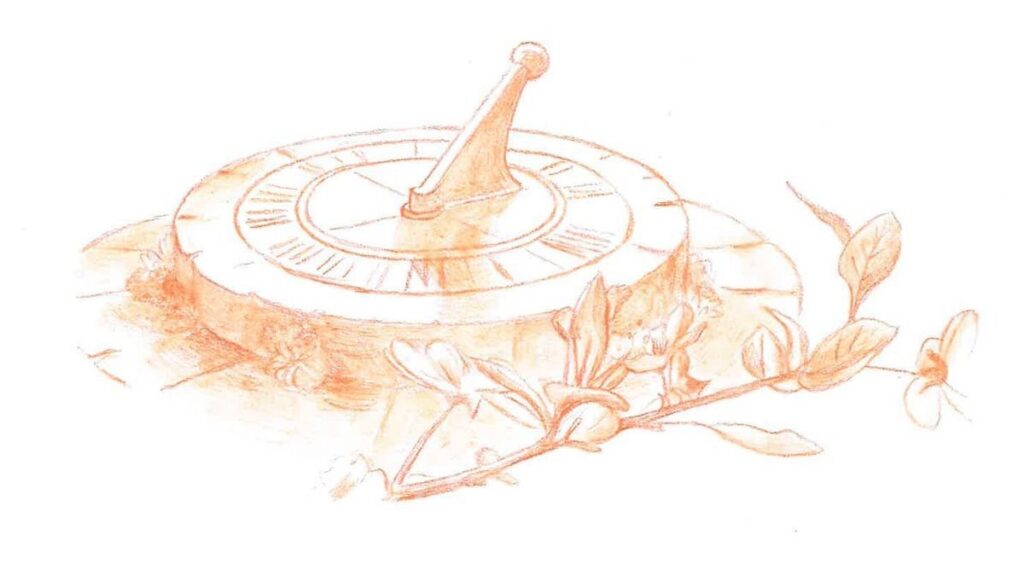
With one exception: Fair Youth is immune to this withering natural law. Between lines eight and nine (between the octave and the sestet) Sonnet 18 turns. This shift (also known as a volta) is traditional. Whether before the ninth line, or after the twelfth, something in a sonnet should change; whether the direction of argument, the tone, perspective, voice, or the poet might even introduce a sudden twist before the end. In Sonnet 18, the turn is Fair Youth being the exception to the everything-must-fade-and-die rule. It’s easy to spot because Shakespeare uses the word But to alter the direction of his thoughts: But thy eternal summer shall not fade. It’s a complete one-eighty! Having spent the octave telling us that all beautiful aspects of the natural world will fade away, we now learn that Fair Youth’s beauty is not subject to the rules of nature: eternal is the key word, the hinge around which the poem turns, telling us Fair Youth’s beauty will last forever. That’s some assertion, given even the godlike sun isn’t immune to being spoiled by passing clouds or passing seasons! Words like shall, technically called modal auxiliary verbs (or modals for short), are used to communicate strength of feeling and probability. Shakespeare doesn’t just ‘think’ his beauty ‘might’ be eternal or ‘could’ last forever – he tells us with certainty it shall never fade away. In fact, even death, who, according to Benjamin Franklin, is one of life’s only two certainties (the other being taxes), won’t be able to brag thou wander’st in his shade. Once again, Shakespeare uses personification to make his argument more bearable: death as a force of nature is impossible to resist; death as a swaggering braggart? Not only is that an easier imaginative leap to make, the tendency to brag and boast juxtaposes Fair Youth’s more temperate and mild-mannered qualities, flattering the poem’s subject by comparison. Death rules over a realm of shade and shadow, visual imagery contrasting the realm of the dead with the gold, sunlit realm of the living. But Shakespeare’s confident his Fair Youth will escape death’s clutches, introducing negation into the third quatrain to assert that, unlike all other beautiful things under the sun, his eternal summer shall not fade.
You may be asking why Shakespeare makes such an unlikely claim. After all, the poem’s subject is but a man, and all men must eventually die. Remember that Fair Youth is probably modelled on somebody from Shakespeare’s life, a wealthy patron perhaps, so it’s not inconceivable that flattery was Shakespeare’s aim. But that’s not all. Shakespeare’s turn depends more on a classical Renaissance idea that art (or poetry) itself can defeat time and preserve beauty. People during the Renaissance were deeply aware of the power of time and change. The period saw rapid social upheaval, the overturning of religious norms, plagues and wars that proved the fragility of human lives and ambitions. Yet Renaissance thinkers were stubbornly convinced that human life had value and dignity, and that human creativity could produce lasting achievements. The idea was ancient – Homer and Ovid wrote about their works outlasting the ravages of time – and Renaissance writers picked up this theme and ran with it. Shakespeare wasn’t alone in the English sonnet tradition: poets like Philip Sydney and Edmund Spenser wrote works suggesting that poetry can defeat time and death. Sonnet 18’s bold claim that Fair Youth can outlast the crushing force of time is justified by the poem’s final couplet, rhymed and strengthened with anaphora (repeated words at the start of the lines) to give it the definitive weight of assertion that cannot be refuted:
So long as men can breathe and eyes can see
So long lives this, and this gives life to thee.
This refers to nothing less than the sonnet itself! You may have noticed Shakespeare repeating the word eternal in line 12. But this time he’s not praising Fair Youth’s beauty again – he’s describing his own poem’s eternal lines. This is the crux of his argument: My poem is strong enough to defeat time; as long as the poem survives, so will Fair Youth. Repetition of eternal ensures readers will notice the move from the world of nature, in which time erodes all beauty, to the world of art where beauty can be preserved for all time.
At the end, then, Shakespeare’s ode is not dedicated to Fair Youth’s beauty inasmuch as he praises his own artistry that can memorialise beauty in lines of ink, so it never fades. The poet becoming the subject of his own praise might seem like a tricky boast. But given that you are reading this sonnet today, it’s hard to disagree with the idea that the best-written words have a kind of magical power to preserve beauty… and even defeat the passage of time.

Suggested poems for comparison:
- Sonnet 130 by William Shakespeare
In Sonnet 18, Shakespeare uses nature to elevate his subject. Images are idealised buds of May and a shining summer sun. But in Sonnet 130, he uses nature ironically to mock the elevated descriptions of beauty common in Petrarchan sonnets. If you want to read a deflation of human beauty, look no further than a poem that begins: ‘My mistress eyes are nothing like the sun’!
- Ode on a Grecian Urn by John Keats
Shakespeare wasn’t alone in believing art could immortalise subjects and defeat time. In the most famous of John Keats’ ode sequence, he examines the engravings on an ancient urn kept in a museum, and wonders how the frozen images of people from long ago are almost alive to the eye.
- The Power of Art by George Santayana
Santayana was a Spanish-born philosopher and poet who became a Harvard professor. In this poem, he contrasts creation with human art. His images of nature are animated and beautiful, outstripping human artists who only capture fleeting moments of beauty, unable to bestow life. A very interesting counterpoint to read after Sonnet 18.
Additional Resources
If you are teaching or studying Sonnet 18 at school or college, or if you simply enjoyed this analysis of the poem and would like to discover more, you might like to purchase our bespoke study bundle for this poem. It costs only £2.50 and includes:
- Study questions with guidance on how to answer in full paragraphs.
- A continuation exercise to help you practise analytical writing.
- An interactive and editable powerpoint, giving line-by-line analysis of all the poetic and technical features of the poem.
- An in-depth worksheet with a focus on explaining the form of a Shakespearean Sonnet.
- A fun crossword quiz, perfect for a starter activity, revision or a recap – now with answers provided separately.
- A four-page activity booklet that can be printed and folded into a handout – ideal for self study or revision.
- 4 practice Essay Questions – and one complete Model Essay for you to use as a style guide.
And… discuss!
Did you enjoy this explanation of Shakespeare’s famous sonnet? Do you agree that human art can outlive time and even death? What impressions of the poet’s subject do the words and images bring to your mind? Why not share your ideas, ask a question, or leave a comment for others to read below.