Posted by
 Seamus Heaney wants to grow up to be like his dad
“With his wonderful gift of eye and ear Heaney has the gift of the story-teller.”
Robert Pinsky
Follower was first published as part of Seamus Heaney’s seminal collection Death of a Naturalist in 1966. If this incredibly rich collection could be reduced to a single theme, it might be something like: ‘the process of growing out of childhood into a more complex adult identity.’ Poems from Death of a Naturalist all explore some aspect of this transition, whether childhood wonder shading into adult knowledge, or experience replacing innocence, or rural life being challenged by a modernising world. Follower fits right into this framework and is often read as one of the poems at the heart of the collection. Seamus writes as an adult looking back at his younger self following his father (Patrick Heaney) around the family farm. Patrick embodied traditional rural values – agricultural skill, closeness to the farmland and animals, physical strength and practical skill – and Heaney remembers how he wanted to grow up to be exactly like this man. But, gradually, the poem reveals how he cannot become a carbon copy of his father, cannot inherit the way of life his father offers. While he comes from the rural world, his own path is taking him in a different direction: to academia and poetry. In another famous and widely anthologised poem from the same collection, Digging, Heaney wrestles with the same dilemma. He comes from a long line of ancestors who work the land (his father is a ploughman, his grandfather cut peat) yet Heaney learns to ‘dig’ only with a pen. In both Digging and Follower, while deeply admiring those who preceded him, he struggles with remaining loyal to his origins while allowing himself to become the person he is meant to be:
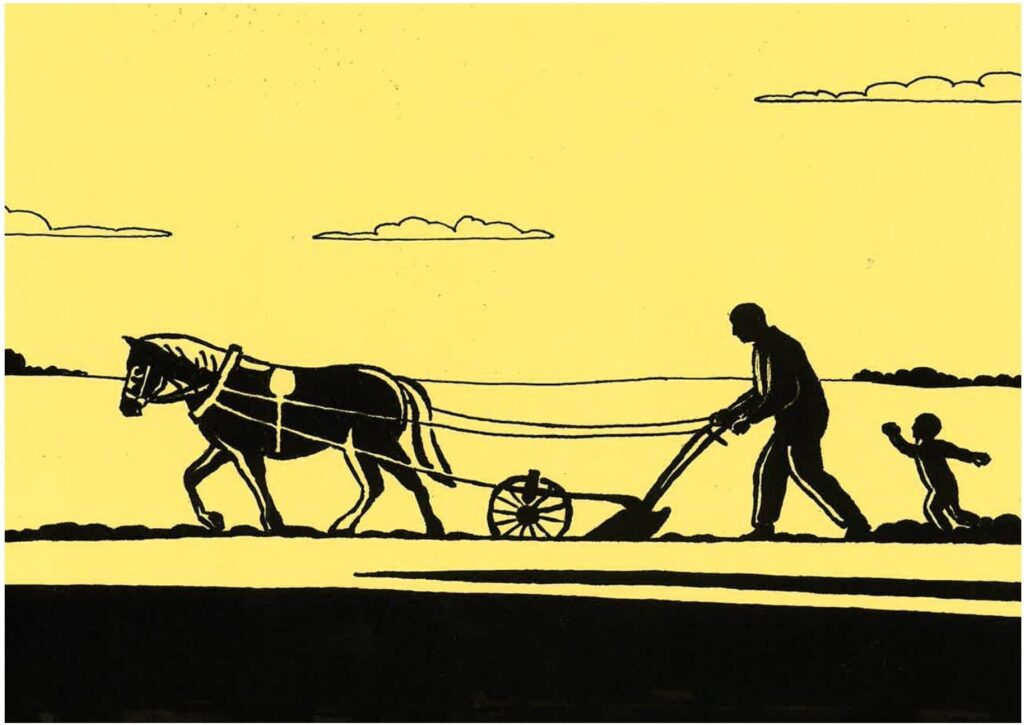
My father worked with a horse-plough,
His shoulders globed like a full sail strung
Between the shafts and the furrow.
The horses strained at his clicking tongue.

An expert. He would set the wing
And fit the bright steel-pointed sock.
The sod rolled over without breaking.
At the headrig with a single pluck

Of reins, the sweating team turned round
And back into the land. His eye
Narrowed and angled at the ground,
Mapping the furrow exactly.

I stumbled in his hob-nailed wake,
Fell sometimes on the polished sod;
Sometimes he rode me on his back
Dipping and rising to his plod.

I wanted to grow up and plough,
To close one eye, stiffen my arm.
All I ever did was follow
In his broad shadow round the farm.

I was a nuisance, tripping, falling,
Yapping always. But today
It is my father who keeps stumbling
Behind me, and will not go away.
Follower is above all a eulogy, a poem in praise of someone or something, in this case Patrick Heaney, the poet’s own father. Heaney’s admiration for his dad and his way of life is on full display. Through the simple and understated first line, My father worked with a horse-plough, he introduces his father as an agricultural labourer. The word worked is unadorned, pointing us towards the reality of a life involving physical labour on the land. Horse-plough adds a little context: this isn’t the age of mechanised farming using tractors, combine harvesters, and automated machinery. We’re in the tail end of a pre-mechanised age when farm work was largely accomplished by hand, the sweat of one’s body, and the use of horses to pull heavy tools. The opening stanza evokes a clear impression of his father’s strength: his shoulders globed like a full sail strung. Standing Atlas-like, capable of bearing the world on his back, this image places Heaney’s father in the middle of the scene, his wide shoulders symbolising his physical strength and dependable solidity. The image is enhanced through simile: like a full sail strung develops the rounded shape of Heaney’s father’s shoulders and adds the suggestion that he is capable of harnessing the power of his horse team as a ship’s sails harness the wind. He’s deliberately positioned between land, animals, and plough. Just as an old ship would drift aimlessly with no sail, the drive and direction of the work is dependent this man linking all the essential elements together. However, while physically impressive, Patrick’s power isn’t the brutish strength of some tough thug. While the horses strained, a word suggesting the exertion required by both humans and animals to drag a heavy plough through the soil, Patrick uses his clicking tongue to control them. This little onomatopoeia captures the way his father doesn’t use shouted commands, a whip, or crude methods to direct their strength; a simple click of the tongue communicates where he wants his horses to go, suggesting the mastery he’s gained through long years working on the farm. While he may be strong, he combines his strength with guile, skill, and the wisdom of experience.
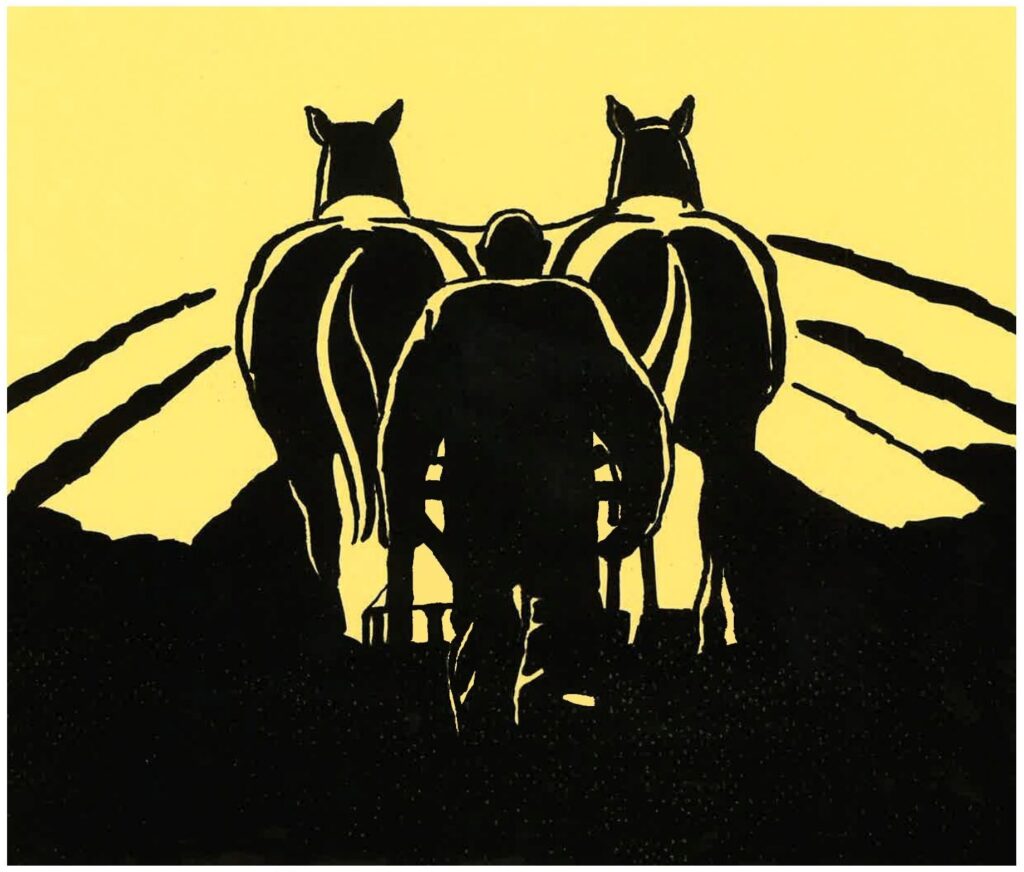
As well as giving us our first impression of the impressive size and strength of the man, the phrase shoulders globed subtly introduces the reader to a sound technique that Heaney uses to accompany his images across much of the poem: assonance. Both words feature a long O sound that, through its rounded richness and deep bass note, we come to associate with the father’s strength and dependability. Bold in the ear, assonant O reverberates beyond this line in words such as horse-plough, worked, horses, tongue and furrow, while the assonant U of full sail strung isn’t too dissimilar. Later, as we watch his father fit the steel-pointed sock or deftly manoeuvre the plough (soil rolled over) or even lift his son out of the mud (sometimes he rode me on his back) the same assonance rumbles like thunder, underlaying the visual images with a sonic reminder of the man’s solidity. We’re told he casts a broad shadow, the long Os conveying the sheer size of a man who takes up so much physical space. However, just as he isn’t a one-dimensional tough guy, neither is Heaney’s poetry only one note. Often the bass O blends harmoniously with softer consonance, such as W in words like furrow, shadow, and narrow, or with sibilance which, alongside assonance, is a sound effect you’ll hear accompanying moments of strength (full sail strung, horses strained) or skill. The blending of assonance with soft consonance produces an effect called euphony, which is sonorous and pleasant to the ear, much as listening to two singers share a harmonious melody is uplifting. Heaney uses euphony to uplift his father’s toil, depicting it as something beautiful, elegant, and worthy of praise and attention. While not shying away from the physical demands of farm work, watching someone as accomplished as his father lead the plough team makes it look deceptively easy, those years of practice distilled into a few smooth, precise movements.
Therefore, we see how Heaney admired his father not only for his strength and control exerted over his horse team, but for his skill and precision too. While he may be a simple farm labourer, that doesn’t mean he doesn’t take pride in his work. Through Heaney’s eyes, his father appears more like a craftsman or artist, ploughing the field with care. This idea is transmitted through the simple diction Heaney often employs when describing his father’s work. We previously noticed the simple clicking he uses to direct the horses: other verbs such as fit, set, and pluck are similarly economical and precise. These words are monosyllables, brevity itself being a way of conveying the precise actions of someone who’s mastered his craft. Stanza two opens with a sentence fragment, the only one of its kind in the whole poem: An expert. Marked with a full stop, this simple statement brooks no argument, only elaboration and further illustration. A later stanza ends with the word exactly, suggesting a perfectionist’s attitude towards getting things just right. We see him assemble his tools like an artist carefully arranging his brushes before putting paint to canvas – set the wing… fit the bright steel-pointed sock – then guiding his plough with such skill through the ground that the cut soil, Heaney uses the word ‘sod’, rolled over without breaking. At this moment, the soil itself becomes symbolic: it turns over so perfectly that it remains intact, showing off Heaney’s father’s precision and craftsmanship. The idea of the soil simply ‘rolling over’ suggests ease and cooperation, as if the ground doesn’t resist the plough while it’s under his father’s command. Patrick’s actions are often accompanied by visual images of brightness, such as when the bright steel-pointed sock seems to catch and reflect a flash of sunlight, or how the beautifully turned turf is polished by his father’s passing. Many of the poem’s major images (the setting up of the plough, the cutting of furrows, the turning around of the horse team) unfold over several lines of poetry, yet they do so smoothly without interruption, pause or punctuation at the ends of lines. Instead, Heaney uses a technique called enjambment to let one line of poetry run smoothly into the next, resembling the smooth way his dad performs his tasks. In one notable example, the turning around of the horse and plough in the headrig (a small patch of ground at each end of the field that would remain unploughed for this very purpose) unfolds over two stanzas and three lines, unmarked in the manner of traditional end-stopped poetry: At the headrig with a single pluck/ Of reins, the sweating team turned round/ And back into the land. Heaney shows us the difference between a worker and a craftsman: for one, ploughing a field is just a task that must be completed; for the other, farming is a way of life and in performing it well one reveals the quality of one’s character. Heaney’s father’s actions embody something my own father was fond of saying: if a job’s worth doing, it’s worth doing well.
In this way, Heaney’s poem elevates farming into more than work or even craft; its artistry conjures something beautiful out of the mud and soil of an Irish farm. From the very first stanza, and the image of the full sail strung, Heaney begins an extended metaphor that transforms the criss-crossing of the field into sailing across an ocean, with the rigging of the ship being the final preparatory step before casting off on an epic journey. Furrows of rippled soil visually resemble the rising and falling shapes of waves, turning the field into an expanse of water across which the father must steer his ship. The choice of words rolling and breaking possess nautical connotations – waves both ‘roll’ and ‘break’ – as does the dipping and rising motion of his father’s walk resemble movement at sea. A standout moment is when his father, like a grizzled sea-captain, narrowed and angled his gaze in concentration, mapping the furrows like a ship’s navigator charting his course. The aforementioned sibilance comes into its own here, orchestrating the memories with auditory imagery that equally well evokes a boat’s sharp keel cutting through the waves as a plough’s blade cutting into the soil’s crust. In the same way Patrick’s broad shoulders represent strength, his eye comes to symbolise expertise, being used in acts of judgment, analysis, and forethought: he exercises qualities of observation as much as physical strength. (If you want to be even more precise, the use of shoulders and eye as symbols of different aspects of Heaney’s father is properly called synecdoche: this is when symbol is but one connected part of a larger whole, as Patrick’s shoulders and eye are parts of his body. In truth, this word sounds more complicated than it needs to be! You’ve even possibly inadvertently used synecdoche yourself in everyday speech when you refer to a helpful person as a ‘useful pair of hands’ or the smartest of your friends as ‘the brains’). The significance of mapping extends beyond a single dimension; in forecasting where he’s going to plough next, the language blends the metaphors of artist and ship’s captain together, as like a cartographer drawing a map he sketches his own lines onto the land and, thematically, carves a path for his son to ‘follow’ in his turn.
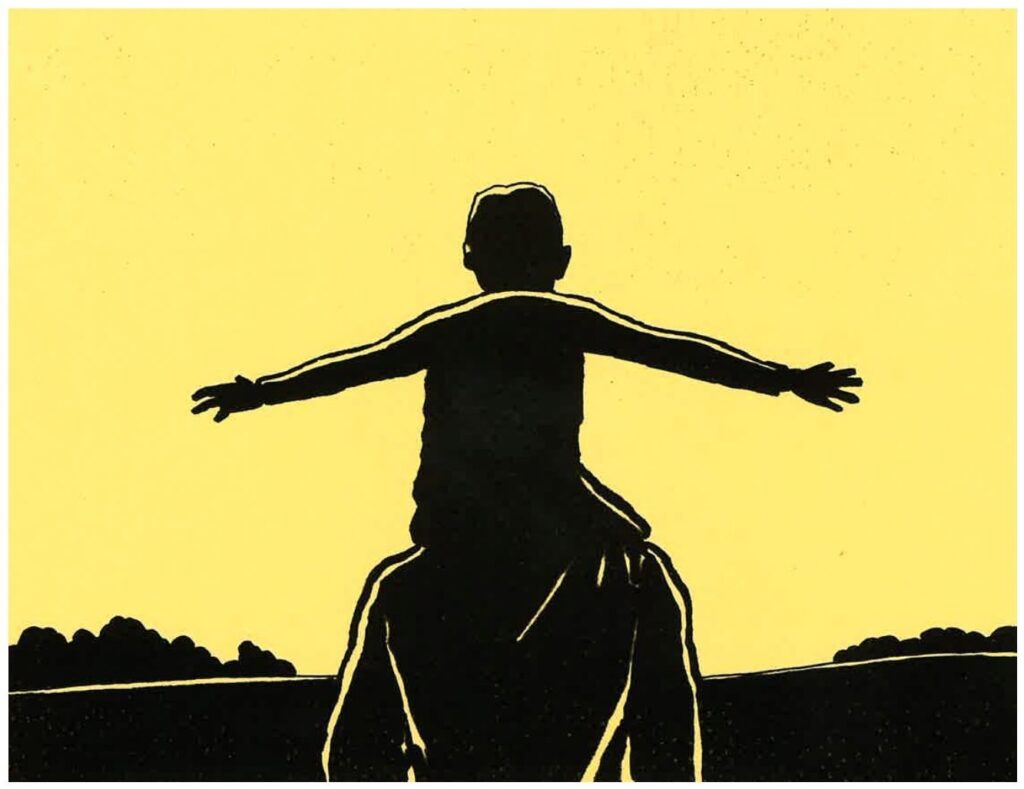
As the ‘follower’ of the poem’s title, Heaney brings his younger self more firmly into the poem (look how the fourth and fifth stanzas both begin with I), shifting the focus from father to son. Given their relative ages, and the years of accumulated experience under Heaney Sr’s belt, it’s no wonder that Heaney Jr felt inadequate by comparison and there’s a clear ‘strong-weak’ dynamic in their leader-follower relationship. Stanza four begins with the admission that I stumbled in his hob-nailed wake; a line that both continues the extended maritime metaphor of the poem (a wake is the triangular trail of parted waves left behind a ship as it moves through water) and establishes the idea of his father moving so powerfully through the world that the son struggles to keep up. As opposed to his father’s smooth competence, boy Heaney moves awkwardly though the poem. A series of contrasts teases this feeling out, beginning with clumsy verbs: where his father consummately set, fit, mapped and so on, Heaney remembers how he stumbled, fell, and ended up being placed unceremoniously on his father’s broad shoulders for support, an image of dependency enhanced by the passive tense (he rode me on his back rather than ‘I rode on…’). Yet parallel to the frustration and inadequacy is a sense of remembered affection. The word sometimes helps balance the tone here, especially the way it’s repeated so when the son sometimes fell, the father sometimes picks him up again, as if Patrick’s there for him not once or twice, but whenever little Seamus needs him. Written from only one side’s perspective, it’s impossible to know how his father felt about Heaney’s clumsiness, so we can really only judge him by his actions which suggest paternal protectiveness and warmth. My own childhood memories of riding on my father’s shoulders are full of fun and love, something that’s brought out by the playful image dipping and rising to his plod. Nevertheless, despite such moments of undoubted tenderness, it’s hard to say that the relationship ever truly grew out of its lopsided, leader-follower dynamic. Heaney’s father comes across as a dedicated man, but also a stoic one (is it hob-nailed that implies a certain hardness and unapproachability?). Perhaps in tending so diligently to his work he neglected to actively pass on his accumulated wisdom, expecting that his son would follow in his footsteps until one day he naturally takes on the mantle of the farmer he’s expected to be.
That this never happens becomes clear in the fifth stanza where the collision between desire and reality happens. Here, Heaney tells us explicitly that he wanted to grow up and plough – to be just like his father. Actually, it feels like his admiration led to a need not just to copy his father, down to the way he might close one eye or stiffen my arm, or assume his role as ploughman, but to actually become his father in a more complete way. His desire to plough is deceptive; on the surface it refers to doing his father’s job. But deep down, at the level of symbolism, ploughing represents the passing on of family tradition, his father’s intimate connection to the land, even his well-rounded multi-dimensional masculinity. The speaker’s ambition to plough is at root a desire to take on his father’s very identity. Yet this dream founders against the reality of a truth revealed by time; his imitation of his father never developed into true mastery, and he admits: All I ever did was follow in his broad shadow round the farm. Here, the protective solidity of his father seems too big for the son. While the shadow is sheltering, it’s also limiting and the father’s presence looms so large it’s impossible for his son to overcome. The metaphor ultimately conveys an inadequacy that cannot be outgrown. At this moment, the title of the poem becomes the writer’s definition of himself. Behind his father physically, in years, experience and skill, he continually occupies a secondary position. The act of following, by his own admission, is all I ever did and yet this ultimately ends in the failure to follow in his family tradition.
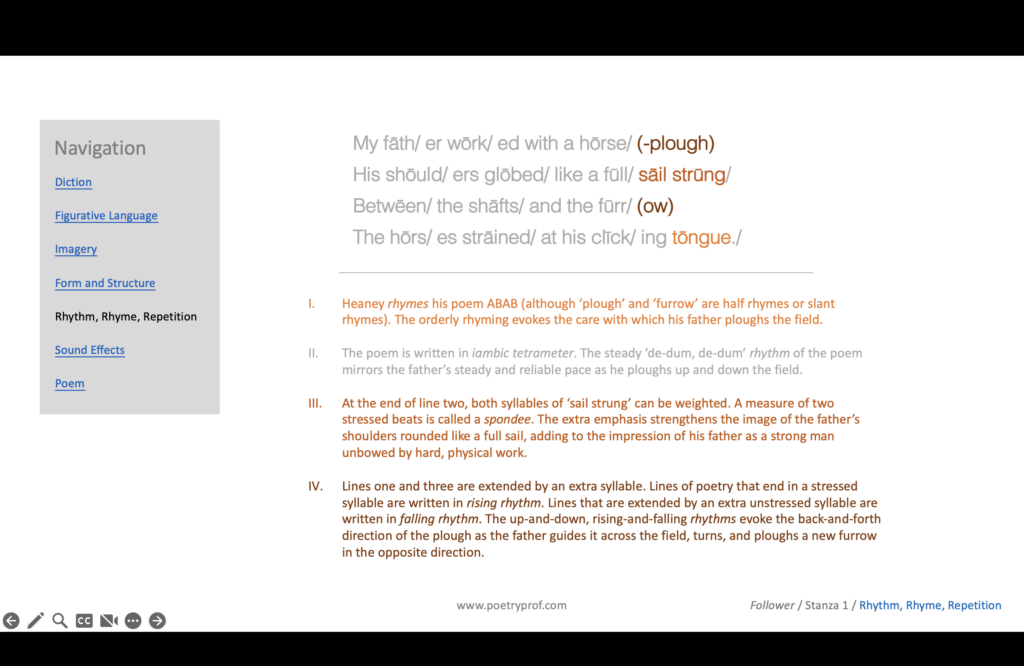
Except… looked at in a different light, Heaney did follow his father. Not into farming, certainly, but in his own way, through poetry. The first beautiful irony of the poem is, just as farming requires artistry, judgment, and intelligence, writing requires the same attributes. The poem’s very form attests to writing as an equivalent of the skills practiced by his father. The exquisitely crafted images paint the portrait of only one master, but the craftsmanship of the poem speaks to an unseen master’s hand. For instance, Heaney writes in quatrains, each stanza of four lines on the page like his father’s furrowed field in miniature. The regular quatrain structure reflects the same attention to neatness and order, is a result of the same discipline, as his father demonstrates in his work. Full rhymes (sod/plod, strung/tongue, round/ground, and so on) and half rhymes (plough/furrow, eye/exactly, and others besides) are placed in a regular ABAB rhyme scheme and a seemingly effortless iambic tetrameter evokes the lilting plod of man and horse team as they move steadily across the farm. Rhythmic variations are used to deepen the poem’s images. For instance, in the first stanza the first and third lines are extended by an extra unstressed syllable (something called catalexis) while the second and fourth end on stressed beats. The resultant rising and falling rhythms (lines ending on a stressed beat are said to be rising, those ending on an unstressed beat falling) evoke the back and forth work of the plough as one line is finished and the father turns his horses to cut a new line in the opposite direction. Above all, Heaney fills his poem with specialised agricultural terms: the wing is the blade of the plough, shafts connect plough to horses, sock is a slang for ploughshare (the tip of the cutting edge) sod for cut pieces of soil, the aforementioned headrig an area of unploughed ground at the end of the field, and furrows the shallow ditches made by turning soil in lines on the ground. These diction choices, the authentic language of his father’s area of mastery, are examples of technical language, and by using it Heaney demonstrates that he has internalised his father’s expertise, in theory if not practice. All together, specialised vocabulary, controlled rhythm, carefully crafted images, assonance, and all the other aspects of poetry we’ve uncovered, create the impression of an unseen master craftsman at work. The parallel is unmistakeable; while the father’s medium was the earth and the son’s medium words, yet both are perfected through years of practice.
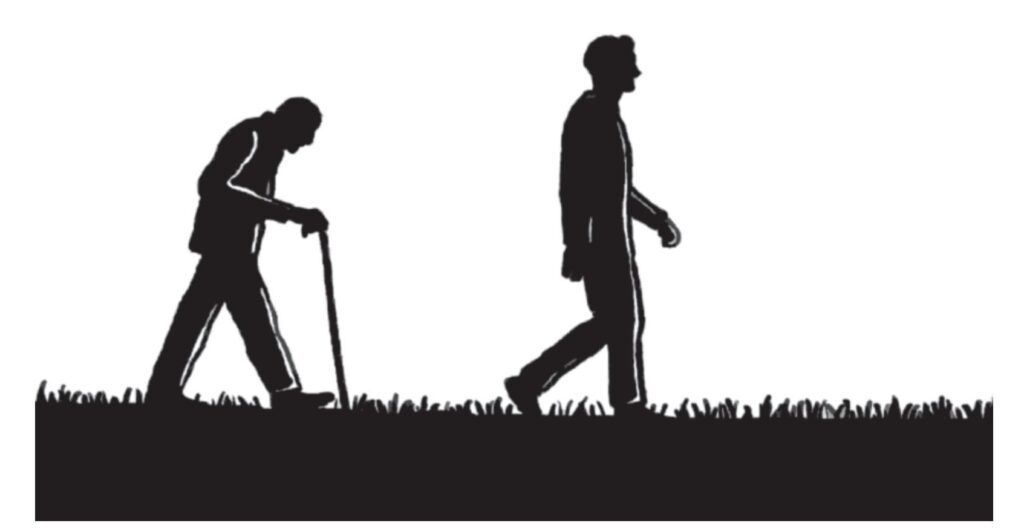
What’s more, the poem has time for one last irony, turning unexpectedly at the end as Heaney reverses the roles of father and son, so that the once proud ploughman is seen trailing behind like the nuisance his son once thought himself to be. This last image might catch you a little off-guard, its poignancy a sudden gut-punch. Of course, time erodes all things and in bringing the poem into the present (But today) we are allowed to see the one who led for so long becoming the follower. The repetition of the word stumbling, removed from the son and applied to the father, makes it hit home more emotionally, stripping the father of all his powers and reducing him to a mere annoyance. If you have a keen ear, you can hear a corresponding breakdown in the poem’s form that mirrors his father’s decline: those iambic rhythms become just a little less smooth (the syllables in the last line simply won’t scan) and that characteristic assonance using long O vanishes entirely. There’s something unsettling about the way Heaney closes his poem with and will not go away. The phrase feels a little impatient or irascible. Is he simply ashamed of an old man’s decrepitude? Or is he resentful of the dependent his father has become? (This thought compares unfavourably with the support his dad offered him earlier in the poem.) Perhaps he can’t bear seeing his father brought so low by the passage of time, or maybe he doesn’t want to think how time forces us all into this withering state sooner or later? Or is the role reversal more symbolic, his father’s troublesome ghost representing how the past always stays with us, no matter how far away we try to go? Does Heaney feel latent guilt at abandoning his family heritage and choosing to plough an entirely different furrow? The tone is difficult to pin down, containing traces of guilt, frustration, or exasperation all rolled into one.
Whatever your thoughts may be, without this ironic reversal the poem would have been a tender admiring memory, a eulogy for someone whose craftsmanship may not be appreciated by the untrained eye. In closing, Heaney elevates it to a poignant consideration of how time and ageing change us all and alter the relationships we come to depend upon. It’s no longer only about a son who follows his father, but about the way time makes followers of us all.
Suggested poems for comparison:
- Digging by Seamus Heaney
A perfect companion piece to Follower. Also published in Heaney’s seminal collection Death of a Naturalist, Heaney compares the way he writes to his grandfather’s work as a peat cutter, reconciling his family’s past with the very different path he chose to take.
- Elegy for my Father’s Father by James K. Baxter
A tradition of working with the soil was passed down through Baxter’s family as well. His grandfather worked as a peat cutter, and in this poem the writer imagines the vivid inner life that, in his stoic manner, he rarely let others see. Like Follower, combines a eulogy with an exploration of inheritance and family legacy.
- Those Winter Sundays by Robert Hayden
In this moving poem, Hayden considers how, unlike Heaney, he never admired nor was grateful for his father when he was young. Looking back, he realises how short-sighted he’d been. But it’s too late to make amends.
Additional Resources
If you are teaching or studying Follower at school or college, or if you simply enjoyed this analysis of the poem and would like to discover more, you might like to purchase our bespoke study bundle for this poem. It costs only £2.50 and includes:
- Study questions with guidance on how to answer in full paragraphs.
- A continuation exercise to help you practise analytical writing.
- An interactive and editable powerpoint, giving line-by-line analysis of all the poetic and technical features of the poem.
- An in-depth worksheet with a focus on helping you unpack how assonance creates effects in the poem.
- A fun crossword quiz, perfect for a starter activity, revision or a recap – now with answers provided separately.
- A four-page activity booklet that can be printed and folded into a handout – ideal for self study or revision.
- 4 practice Essay Questions – and one complete Model Essay for you to use as a style guide.
And… discuss!
Did you enjoy this explanation of Seamus Heaney’s moving eulogy to his father? What do you make of the role reversal at the end? Do you have any insight to bring to the complicated feelings expressed in the final lines? Why not share your ideas, ask a question, or leave a comment for others to read below.