Posted by
 Ellis Ayitey Komey resists the coming of the dark
Born in 1927 on what used to be called the Gold Coast (now Ghana) Ellis Komey was part of a mid-twentieth century explosion of African writers and poets. Through short stories and poems like Oblivion published throughout the 60s and 70s he helped bring Africa’s distinctive voice to a global readership. Oblivion is a widely anthologised poem and deservedly so. It’s a poem that rewards immersion, sitting with it for some time and letting the luscious images seep from the page into your mind where they come fully to life. Carefully constructed so that each line peels back a new layer of the forest scene, the experience of reading Oblivion is to sink into a fully realised world of the imagination. The poem vividly describes a forest landscape, complete with dense foliage, frogs chorusing underfoot, industrious crabs busy building nests in the shade of wide fringed palm leaves, wise old owls perched in the treetops, and more… the forest veritably bustles and teems with life. The poem’s speaker has a particularly compelling voice, warm and welcoming, but also plaintive and yearning – particularly in his repeated desire to remember – and the realisation gradually dawns that, despite the vivacity of the poem’s imagery, all the things in the poem are destined to decay and die, and one day even the speaker’s memory will fade with the passage of time:
I want to remember the fallen palm
With whitening fluid of wine
Dripping from its hardened belly
In this forest of life.

I want to remember it from the road
With mud on my feet,
And thorn-scraped flesh
From the branches by the water.

I want to remember them well
The sight of the green-eyed forest
The jubilant voices of the frogs
And the pleading cries of the owls.

I want to walk among the palms
With their razor-edged leaves
Shadowing the yam and cassava shrubs
Under which the crab builds its castle
And the cocoa pods drooping like mothers
Breasts feeding a hungry child.

I want to remember them all
Before they die and turn to mud
When I have gone.
The poem’s setting, deep in a verdant green forest, feels so immediate and vital that it almost distracts us from the poem’s central action, which is the attempt by the speaker to commit his experiences into his memory. The poem has an oral or incantatory flavour that suggests a connection between the processes of writing, speaking, and remembering. As the words on the page preserve the images of the forest for us to read, so the speaker hopes to inscribe his memories deeply onto his consciousness so that they will never fade away. I want to remember tells us the desire is not simply to recall, but to preserve the memory in perpetuity; the little verb want adds the feeling of a deeply held wish or desire on the part of the speaker. It’s not simply ‘I remember’, but I want to remember. While not in the main body of the poem, the title Oblivion is the first thing we read and so this word casts a long shadow, informing everything that comes after. While having connotations of ‘nothingness’, the true meaning of oblivion is being unaware, or of being unable to remember. The poem’s main focus is therefore the quality of memory itself, and the speaker seems highly conscious of the idea that all the things he’s experienced in his life, the places he’s been and things he’s seen, exist in his head as memories. Being an organic creature like all those who live in the forest, he is subject to the passing of time. In other words, he – like the fallen tree we’ll get to very soon – will eventually fall into old age, decline, and die. The line gains significance through its repetition at the beginning of every verse, so it becomes the poem’s refrain. This kind of repetition (words at the beginning of lines or verses) is properly called anaphora, and each time the line repeats it deepens the slow realisation that the speaker, while describing a scene that is so full of life, is simultaneously aware of his own mortality. Each anaphora adds a new urgency to the poem, as if the process of forgetting, of sliding closer to that creeping oblivion, has already begun.
Komey uses ways of structuring his poem that foreground the process of remembering. Firstly, the poem is written in free verse, which means it doesn’t follow a regular rhythm or rhyme scheme. The poem unfolds more fluidly, evoking the ceaselessly moving and changing forest scene, and the quality of thought itself, as memories might emerge slowly then suddenly all in a flow. Many lines of the poem run one into the other without a traditional end-stopping comma or punctuation mark at the end of each line. Komey prefers to use enjambment so the poem moves smoothly and naturally down the page, evoking the subtle way a forest moves – the waving of palm fronds, the busy industry of the crabs, the dripping of sap or moisture onto the forest floor. Yet at the same time, despite its easy flow, the poem is carefully constructed so that each line adds a new layer of detail, image, or experience onto the previous line’s detail. Look at the second verse as an example: on line one we see the speaker standing on a road; in line two we get the detail of mud on the speaker’s feet (suggesting he’s moved through – or experienced – the forest for himself). The third line shows us scrapes on the speaker’s body, while the last line gives us a glimpse of water, perhaps a river or pool shaded by overhanging branches. Verse three features a conspicuous parallelism that makes this even more apparent. The… voices of the frogs and the… voices of the owls sit side by side on lines that are identically crafted. Calling attention to its own composition so conspicuously suggests the conscious act of memorisation on behalf of the poem’s speaker. He’s not letting his mind aimlessly wander; he’s focusing on the images from his life’s experiences, purposely committing each detail to memory, and letting himself go deeper and deeper into the forest. In this way, the poem’s rich, fecund images become more than simple descriptions: they are a deliberate act of remembering, a way of holding back time as the speaker resists his own approaching death, delaying the moment when all experience ends.
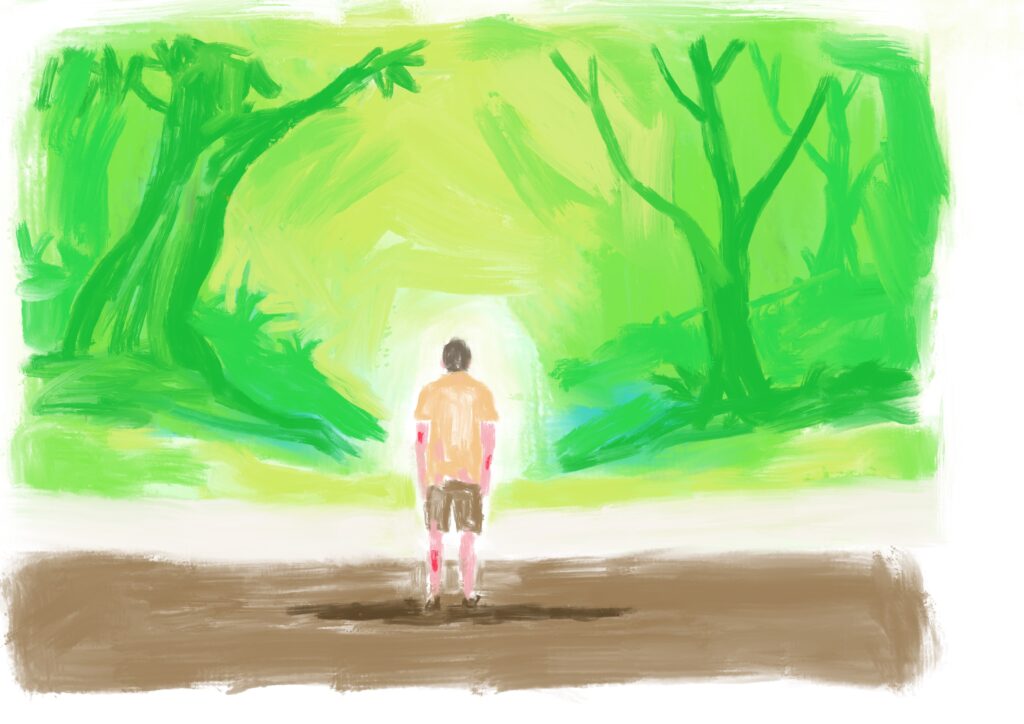
This means that the forest is more than just a forest. The first verse’s closing metaphor tells us that this is the forest of life, implying quite directly the twin ideas that the forest is both a whole world of its own, a place where life flourishes, but also that it represents the speaker’s own life, that the forest belongs to him in the way that the experiences of your life belong to you. Being Ghanaian, it’s no surprise that Komey’s specific diction conjures up images of a verdant African jungle. Yam and cassava are staple foods (resembling the sweet potato) in Ghana and palm and cocoa trees are both common to this part of the world. In verse one the speaker describes himself looking upon the forest from a road. With its connections to journeys and pathways, we understand the speaker is standing on a road that symbolises his own journey through life. In remembering his life, he metaphorically retraces his steps along this road, seeing again and reliving the experiences of his past. As his memory deepens, he is able to immerse himself – and therefore us – in his life experiences, moving from a slightly detached observational point (the road) to interaction and immersion (mud covers his feet, he pushes through thorny branches), his memories coming back so strongly until it seems he walks into the forest depths, through the undergrowth all over again. The poem’s imagery occasionally involves pain as well as nice memories: the speaker is thorn-scraped, as if he’s lived through some hard moments, and later he describes leaves as being razor-edged. These are tiny reminders that there’s danger and pain out there in the world and that living through these experiences has added hard lessons to the totality of his life’s learning.
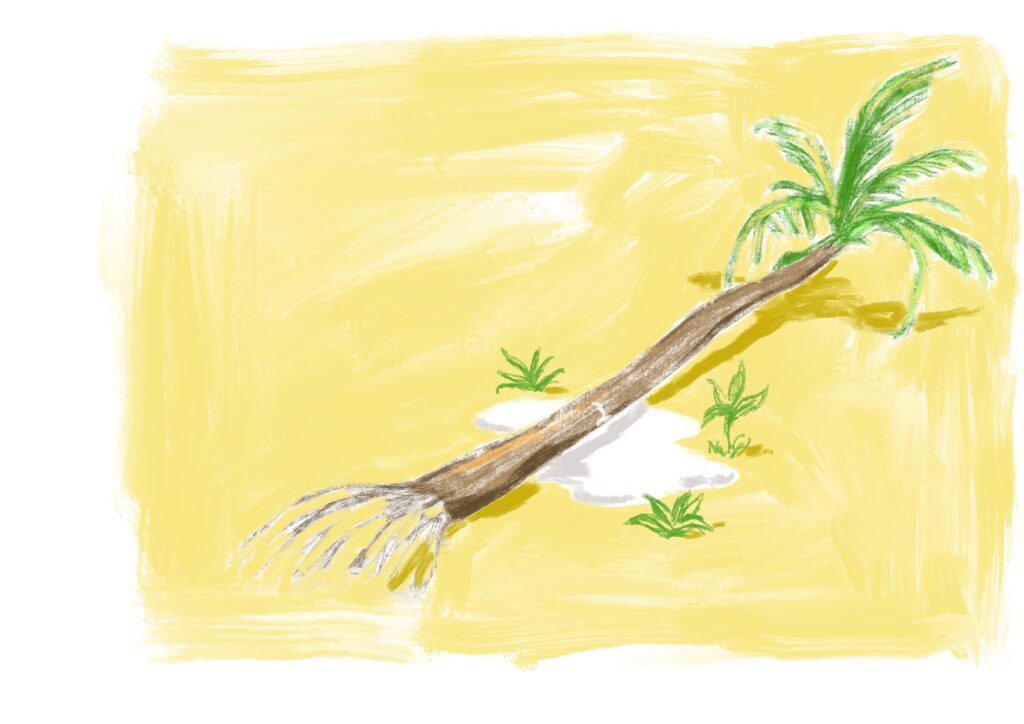
In fact, the speaker’s knowledge that death is part of life comes through his study of the fallen palm that he’s memorising in the first verse. Through faintly religious diction (palm, wine, feet, thorn, flesh) that hints at the story of Christ’s death and resurrection, and through more direct personification of the palm (belly describes it as a person lying prone) it’s easy to see the fallen tree as a symbol of mortality. Like a person who’s suffered a wound to the torso, the palm drips sap onto the forest floor in a way that resembles bleeding. Described as wine, this metaphor carries connotations of blood through wine’s deep red colour, and also through its place in church ritual where wine represents the blood of Christ. It’s a powerful and uncomfortable juxtaposition; the slow congealing of blood onto the floor of the forest of life is an unmissable sign that death and life always coexist. Verse two establishes an equivalency between the speaker and the palm tree through the wounds both carry on their bodies. The speaker feels his thorn-scraped flesh, with faintly biblical diction again prompting a moment of reflection. Unlike alternatives such as ‘skin’ or ‘body’, the word flesh suggests wounds that cut deeper than scratches or scrapes. The softness of human flesh contrasts with the hardened belly of the fallen palm, yet nevertheless the two share a similarity: whether soft or hard, tree or man, both are mortal and must one day face the oblivion we can feel coming closer even as the speaker retreats further into the protection of his forest-memory.
The same mortality we see in the fallen tree and human visitor is a facet of the entirety of the forest ecosystem, including the lives of all the denizens of the forest such as the frogs and owl we meet in the third verse. There’s a subtle-but-important shift in the poem’s anaphoric refrain which broadens the speaker’s perspective; moving from a focus on the fallen palm and the self-examination that follows, the word them opens the poem up to encompass a wide swathe of forest. We begin to get the sense that the forest is bigger and wider than we first imagined, deep and layered in light and shadow. Another personification describes the forest as green-eyed, as if it is looking searchingly at the speaker through the myriad eyes of all the little creatures who call it their home, as well as giving it its own collective consciousness, like the whole forest is one huge organism. Yet, while the forest may peer back at the speaker, it keeps many of its own secrets. Shy, elusive, nocturnal creatures, we hear but can’t see the frogs and owls that live underfoot or perch overhead. Komey uses auditory imagery to give us only the sound of these creatures voices, describing the frog’s croaking as jubilant while the owl’s voice is pleading. The juxtaposition of these words brings out their opposite associations: the frogs chorus happily in jubilant celebration while the owl’s pleading contains a note of fear. Again, the blend of images suggest that, in the forest of life, danger, threat, and even death is as ever-present as multifaceted life. Of all the possible jungle animals he could have chosen, the poet’s use of frogs and owls is telling. Symbolic creatures in their own ways, these animals open up a range of interpretive possibilities: the frog is often associated with fertility and abundance while the owl represents wisdom, sagacity, or secrecy, the associations crashing together in a way that suggests a multiplicity of beings coexisting under the forest canopy. What’s more, these two particular creatures appear in faery stories as witches’ familiars, bringing a note of mystery or foreshadowing the darkness to come… what else lurks unseen in the shadowy forest hollows? Their cries haunt the forest, giving the scene a murky, haunting aspect and keeping those inklings of death, decay, and mortality bubbling away just under the poem’s surface.
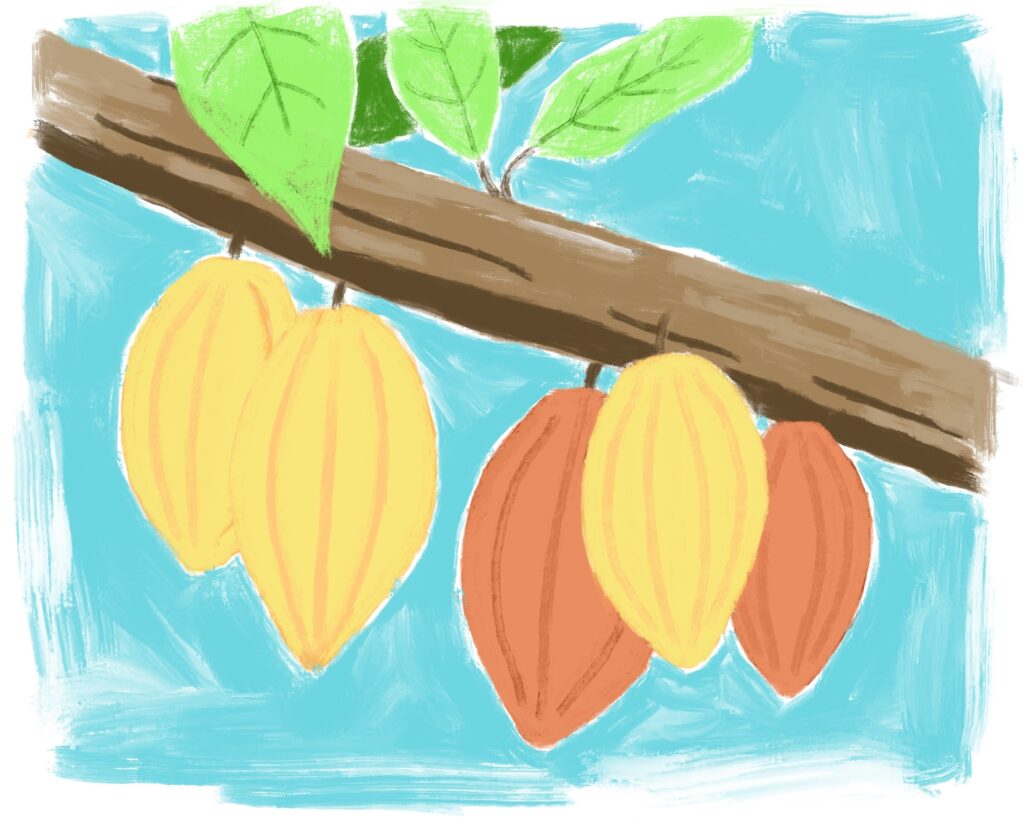
Therefore, every verse of the poem holds life and death in an uneasy balance. Amongst the teeming life lies unmistakeable reminders of inevitable oblivion creeping closer, the poem’s title unmentioned anywhere in the body of the verses, but hinted at in the occasional darker word or shadowed image. This latter word is from the extended fourth verse, in which the forest seems to draw protectively around itself, becoming a fully realised, self-sustaining ecosystem. The aforementioned diction shadowed along with razor-edged carry connotations of both danger and protectiveness. Shadows’ darkness can be ominous or scary, yet shadows also shelter and shield from prying eyes. The same goes for razor-edged leaves which are dangerous to the careless wanderer, but also protective of the little creatures that shelter underneath. Another of the forest denizens, the crab, is using the leaves this way; he’s busy building his nest under the yam and cassava shrubs, using the shade they cast as a protective umbrella to keep his home hidden and safe. Komey uses the surprising word castle as a metaphor for the crab’s nest. A castle is both a home and a defensive fortification, strong and sturdy, a redoubt and protection against harm. Indeed, the impression of defensiveness and protection is strongest in this fourth verse, where lush, verdant descriptions culminate in the closing image of cocoa pods shaped like mothers’ breasts feeding a hungry child. The metaphor is extended over two lines, strongly suggesting the nurturing, life-giving power of the forest and hinting at the circle of life that nature always strives to continue. Yes all individual things – trees, crabs, owls, speaker, and all the forests’ countless other little plants and animals – are mortal and death and decay are ever-present, but the forest ecosystem as a collective entity will endure, reproduce and survive endlessly. When turned over in the mind, the poem’s images remind us that life ends in a way that sustains other life. A jubilant frog might meet its sudden end snapped up by an owl, and through his death feeds and strengthens the owl. A fallen palm drips whitening fluid like milk, a biological soup pooling and soaking into the ground from which new life might spring. That’s not to say that oblivion should be welcomed by the speaker, and in choosing these metaphors and images (mothers feeding, milky white sap, certain religious dictions) he unconsciously reveals his unspoken wish to resist death, prolong life, or be resurrected again. I’m sure it didn’t go unnoticed that, at the beginning of this most lively and vivacious of verses, Komey subtly altered the first line anaphora to say I want to walk among the palms again. The transition from remember to walk among betrays an unbearable longing to escape into something more real, more experiential, than memory’s images no matter how compelling they might be. To feel the painful cut of razor-edged leaves, feet sinking into thick mud, means to be still alive and as long as the speaker still feels perhaps he can put off the forgetting of oblivion indefinitely. As the forest draws protectively around itself, so too does the speaker’s memory harden protectively around him, so vivid it seems it might preserve these experiences forever.
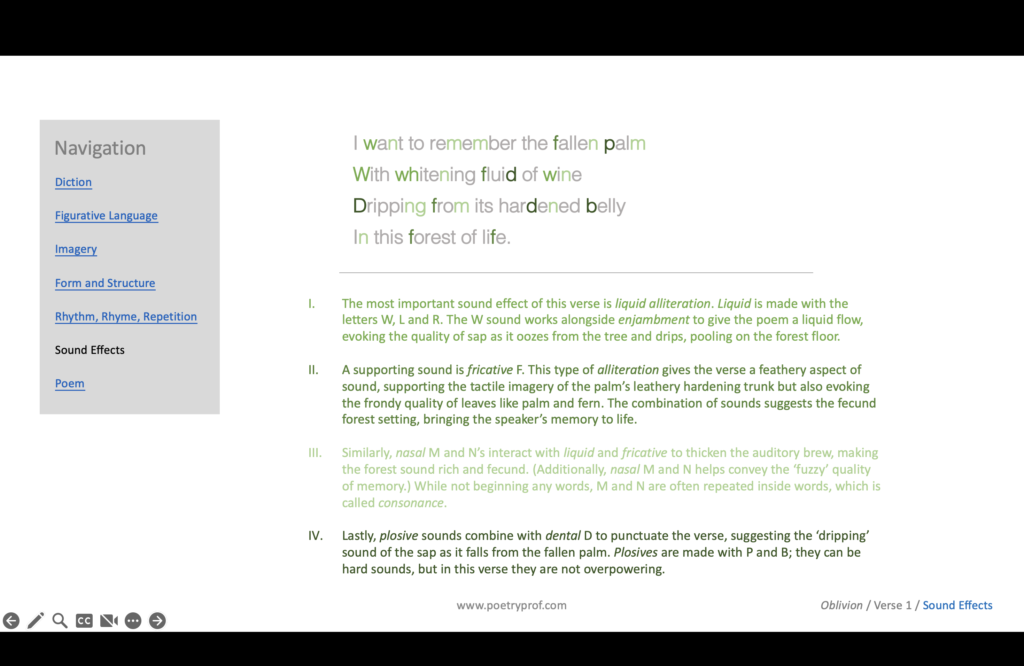
What makes Komey’s imagery so luscious, how he brings the forest scene alive so convincingly, isn’t immediately obvious. When we speak about imagery, we often privilege the visual aspects of the poem, responding to what we can see first of all. But the longer we sit with the poem, the more our other perceptual fields engage with the words too. Our perceptions are made up of different senses; beyond sight we use sound, smell, touch, and even taste to interact with and experience the world. Through sound, Komey illustrates the power of auditory imagery to add layers of complexity and depth to his forest-memory. Using a mixture of alliteration and consonance (alliteration is the repetition of sounds at the beginning of words; when using consonance sounds are repeated inside words as well) Komey subtly weaves a sonic tapestry that immerses readers so completely it feels like we’re right there beside the speaker as he dodges razor-edged leaves and pushes through cassava shrubs. These lines contain thick sibilance, made with letters such as S, SH and Z, a sound that easily evokes natural noises such as the chirpings of birds and insects, or the whispering susurrations of foliage and vegetation. Another auditory layer is created through fricatives: most commonly made with F, V or TH (although the DG in edged has a little fricative to it as well) this effect comes into play in phrases like the forest of life and with mud on my feet and thorn-scraped flesh. Fricative consonance creates a soft, leafy sound that evokes the rustle of wind in the trees or the friction of pushing through thick undergrowth. Sibilance and fricative happily blend and overlap, expanding the imagery in three dimensions and allowing for deeper immersion. It makes the difference between the reader observing the scene from the road, and taking a walk among the trees.
It’s in this blend of different sound effects that Komey shows his true mastery. Below the whispering fricative-sibilance we can detect lower, rounder notes, such as liquid sounds that flow through lines like I want to remember the fallen palm with whitening fluid of wine. Liquid is a much less easy sound to identify and describe than sibilance or fricative. Made by rounding the mouth into a kind of echo chamber, bring the sensation of humidity or moisture into the forest, early morning mist condensing dew onto leaves, steam rising through branches as the day heats up. Combined with a humming nasal (made with the letters M and N), these sounds not only thicken the forest’s auditory imagery, but also evoke the very quality of memory: shimmering, amorphous, ambiguous, hazy. All four sounds discussed thus far (liquid, nasal, sibilance, fricative) are classed as soft sounds; by combing soft consonance with assonance (created by repeating vowel sounds such as A in shadowing yam and cassava or I in, for instance, with whitening fluid of wine dripping, Komey creates an effect called euphony. Audible when sounds blend harmoniously, euphony resounds beautifully in the ear and, in this poem, is incredibly seductive, lulling us deeper into the forest, evoking the harmony of life that lives within, and even suggestive of escaping the passage of time through the retreat into memory as well.
The final short verse, though, is an admission that escaping death is impossible. Rather than death itself, it’s the fear of forgetting that powers the poem, as if the existence of all those countless frogs and owls and trees and crabs depends upon the speaker’s memory to keep them alive. One last time he declares: I want to remember them all, his voice longing to hold all the experiences of his life firmly in his mind so that they can be preserved forever. But the poem’s last line finally acknowledges the truth of mortality: when I am gone is written with the force of certainty, he knows its not ‘if’ but when oblivion comes. The poem’s final word, like the word die that appears in the poem for the first time, is an admission of the inevitable. All things living and remembered will fail at the very last, when wood and flesh and plant matter and the mind that makes memory possible returns to the ground. But… paradoxically it’s in this very same image that an alternative perspective gives us hope. The repetition of mud from earlier in the poem creates a loop composition that brings to mind the circle of life idea again. Yes mud is a sign of death and decay, as everything living loses its distinct identity through decomposition when it returns to the ground. But it’s also a symbol of resurrection and first beginnings. Life crawls from mud. At the end, to die and return to mud is not the total annihilation of oblivion, but just another spoke in the ever-turning wheel, another moment in the growth-decay-growth cycle of the forest of life.
And the forest will keep on breathing even after the poem’s speaker, you, and I are all finally gone.
Suggested poems for comparison:
- The Change by Ellis Atiyey Komey
Proving that Oblivion was no fluke, Komey’s lush imagery and symbolic language is on show in this rich poem as well. Moving through the stages of life from adolescence to adulthood, Komey again explores the power of memory to preserve experiences that would otherwise be lost.
- Before the Snake by Nathaniel Tarn
In this lovely prose poem, a natural space (a garden or small copse of trees) transforms into a lush Eden, providing refuge from the thoughts and pressures of life. The speaker finds himself able to attune with nature so strongly he can ‘hear the sun and the wind which comes out of the world’s lungs’.
- The Waterfall by Lauris Edmond
A scintillating poem and a perfect companion piece for Ellis Komey’s Oblivion. Edmond’s poem is similarly imagistic and luscious, as she describes life like a drop of water tumbling and arcing through the air… The dark pool at the bottom of the fall is her equivalent to Komey’s unseen but inevitable oblivion.
Additional Resources
If you are teaching or studying Oblivion at school or college, or if you simply enjoyed this analysis of the poem and would like to discover more, you might like to purchase our bespoke study bundle for this poem. It costs only £2.50 and includes:
- Study questions with guidance on how to answer in full paragraphs.
- A continuation exercise to help you practise analytical writing.
- An interactive and editable powerpoint, giving line-by-line analysis of all the poetic and technical features of the poem.
- An in-depth worksheet with a focus on explaining how consonance and assonance create effects like euphony.
- A fun crossword quiz, perfect for a starter activity, revision or a recap – now with answers provided separately.
- A four-page activity booklet that can be printed and folded into a handout – ideal for self study or revision.
- 4 practice Essay Questions – and one complete Model Essay for you to use as a style guide.
And… discuss!
Did you enjoy this explanation of Ellis Komey’s richly descriptive poem? How did you respond to the images he crafts? What are some other interpretive possibilities of all the symbols in the poem? Why not share your ideas, ask a question, or leave a comment for others to read below.