 Posted by
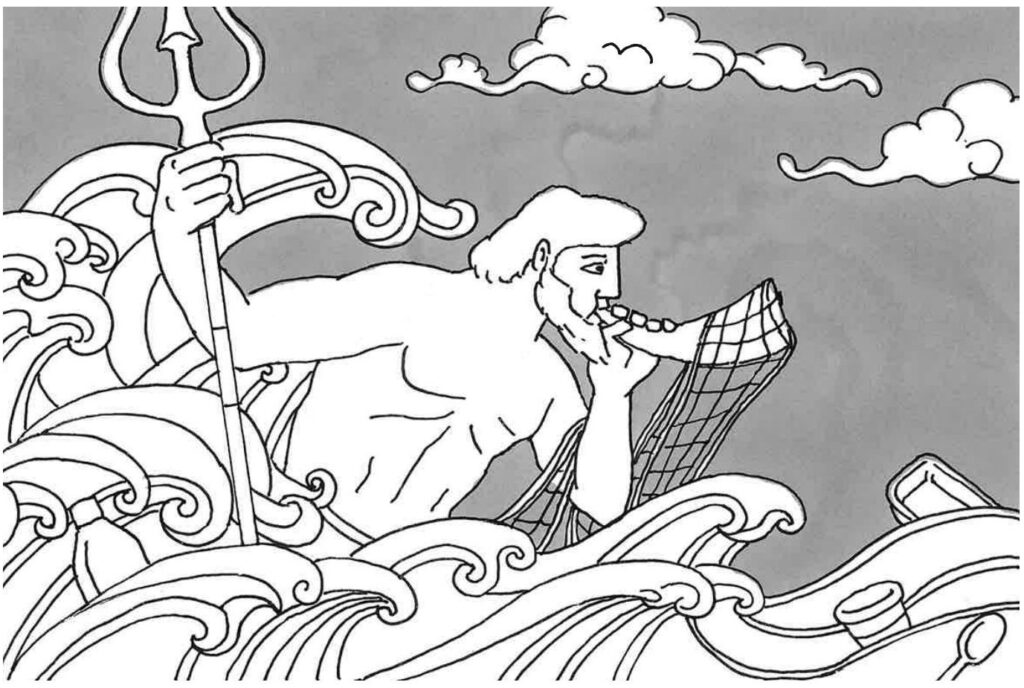
 Boey Kim Cheng asks whether nature’s champions can still save her
“…to make sense of the world through words, to connect others by means of shared lineages, and to leave an enduring legacy.”
Eileen Chong writing about Boey Kim Cheng in the Sydney Review of Books
In a 2025 interview with The Straits Times, Boey Kim Cheng said: “You learn to love what you have lost.” Born in 1965 in Singapore, Cheng emigrated to Australia in 1997, yet is continually drawn back to his birth nation in his writing. Singapore too never lost its affection for her departed son: his poems Another Place and Clear Brightness are widely anthologised and taught in Singapore. His lyrics chart the losses of a rapidly growing and changing city, in his own words, “the constant tear-down and rebuilding in Singapore, the frantic pace of life and change, the disappearance of old buildings and places.” Report to Wordsworth continues the theme of mourning what is lost, now expressed as environmental devastation on a global scale. The same forces he saw modernising Singapore have extended to the whole planet, erasing the natural world in the process. While often Cheng’s poems explore his own feeling of disconnect and estrangement from his home, now he imagines the whole of humanity estranged from the natural world which succours us and gives us life. Facing rampant and insatiate destruction, who will protect Nature in her hour of need?
You should be here, nature has need of you.
She has been laid waste. Smothered by the smog,
The flowers are mute, and the birds are few
In a sky glowing like a dying clock.
All hopes of Proteus rising from the sea
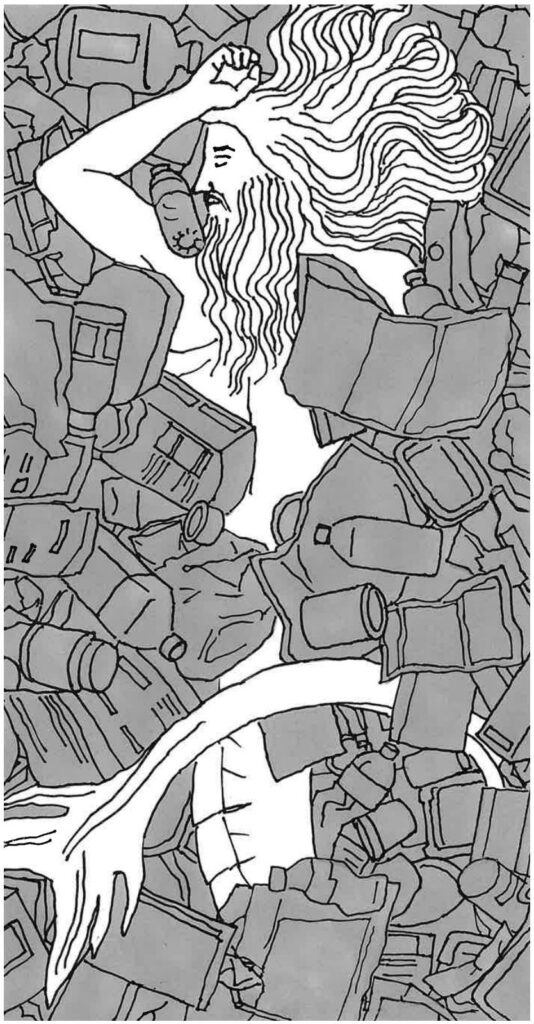
Have sunk; he is entombed in the waste
We dump. Triton’s notes struggle to be free,
His famous horns are choked, his eyes are dazed,
And Neptune lies helpless as a beached whale,
While insatiate man moves in for the kill.
Poetry and piety have begun to fail,
As Nature’s mighty heart is lying still.
O see the wound widening in the sky,
God is labouring to utter his last cry.
You’ve no doubt already realised that Report to Wordsworth relies heavily on allusion to convey the sincerity of its message. An allusion is an unexplained reference to something outside the text that the writer trusts the reader to pick up on and identify. Commonly these references are historical, political, classical, or literary: Cheng uses literary and classical references here. When Kim states: You should be here, he’s alluding directly to William Wordsworth, a famous English Romantic poet of the 18th century. Romanticism, of which Wordsworth was a pioneer, was a literary and social movement that arose in response to the Industrial Revolution. Born in the north of England, the movement sought to counter the mechanisation and commercialisation of the world through a search for the ‘sublime’. This word, more of a feeling really, means a kind of boundless sense of beauty that can only be found in the natural world, not the ‘small’ beauties of human invention and progress. Wordsworth, alongside other famous Romantic writers of the time (Samuel Coleridge, John Keats, and William Blake, to name just a couple) sought the sublime in nature. While Romanticism wasn’t centered around Wordsworth, Kim uses this allusion because, as a founder of the movement, he’s arguably its most famous proponent (sorry Shelley, Byron, et al). When Cheng says You should be here… he’s sending a message beyond the grave – in poetry, addressing an absent figure as if he or she is present is called apostrophe; Wordsworth died in 1850 – to a man who championed nature during a time when the industrial onslaught began. And, in looking to the past in order to engage with the present, Cheng is tapping into the very essence and tradition of Romantic poetry, where writers revisited and reappropriated the symbols of antiquity (urns, friezes, Greek mythology) in pursuit of their own sublime mysteries.
Cheng’s conceit (the central idea of a poem, often expressed through an extended metaphor) is that he’s compiling a fictional report for Wordsworth’s attention, updating him on the progress of his movement. Sadly, the spirit of Romanticism has failed: today’s Nature is under renewed assault. She has been laid waste is the summary of the report, expressed in language that would be hyperbolic (to ‘lay waste’ means to completely destroy) if it wasn’t so catastrophically true. Throughshe, nature is personified as a woman in need of rescue, Cheng relying on traditional, even fairytale, notions of female vulnerability as if nature is a damsel in distress waiting for her champion to ride in on his white steed and save the day. Cheng says to Wordsworth, you should be here, nature has need of you, summoning him like he’s the gallant knight. The tone of his request is difficult to interpret: modality(should) gives Kim’s voice a note of frustration, as if Wordsworth is a soldier who’s abandoned his post at the crucial moment. While Wordsworth is not the target of Cheng’s ire, nevertheless the blend of N alliteration with strong assonance (wide E in be, here, need, and been; long A in nature, laid waste) makes his voice strident, even desperate, and tinged with deep sadness and regret. Today, when nature needs her literary champion more than ever, he’s been gone these many long years.
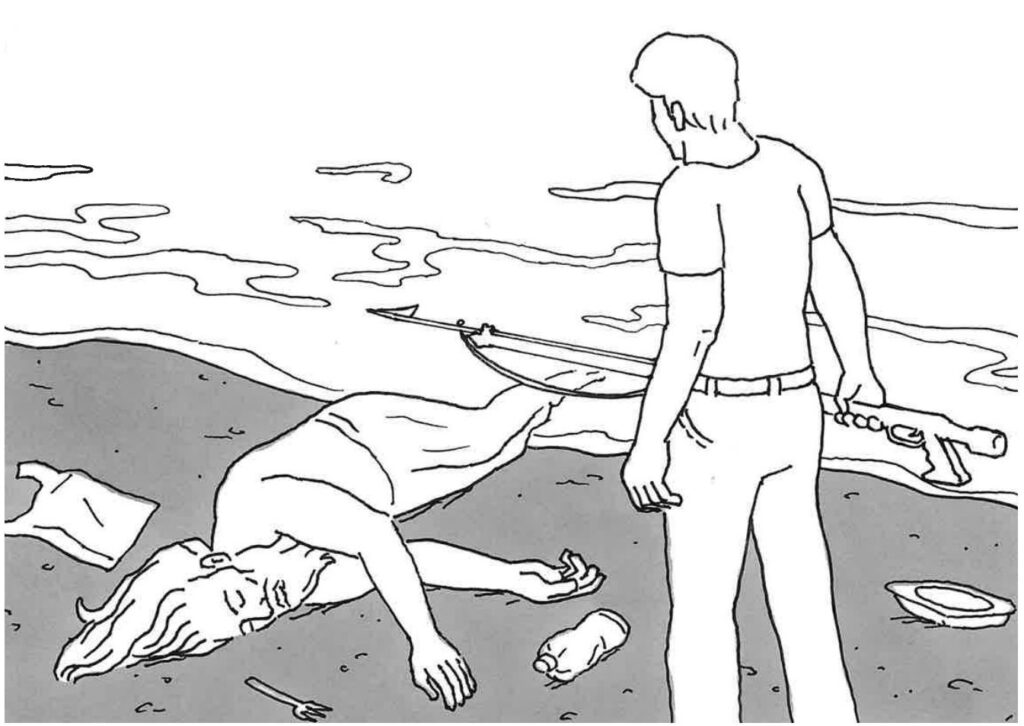
Through the personification of Nature as she, Cheng evokes protective, or even chivalrous instincts to defend someone nurturing, maternal, the source of life; by implication anyone who would violate Nature must be villainous, acting with evil intent. Astoundingly, the villain of the poem is no fairytale ogre, but simply we or man, words Cheng uses as shorthand for humanity in general. Sadly, in this poem we don’t evince a trace of our so-called humanity. When people appear, they are depicted as merciless hunters: insatiate man moves in for the kill, a line combining M alliteration with short, sharp assonant I to create the impression of an encircling noose tightening around the helpless body of Nature as she lies, inert, still, and desperately vulnerable. These people are not traditional hunters, but representatives of modern industries such as industrial-scale fishing or agribusiness: Cheng’s critiquing the global scale of human destruction, not traditional cultures who don’t threaten the survival of species. He uses the word insatiate, pointedly meaning ‘unable to be satisfied’, but with connotations of ‘gluttonous’, ‘voracious’ and ‘rapacious’ mixed up in there as well. No matter how much of the landscape we urbanise, how many forests we fell, or mines we dig, the developed world is built on the premise of ceaseless extraction to fuel economic growth. Nowhere is safe from the implacability of human activity; pollution knows no geographical or political borders. Cheng identifies the chief weapons wielded in the war against nature as smog and the waste we dump, both byproducts produced on a global scale by assorted industries. Whether on land (flowers) at sea (beached whale) or in the sky (birds are few) there’s no landscape that’s safe anymore. Some of the most emotive imagery is suggestive of ‘suffocation’ (smothered, choked, mute) by pollution leaching into soil, sky, and sea. Poisoned air is unbreathable and Nature can’t even cry out pitifully for help: the flowers are mute. Personification is used with poetic license to symbolise reality: nature has no way of speaking up for herself, and her defenders are often brutally silenced by vested interests who perpetuate violence against the living world and those who would protect her.
Perhaps because of the popular (although not exactly accurate) saying ‘we know more about the surface of the moon than we do about our own oceans’, you might think that the deep seas have escaped the worst of our destructive impulses, that things can’t be as bad in the big blue as they are on land or in the skies right over our heads. Kim’s second tranche of allusions, classical this time, dispel this notion. Mixing his mythologies, he chooses two Greek gods – Proteus and Triton – and one Roman god, Neptune (in Greek myth called Poseidon), who, in their respective canons, ruled over oceans or bodies of water. Here, these most powerful and magical of nature’s champions, her classical protectors, have all fallen to insatiable man. Proteus, the eldest son of Poseidon, known as the Herdsman of Seals, was a shapeshifter as well as ruler of rivers and seas (Homer calls him the Old Man of the Sea); Triton, Poseidon’s second son, was a merman and possessor of the deep ocean realms; and Neptune himself was the most powerful god and ruler of the whole ocean – all are rendered pitiable by Cheng’s evocative imagery. Triton’s famous musical horns are tangled in discarded fishing netting, his eyes are dazed and insensible. Like the mute flowers of the first quatrain, Triton is metaphorically choked or silenced by human debris, making the call to Wordsworth more poignant and relevant; as nature cannot speak for herself, Cheng appeals to a man whose power was words to return and lend his voice once more in support of her struggle. Proteus is entombed, a word meaning to be buried or trapped, and heavily associated with death. His hopes of rising are cancelled by the emphatic word sunk, plastic waste weighing him down and dragging him back to the depths as if he’s inert and lifeless rather than the powerful shapeshifter of mythology. Even the most mighty of nature’s classical champions, Neptune himself, lies helpless as a beached whale, an image of the ruler of all the seas made pitiful and weak. Over the course of the poem’s second and third quatrains (the internal structure of a sonnet divides into three groups of four lines each, or three quatrains, plus a rhyming couplet) Cheng moves from a lexical field of movement, with diction like hopes, rising, sunk, struggle to be free – the gods trying valiantly to ward off their attackers – to one of stillness: lies helpless, beached, fail, lying still. The reversal of power is clear and blunt: deities once strong enough to rule the seas are now victims of pollution, overfishing, and the implacability of mere man. Throughout, Cheng displays himself as a worthy successor to Wordsworth through his manipulation of sound to support meaning: as his titans exhaust themselves in futile combat against overwhelming odds, he overlays their struggle with mournful euphony (created by the combination of assonance with soft consonance) a sad echo of Triton’s faded musicianship: nasal M and N and assonant O and U – hopes, Proteus, sunk, entombed, sunk, notes, struggle, famous horns, choked – sounds anchored in the lower register like Proteus’ inert body sunk back to the depths.
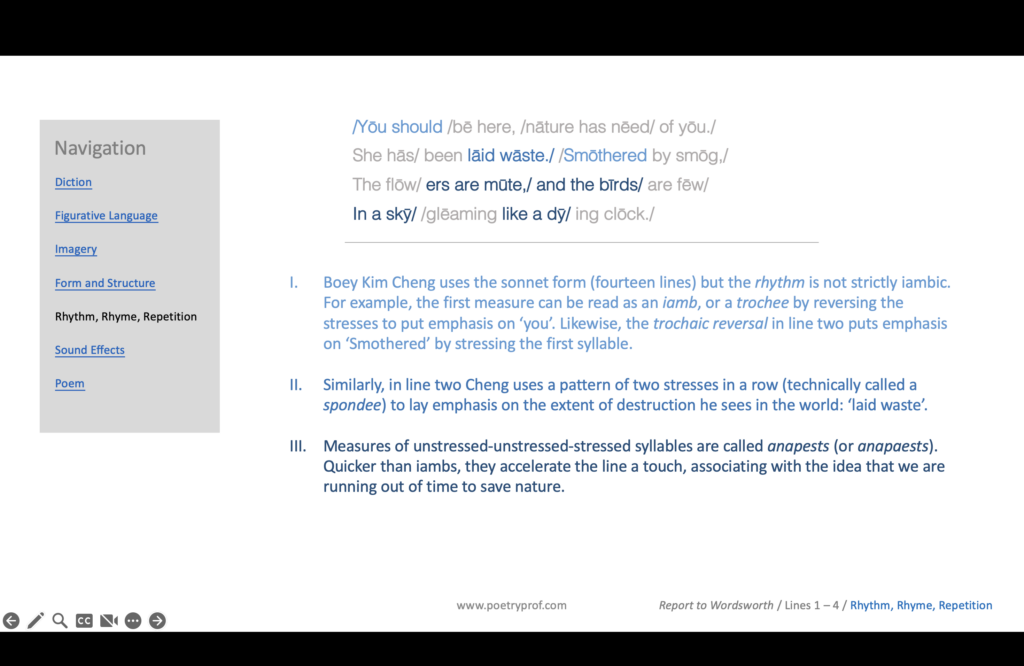
Cheng’s choice of sonnet form to deliver his report is particularly apt. As you probably know, a sonnet is a traditional fourteen-line poem usually delivered in a single stanza, and historically a favoured form of English language poetry. William Shakespeare, arguably England’s most famous sonneteer, was a strong inspiration for the Romantic poets, and the sonnet form hearkens back to a time when nature was less spoiled than she was even in Wordsworth’s day. However, Cheng doesn’t dogmatically replicate the sonnets of tradition, and Report to Wordsworth demonstrates a masterclass in matching the flexibility of this form to content. For instance, his poem follows a loose iambic rhythm, but Cheng employs several pointed rhythmic variations to create effects. The first of these is on the poem’s opening word, when he inverts the traditional ‘de-dum’ rhythm of an iamb to put stress on the first syllable instead: Yōu should bē here. Technically called a trochaic reversal, Cheng stresses the appeal to Yōu, creating urgency, even desperation as he races against time (the simile sky glowing like a dying clock implies a metaphysical countdown to doomsday) to get his message out there before it’s too late. You’ll hear trochaic reversals elsewhere, normally signalling a key moment; Smōthered by smōg puts weight on the first syllable too, evoking the choke of acrid pollution like a pillow pushed down on the world’s face. Strūggle to be frēe is another, as Triton mounts a brief-but-futile fight against the waste that entangles him. Occasionally, Cheng stresses both beats in a single measure: called a spondee, you can hear this in the phrase hēlpless as a bēached whāle, the two strong, dull beats at the end of the line anchoring Neptune firmly on the sand, as his body lies inert and unmoving. Over the course of the whole sonnet, frequent small rhythmic variations convey Nature’s struggle against the forces arranged against her, and disrupt the reading experience in the same way the rhythms of the natural world have been disrupted by human encroachment. Wordsworth would certainly have approved.
For the same purpose of discomforting readers are other formal features disrupted and altered. Traditionally, each of a sonnet’s fourteen lines should be end-stopped (punctuated at the end of each line), but Cheng instead uses enjambment and caesura to disrupt that expectation. In one of my favourite moments, enjambment (the flowing of one line smoothly into the next without punctuation or pause) conspicuously places have sunk and we dump at the beginning rather than the end of lines:
All hopes of Proteus rising from the sea
Have sunk; he is entombed in the waste
We dump.
The effect is to reinforce the accusatory tone of the poem. Helped by alliteration (sea have sunk, waste we dump) and an unexpected internal half rhyme (sunk/dump) Cheng links nature’s degradation to human action unmistakably – it’s we who’re dumping all that waste. The verbs sunk and dump are both abruptly marked by punctuation, creating caesura (a deliberate break in a line of poetry) that disrupts the poem’s flow much as the oceanic currents are disrupted. These moments of deliberate pause force us to linger on the accusations momentarily: the word we includes writer and reader, you and me, as agents of ecological collapse. That sunk/dump half rhyme is no accident either: while Cheng employs a traditional ABAB, CDCD rhyme scheme, several lines end in half rhymes, creating an aural dissonance that is less comfortable to the ear than when words harmonise pleasantly. Further examples include smog/clock from the first quatrain and waste/dazed from the third. The effect is subtle although the meaning is not: humanity stopped harmonising with nature a long time ago, and now we’re seeing the results.
Where traditional sonnets turn, Cheng gives us a smooth escalation into catastrophe. Also called the volta, a sonnet’s turn is the point where something changes: whether the tone, perspective, a new idea emerging, sometimes the poet might even offer a counterpoint or concession to the poem’s prevailing argument. Cheng’s sonnet offers no relief. Instead, he charts an implacable course that’s heading in one direction; total ecological collapse. His turn (Poetry and piety have begun to fail, positioned atypically on the eleventh line) is more an upping of the stakes than a change, as he moves from the defeat of nature to the failure of entire cultural institutions to call a truce. Actually, it’s hard to tell whether this is a cause or consequence of global ecocide. Is Cheng saying that poetry and piety (symbolising humanity’s higher institutions: poetry represents our cultural and artistic institutions, piety our religious, moral, and spiritual institutions, such as the church and the world’s major faiths which are supposed to guide humanity) are, like Nature herself, victims in mankind’s war against anything that can’t be extracted, bought, sold, or commodified? Or is he implying that these institutions have begun to fail in their duty to speak up for beleaguered nature? Certainly, the word piety makes me wonder whether we’ve reached a point where humanity no longer feels accountable to any power higher than itself. Later, when Cheng uses an onomatopoeic O in place of human language, like he’s temporarily lost the necessary words, we get an audible expression of the argument that poetry… has begun to fail. At this moment ‘muteness’ afflicts humanity as well. Even God is labouring to utter any sound. If any counter-voices still exist, they are simply not loud enough.
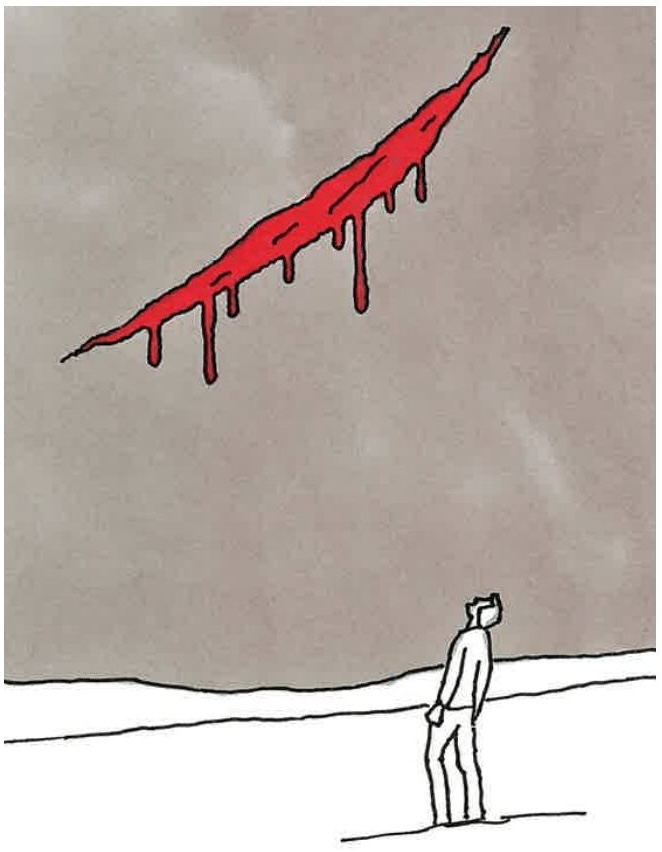
The sonnet’s final couplet gives us the impression that it may already be too late to save the world from its fate. Accentuated with strong W alliteration, a conclusive full rhyme that brooks no alternative, and the same wide assonance that he’s used before (O see, wound, labouring, last, widening, sky, cry) Cheng returns our gaze to the barren, birdless sky… now rent with a terrible gaping wound. This is a surreal image, but nevertheless it communicates very clearly: humankind’s appetite for destruction is so immense it’s visible as a wound on the fabric of reality. Apocalyptic, the image suggests a final barrier has been crossed, a line from which there is no return. The wound is not only on nature’s corpus, but on ourselves: the air is the substance we breathe and depend upon for life. Scarily, thanks to the active verb widening, Nature’s dying in front of our very eyes. And, continuing the pattern of escalation, today’s living God finds himself in exactly the same position as the ancient gods of myth. Look how the word labouring (meaning to expend extreme effort) echoes Triton’s struggle, as if our modern God’s acting out the very same tragic story, with the same predictable ending. Last cry leaves us in no doubt that this wound is mortal. Wordsworth’s nearly two hundred years gone and his literature, something he hoped could be a counterforce to the destruction of nature, is failing; if the old and new Gods are all silenced, dead, or dying… who is coming to rescue this damsel in distress?
The answer, it seems, is no one.
Suggested poems for comparison:
- The Planners by Boey Kim Cheng
In this famous and widely anthologised poem, Cheng imagines the slow, encroaching urbanisation of Singapore, one of the world’s densest cities. Stripped of anything resembling disorder or soft creativity, the city is built on mathematical principles that leave no room for piety or poetry either.
- The Second Coming by William Butler Yeats
Like Cheng, Yeats conjures an image of the end of the world. But in his Second Coming it is heralded by the arrival of a fantastic and terrifying creature. In this poem, the old gods aren’t dead – they are coming for retribution…
- Plastic: A Personal History by Elizabeth Bradfield
Today, Cheng’s Report to Wordsworth would be classed as eco-poetry, a new and rapidly growing genre that addresses pressing environmental issues. Here’s another from 2021 – a brilliant poem about plastic, now ubiquitous, that looks back nostalgically to a pre-plastic less wasteful time. What did we do before go-to lids? Bradfield asks, before answering: Things must have just spilled and spilled. A brilliant poem to read after Report to Wordsworth.
Additional Resources
If you are teaching or studying Report to Wordsworth at school or college, or if you simply enjoyed this analysis of the poem and would like to discover more, you might like to purchase our bespoke study bundle for this poem. It costs only £2.50 and includes:
- Study questions with guidance on how to answer in full paragraphs.
- A continuation exercise to help you practise analytical writing.
- An interactive and editable powerpoint, giving line-by-line analysis of all the poetic and technical features of the poem.
- An in-depth worksheet with a focus on explaining rhythm and meter.
- A fun crossword quiz, perfect for a starter activity, revision or a recap – now with answers provided separately.
- A four-page activity booklet that can be printed and folded into a handout – ideal for self study or revision.
- 4 practice Essay Questions – and one complete Model Essay for you to use as a style guide.
And… discuss!
Did you enjoy this explanation of Boey Kim Cheng’s powerful sonnet? Which images stood out most clearly for you? Do you sense any note of hope in the poem’s ending? Why not share your ideas, ask a question, or leave a comment for others to read below.



Hi Doug, I’ve just purchased your Songs of Ourselves Selection B (2025-2027) super bundle but can’t seem to download it. It always fails halfway. And now the ‘cart’ page is empty and the download link is no longer there. Please help!
Hi –
Please check your gmail, I’ve sent you the files directly. Thank you so much for supporting my site, I hope you find the resources useful.
Hi Doug, thanks for your quick response. Have got all the files now. Lots of useful material in there.