 Posted by
 Matrimony’s not quite so holy in Katherine Philips’ anti-marriage poem
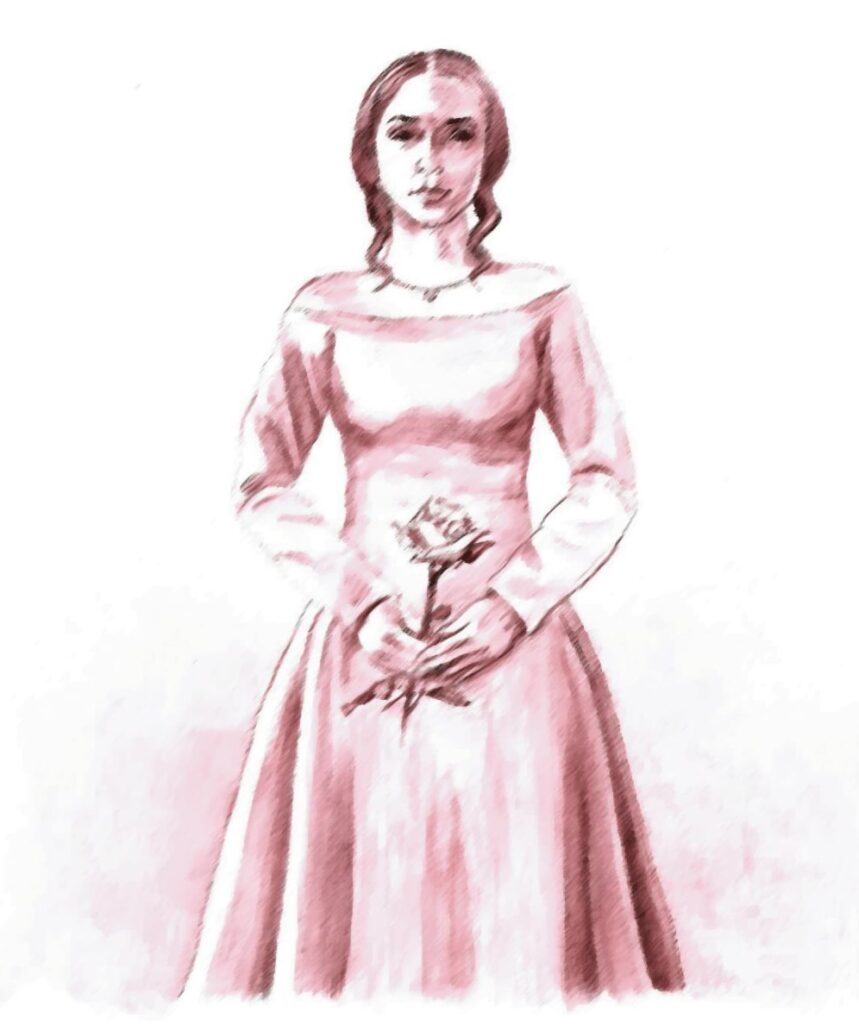
“In an age when women were urged to be “chaste, silent, and obedient”—she achieved acclaim as a poet to be read and emulated”
Elizabeth H. Hageman, writing at Poetry Foundation
English poet Katherine Philips lived through tumultuous times. Born in 1632 – possibly on the first day of that year, although records are not clear – Katherine would grow up in a country torn by civil strife. King Charles I held the throne and often ruled without calling parliament. Royalists supported his divine right to rule as he pleased, opposed by Parliamentarians who eventually put the king on trial and established a Republic. Overthrown in 1660 with the Restoration of the monarchy, almost all of Katherine’s life (she died in 1664) was lived against a backdrop of tension and conflict. Incredibly, as a Royalist – supporter of the King – Katherine was on the opposite side to her husband, James Philips, a Welsh Parliamentarian. He fought for Parliament during the civil wars, sat on the High Court of Justice, and benefitted from the division of royal estates after Charles was overthrown. By contrast, Katherine admired King Charles, wrote poems in support of the king and mourning his execution, and publicly celebrated the restoration of Charles II. Not only this, but they married young; James was 24 and Katherine barely 16 when they tied the knot. Years later, Katherine’s writing put her husband at risk, something she acknowledged in a poem in which Katherine insisted that her political beliefs should not be imputed to her husband and that marital loyalty should not be confused with political loyalty. In the 1650s, this was a somewhat uncomfortable proposition, as political belief was not the private matter it often is today.
A married state affords but little ease;
The best of husbands are so hard to please:
This in wives’ careful faces you may spell,
Though they dissemble their misfortunes well.
A virgin state is crowned with much content,
It’s always happy as it’s innocent:
No blustering husbands to create your fears,
No pangs of childbirth to extort your tears,
No children’s cries for to offend your ears,
Few worldly crosses to distract your prayers.
Thus are you freed from all the cares that do
Attend on matrimony, and a husband too.
Thus, Madam, be advised by me:
Turn, turn apostate to love’s levity.
Suppress wild nature if she dare rebel,
There’s no such thing as leading apes in hell.
It’s tempting to put A Married State in some kind of context by referring to Katherine’s own marriage to James Philips, her political opposite and senior, imagining all kinds of trouble and turmoil between them. But by all accounts Katherine and James’ marriage was stable and they held mutual admiration and respect for one another. On the other hand, political clashes could not have been easy to bear, something that young Katherine may have suspected before she was wedded to James (A Married State was first published in 1667, but written many years previously when Katherine was 14 years old and not yet married). In this case, her speaker is not the exact mirror of herself. Instead, what we might imagine is young Katherine drawing inspiration from observations of the social scene around her, and somewhat dreading the day of her own nuptials. Therefore, while the poem is not autobiographical, its imaginary critique of marriage does seem to predict some of the unease that Katherine may have felt as she considered the legal, social and emotional obligations of her impending union. The poem was certainly part of a burgeoning literary awareness of how orthodoxy limited women’s engagement with the world. Under English laws of the time, marriage placed a woman under ‘coverture’, meaning that the wife subsumed her legal and social identity to the husband. She ceased to have any legal status independent from him; for example, a married woman could not own property, sign contracts, sue (or be sued – a very thin silver lining) and her wages and any other goods automatically belonged to him, such as dowries which were passed from families of women who were to be married directly into the husband’s control. And on top of all this, unwritten but tacitly binding norms governing married women included the expectation of silence, modesty, and obedience. Publishing women’s writing was seen as suspicious precisely because it violated all of these norms, something Katherine would grow up to experience when her pro-Royalist poetry reflected on her husband’s honour.
Knowing all this, it’s not hard to see how Katherine might view single-dom as a powerful alternative to marriage, seeking instead mutually beneficial friendships that preserve rather than diminish equality. After all, an unmarried woman could write without fear of importuning her husband, an unmarried woman could run a business and keep any profits. Friendship upheld values that marriage claimed to offer – such as mutual respect and guarantees of affection – but all too often failed to deliver. Indeed, it’s reported that Katherine and her husband held each other in very high esteem, and some letters point to a close friendship rather than a passionate entangling of their lives. As well, Katherine would grow up to cultivate a close circle of female writers and thinkers, forming the Society of Friendship with other women who wrote using nom de plumes: inside this circle, Katherine was known as Orinda; Mary Aubrey, an old schoolfriend and one of Katherine’s most longstanding correspondents, called herself Rosania; and Anne Owen, whom Katherine dedicated a poem to, took the name Lucasia. All these women shared Katherine’s Royalist loyalties, and the group’s members developed ties of friendship that were deep, constant, and stable – the diametric opposite of romantic love, marriage, or sexual attraction that Katherine thought of as unstable, and prone to power imbalances. While Katherine’s male contemporaries (like Andrew Marvell) were writing poems about sexual conquest (check out To His Coy Mistress in which a man tries to baffle a woman into bed with his cleverness), the Society of Friendship wrote poems and letters that emphasised constancy over authority and equality over hierarchy. The taking of pen names was important to the women of the group; in a time where few women wrote independently, or were even tolerated to have any kind of literary identity, these alter-egos became a way of symbolising what women poets could achieve, and at the same time allowing Katherine and her Society to speak publicly while maintaining social decorum and modesty.
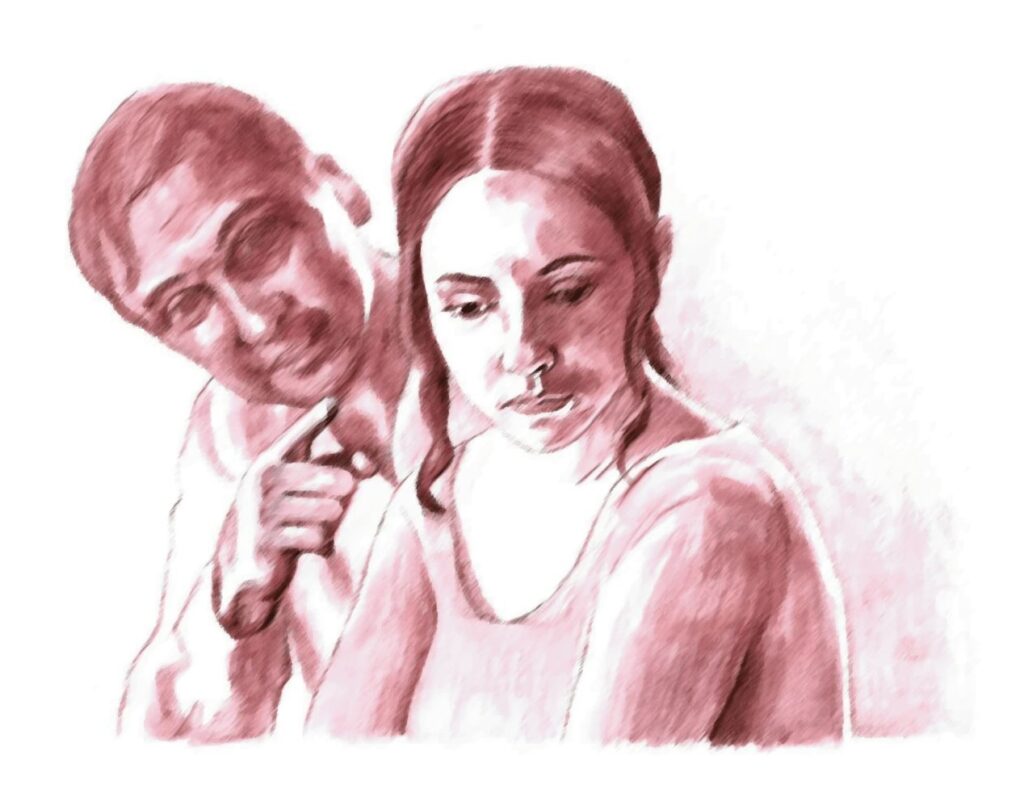
Crystallising these ideas, we can look more closely at the first four lines (or opening quatrain) of A Married State, a quietly revolutionary example of an anti-marriage poem. The assertion in the first line lands with axiomatic force: a married state affords but little ease. Right from the off, Katherine couches her poem in a restrained, almost legalistic language, describing marriage as a state rather than a relationship. The word affords suggests a granting of an allowance rather than the growth of understanding or pleasure between two people. In the seventeenth century, the word ease would connote more than it does today, something like freedom from anxiety or fear than simple ‘relaxation’. So straight away, Katherine imagines marriage as a kind of unsatisfactory contract that won’t deliver its promises. Tellingly, she’s not imagining a ‘bad’ marriage; she says the best of husbands are so hard to please. In other words, even ‘good’ marriages are marred by inequality, where the wife must labour to satisfy her husband. Hard to please implies ongoing evaluation or shifting benchmarks that demand tireless attention, and places the burden of maintaining a happy marriage on the wife alone. Not that a harassed wife is allowed to complain; wives are expected to be silent and obedient, after all. Instead, the consequences can be faintly traced in subtle-but-visible ways on careful faces – a fearful glint in the eye, maybe, the way wives hold their lips tight, or wrinkles etched into cheeks made old before their time. A disturbing effect of this image is to suggest the trials of marriage leave traces like physical scars, faintly pointing at the domestic violence that would certainly have blighted many women’s lives (again, while her husband-to-be never treated her like this, nevertheless even as a girl, Katherine was observant enough to notice signs of trouble in the marriages around her). The word careful does double-duty: on one hand, the word can be read as ‘full of care’ or full of anxiety and worry. But it also suggests the carefulness of self-checking, overcompensating, and self-censorship. The final line of the opening quatrain points to how women must hide their true feelings behind a compliant mask; they must dissemble their misfortunes, where dissemble means to put on a false face, or even to lie. Katherine couldn’t be clearer: marriage, even a good marriage, inevitably turns women into pretenders who must keep up appearances at all costs lest their husbands become displeased.
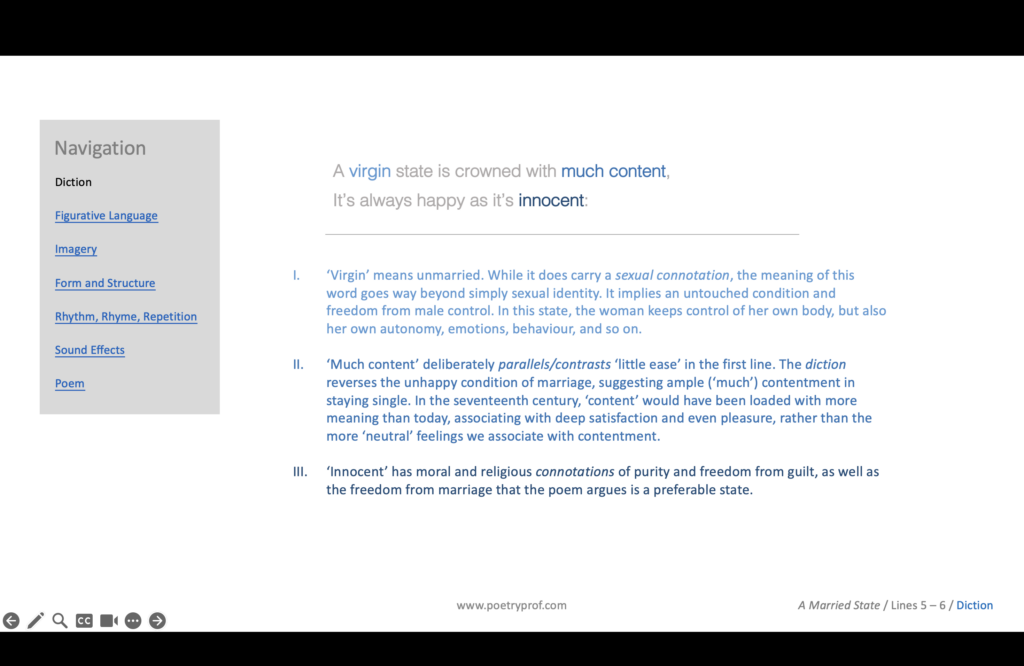
After this less than stellar advert for the state of holy matrimony, Katherine presents an alternative ambition for women: a virgin state. This phrase purposefully parallels a married state from the first line, in doing so suggesting that far from being a state of lacking, virginity is equally valid. Again, the idea that a woman’s life can be defined by anything other than the seeking of a husband to father her children was quietly revolutionary. As if pre-emptively rebuking all those Disney princess films yet to be made, Katherine imagines a woman made happy and content not by marrying a handsome prince, but by remaining steadfastly single. In the seventeenth century, content carried heavier connotations than it does today, including the meaning of being free from fear or anxiety. Alongside happiness, contentment is presented not as a humble aspiration but as something regal and elevated through the triumphant metaphor of a woman being crowned with happiness, a word which can be directly contrasted with the dry word afford placed in the same position on the first line. Of course, being unmarried means remaining a virgin (at least it does if one wants to avoid gossip and scandal) meaning women will need to sacrifice their sexual desires – but the poem argues that this is a small price to pay in exchange for personal autonomy. The phrase crowned with much content is embellished with the poem’s first example of alliteration: two resplendent C sounds adorning the image as a golden circlet adorns the brow of a proudly single woman. The sound rings loud and true in the ear, a defiant contrast to the softer consonance of the first four lines where subtle fricatives (affords, wives careful faces, though they) and sibilance (ease, please, faces, spell, dissemble, misfortune) combine to bring to mind the enforced meekness of a married woman humbled into submission.
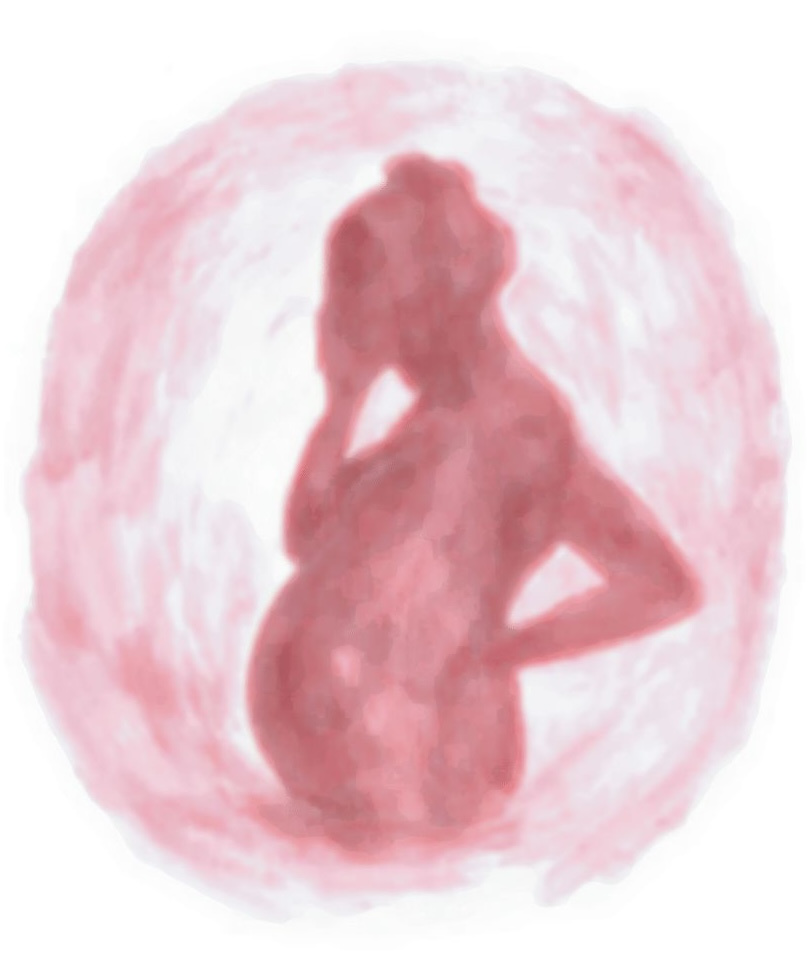
The heart of the poem is expressive of freedom from restrictive obligations. As if ticking off items one after the other on her fingers, Katherine lists all the things that women won’t have to worry about if they stay unmarried, emphasising through anaphora (repetition of No at the beginning of three consecutive lines) that the cost of virginity is really no price at all: no blustering husbands… no pangs of childbirth… no children’s cries… She’s not thinking about the best of husbands here; the word blustering suggests a spectrum of bad impressions, from petty grumbling or buffoonery to a man raging in anger like a strong wind. Indeed, the ‘blustery’ image of husbands suggests male anger is something natural that, like a sudden storm, can arise out of nowhere bringing danger and destruction along with it – violence being detectable in the associations of this word. Similarly, while now we say pangs to mean anything from hunger to cramps, in the seventeenth century pangs of childbirth could be much more serious. Without anaesthetic, antiseptic, or antibiotics, childbirth was a seriously painful and dangerous undertaking for both mother and child, with shockingly high mortality rates that wouldn’t truly come down until the twentieth century… three hundred years in Katherine’s future. Given these horrific possibilities, cries of children doesn’t seem as terrible a fate, but it’s a reminder of the limits of life’s ambitions for most women. Katherine and her small coterie were relatively lucky in that they could carve out identities as writers; most women lived much more circumscribed lives with childbearing being one of the only areas where women were granted limited responsibility. The repeated No… no… no… accumulates so that marriage starts to feel more like a series of unavoidable burdens than a single event that can be negotiated. Each line each adds another challenge – domestic power imbalance, physical pain, and the responsibilities of motherhood – piling up and overlapping hardships until they feel too much to bear. Perhaps any one problem can be coped with, but the rapid-fire sequencing makes a married woman’s life feels overwhelming. Each No… is paired with the word to: No husband to create your fears, No pangs of childhood to extort your tears, and so on. This kind of repeated grammatical pattern is called parallelism, and Katherine uses it to evoke the relentlessness of female obligation and the emotional consequences it causes. Look how each line ends with a negative emotional state: fears, tears, noise, and distraction. The last line adds the dimension of spiritual consequence into the mix, upping the stakes even further as different burdens are neatly brought together through the religious metaphor of the cross: Few worldly crosses to distract your prayers. Through the connotation of marriage equaling sacrifice (Jesus carried a wooden cross to his own crucifixion; even today we talk about heavy, unavoidable responsibilities being ‘crosses to bear’), Katherine implies the near-heretical thought that the state of holy matrimony is ironically an obstruction to religious devotion. If getting married distracts your prayers, why put your immortal soul in jeopardy just for some hard to please, blustering buffoon of a man?
Katherine’s poem is radically subversive because, in a time where there were no real alternatives for women other than to be married and bear children, she argues that, actually, this fate is avoidable for any reader wise enough to buck convention and listen to her advice. We’ve mentioned before that Katherine was only 14 years old when she wrote this poem, but she crafts the voice of her speaker so carefully that it feels like we’re receiving the wisdom of an older, wiser figure. Much of this comes through the poem’s carefully constructed form. Katherine writes in lines of perfect iambic pentameter: each line contains exactly ten syllables, arranged in pairs of weaker-then-stronger ‘beats’, the famous iamb. Often associated with the sound of our heartbeat (the rhythm of iambic meter goes de-dum, de-dum, de-dum) in this poem it’s got less to do with love’s levity – a phrase Katherine uses to disparage love as an unserious, flighty emotion – and more to do with evoking both the authority of the speaker and a sense of careful control into the poem itself, using the speaker’s mode of address to reflect the restraint a wife must constantly display. Each line is end-stopped carefully, again making the poem feel restrained, formally composed as a wife might school her face to stay composed even when her emotions are running high. In other words, the poem’s form practices what wives must practice: self-discipline. Additionally, the poem’s tight, full rhymes contribute to the impression of a speaker wise beyond her years, each couplet delivering a new aphorism, or quiet, understated truth being passed from one woman to another. In the poem’s central section, the rhyme scheme coalesces so that four sequential lines rhyme AAAA. Confidence oozes from lines such as Thus, Madam, be advised by me which uses the imperative tense (otherwise known as the command tense) to convey a sense of authority on the speaker’s part, or Turn, turn apostate to love’s levity, embellished with a rhetorical flourish (anaphora) and a fluffy alliteration that makes love sound bouncy, an unserious emotion that’s here-then-gone, a mere distraction from life’s more important concerns.
The end of the poem plays into a longstanding poetic tradition of placing emotion in conflict with reason. Classically, emotion is governed by Dionysus, the god of chaos, disorder, insanity (and also theatre, vegetation, and even wine, things that have an inherent chaos, spontaneity or hard-to-grasp intangibility about them). He is diametrically opposed by his half-brother, Apollo, who stands for logic, progress, clarity and harmony, all forces of reason. Katherine taps into the Apollonian/Dionysian dichotomy when she urges her listener to suppress wild nature if she dare rebel (using that imperative tone again, conveying authority but also urgency). Through the word she, women’s sexual urges (wild nature) are personified as rebellious feelings that should be taken firmly in hand lest they derail a woman’s life, leading to all the unhappy outcomes that were detailed earlier in the poem. In the seventeenth century, the reasonable course of action for a woman was to seek a husband, so there’s a delicious irony in the implication that wild nature is the part of a woman that actually wants to do the conventional thing – fall in love and get married. The wild language she uses implies this is a result of Dionysian desire rather than logical thinking. She argues that what seems mad – opting to stay single – is actually the only reasonable, hence Apollonian, course to take.
Which brings us to the poem’s final line, a marvellous allusion to a medieval belief that Katherine debunks in no uncertain terms: there’s no such thing as leading apes in hell. It’s uncertain where this idiom originates: Shakespeare uses ‘ape-leader’ as an insult in both The Taming of the Shrew and Much Ado About Nothing, referring to an old proverb that maids who die unmarried will be condemned to lead a band of monkeys around hell for all time! A fairly safe assumption is that, having remained unmarried, such women would have borne no children, so the punishment – caring for apes in ‘leading strings’ like the reins used to guide small children – somewhat fits the perceived ‘crime’. No matter the providence, the existence of such superstition points to how women through the centuries have been coerced through tradition into accepting marriage as a de facto natural condition. In boldly stating in no uncertain terms there’s no such punishment, Katherine challenges notions that women should be bound for life, offering the possibility of a new kind of freedom for those brave enough to buck convention.
Suggested poems for comparison:
- The Forsaken Wife by Elizabeth Thomas
Written less than a century after Katherine Philips’, this pointed poem also debunks the popular, romantic impression of marriage as a woman’s only shot at happiness. It gives an insider’s perspective on what it feels like to be with an unfaithful husband who can’t keep his wedding vows.
- After Eden by Rachel Wetzsteon
Katherine Philips’ A Married State is an early example of what might be called ‘anti-marriage’ poetry. Proving the sub-genre is alive and well in the 21st century is this sad and cutting poem about a sudden break-up and what comes after.
Additional Resources
If you are teaching or studying A Married State at school or college, or if you simply enjoyed this analysis of the poem and would like to discover more, you might like to purchase our bespoke study bundle for this poem. It costs only £2.50 and includes:
- Study questions with guidance on how to answer in full paragraphs.
- A continuation exercise to help you practise analytical writing.
- An interactive and editable powerpoint, giving line-by-line analysis of all the poetic and technical features of the poem.
- An in-depth worksheet with a focus on explaining how diction and connotations of words contribute to the deeper meanings of the poem.
- A fun crossword quiz, perfect for a starter activity, revision or a recap – now with answers provided separately.
- A four-page activity booklet that can be printed and folded into a handout – ideal for self study or revision.
- 4 practice Essay Questions – and one complete Model Essay for you to use as a style guide.
And… discuss!
Did you enjoy this explanation of Katherine Philip’s indictment of marriage? Do you know anything more about the surreal last line and the image of leading apes through hell? How do you react to the poem’s themes and conceit? Why not share your ideas, ask a question, or leave a comment for others to read below.



There is a mistake in the poem, it should say “Therefore, Madam, be advised by me” and not “Thus, Madam, be advised by me”