Posted by
 William Blake sweeps away the comforting lies that enable child exploitation
“He was strongly opposed to slavery and to ‘mental tyranny’ – which for him included organised religion”
Professor Halmi, Oxford University
The sweet notes of The Chimney-Sweeper are instantly recognisable. Blake’s poem is one of the most well-taught in British schools, the length and breadth of the land, and many people remember the poem’s strong imagery long after: Little Tom Dacre’s white hair, the dream of angels freeing all the little children from coffins of black, the rush of joy as they run ‘leaping and laughing’ towards the river. The thing is – none of those sweet moments are in the poem you’re about to read! Before you think your memory is playing tricks on you, let me explain that Blake wrote not one but two versions of his famous Chimney-Sweeper poem. The first was written for his collection Songs of Innocence in 1789, the second for Songs of Experience in 1794. While it’s the sweeter, lighter poem people tend to remember, Blake wrote the poems in Songs of Experience to be darker, more cynical, inverted mirrors of his Songs of Innocence. His pair of Chimney-Sweeper poems – especially the sharp, accusatory second poem that we’ll discuss here – are his expressions of outrage, a response to a world poisoned not only by the fumes of the Industrial Revolution, but by class and religious hypocrisy, as people in a position to improve the lives of children instead turned a blind eye to the suffering they saw:
A little black thing among the snow,
Crying ‘weep, ‘weep, in notes of woe!
Where are thy father and mother, say?
‘They are both gone up to the church to pray.

‘Because I was happy upon the heath
And smiled among the winter’s snow,
They clothed me in the clothes of death
And taught me to sing the notes of woe.

‘And because I am happy and dance and sing,
They think they have done me no injury:
And are gone to praise God and his priest and king,
Who make up a heaven of our misery.’
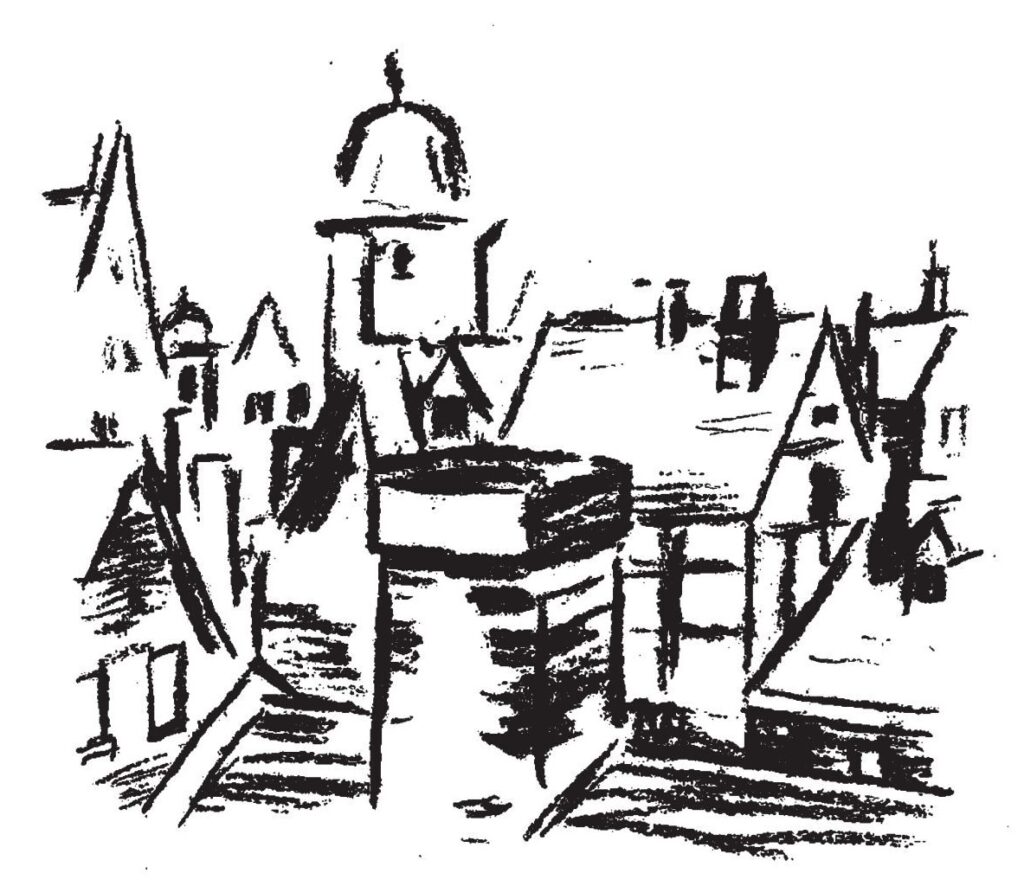
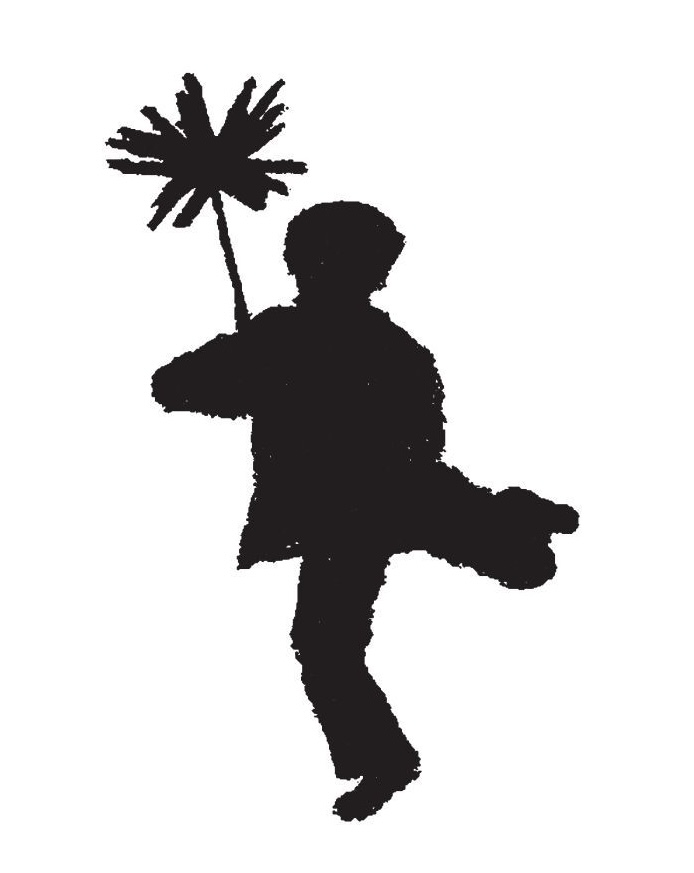
In the 18th century, children as young as four or five years old were forced into chimney-sweeping. Physically small enough to squeeze into chimneys of grand houses, boys crawled into cramped, dangerous conditions where many suffered injuries and even died in accidents. (While the poem can be read either way, I’ll refer to the child as ‘boy’ throughout this essay because, while girls were part of chimney cleaning teams and occasionally used as ‘climbers’, typically it was boys who had the unenviable task of squeezing themselves into the chimney flue, the most dangerous part of the job.) Those who survived long enough developed deformities and lifelong ailments through exposure to cancer-causing soot (lung cancer caused by exposure to chimney chemicals was in those days called ‘soot-wart’). Of course, it wasn’t the children of richer, well-to-do families who were forced into this life. Mostly, chimney-sweepers were orphaned or abandoned children, or children taken from extremely poor families with almost no choices left. That’s probably the case here. It’s not absolutely clear from the poem whether the boy’s father and mother are his biological parents, foster parents, or adults who profit by taking on street waifs and strays. The state would pay a small stipend to people who took on children as apprentices and ‘master sweeps’, adults to whom the children were legally bound, took that money – then doubled down by pocketing profits from the chimney sweeping services they offered as well. Of course, the children themselves wouldn’t see much beyond a heel of bread and a threadbare blanket to wrap up in at night, just enough to keep them alive and healthy enough to work. Whatever the ins-and-outs of the boy’s parentage, those he thinks of as his father and mother have, whether through choice or circumstance, inducted him into the life of a chimney-sweeper. In the boy’s words: they clothed me in the clothes of death and taught me to sing the notes of woe. Metaphorically, clothes of death aren’t clothes at all, but soot that stains the boy from head to toe. His notes of woe are the plaintive cries of ‘sweep, sweep’ that boys sitting on the kerbsides outside grand houses would call to advertise their services. In stanza one, Blake modifies the word ‘sweep’ so it becomes ‘weep, using an apostrophe to elide the ‘s’ and conflate two words into one, a little detail suggesting that the boy’s work is the source of his sadness. It’s like an inverted Mary Poppins without any fun, with no happy ending, and where all the songs are used to mask the misery of such an existence.
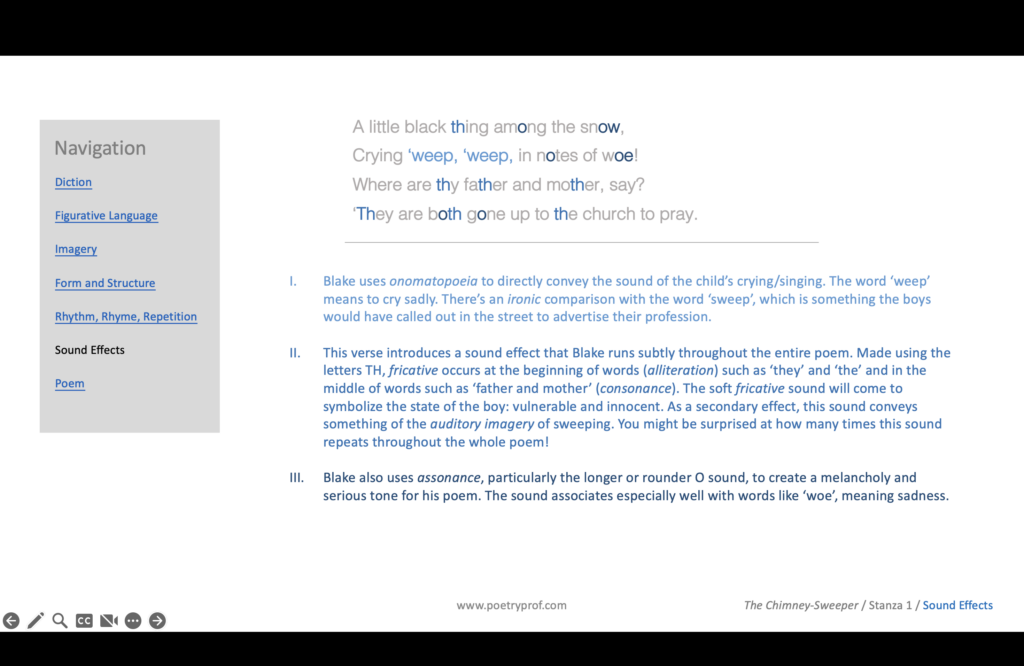
Blake’s poem follows an unusual structure in that it has two speakers; we begin by hearing the words of an unseen adult who stumbles upon a child alone among the snow. Opening with an adult speaker’s lines allows Blake to present an image of a chimney-sweeper as he’s seen from the outside (an important contrast with the mirrored poem from Songs of Innocence which is presented only from the little boy’s point of view). Described as a little black thing, diction imagines the child as vulnerable (little) yet bereft of anything resembling childish innocence. Covered in soot from head to toe, his clothes stained black, all the speaker can see is a thing, a word that dehumanises the boy, stripping him of any recognisable human features. Perhaps this is not a judgment made by the speaker per se, it’s more an indictment of a society that would permit a small boy to be placed in this situation. In uttering these words, we realise that, until he gets close enough, there was no way to see that this was, in fact, a human child! Circumstance has metaphorically transformed the boy from a ‘child’ into a thing, disposable, with no name or defining features. The words are given a sharp edge by both sounds and patterns of rhythm: written in flexible measures of two or three syllables (iambs and anapaests), Blake places emphasis on words such as little and thing, calling attention to the dehumanised depiction of the boy. He’s not dogmatic about rhythm: for instance, the second line inverts the first iamb into a trochee, so the stressed emphasis falls on cry, heightening the sound of the child’s misery and so highlighting his vulnerability. However, it’s the harder, sharper consonant sounds made by letters such as dental D and T, plosive B and P, and hard guttural C that gives the poem its bitter edge. Skim the poem again, and you’ll find them when Blake is at his most scathing, in lines and phrases like: They clothed me in the clothes of death, both gone… gone to praise God and his priest and king. A collection of hard sounds in this last example work to make it seem like the boy’s spitting accusatory words at his interrogator, daring him to blame the boy when it’s adults who are truly at fault.
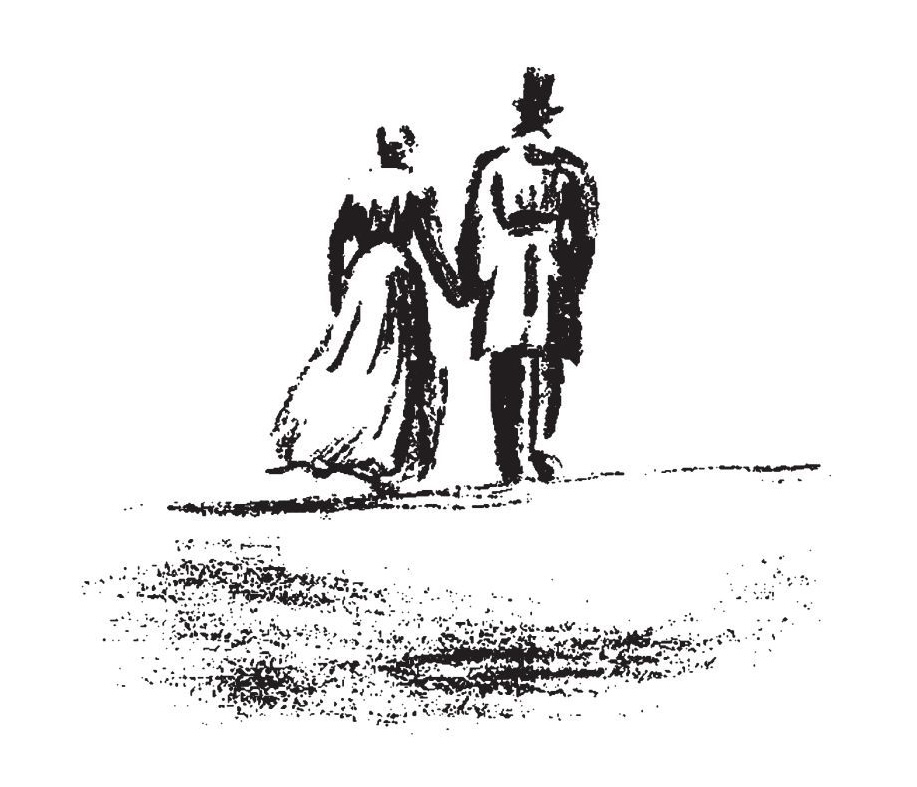
This subtlety is part of a pattern of adult critique that develops over the course of the poem. Whether the boy’s vanished parents, religious and state leaders (priest and king), or even the adult speaker himself, none escape Blake’s critical words. After all, the unseen adult is a part of a setting where child chimney-sweeps were commonplace. Whether the voice is the poet’s own, an invented speaker, or even a device to place the reader inside the poem, with the poetic world being fairly elite and privileged, it’s not farfetched to suggest Blake may be asking his readers to shoulder their share of the blame. While I’m not suggesting the speaker is directly responsible for the child’s situation, he certainly addresses the child in a blunt and forthright manner that’s more than a little cold: Where are thy father and mother, say? The last word, say, is quite striking, turning the line from a simple question into a demand for a response. I can’t help feeling Blake is purposefully letting his speaker’s tone of voice come across as detached, and it’s debatable as to whether the sight of the boy has aroused the speaker’s pity or merely his curiosity. To me, he appears intrigued rather than caring; before attempting to comfort or help, he prefers to satisfy his own curiosity about this little black thing, asking the child – innocent victim of widespread exploitation – to account for his parents’ whereabouts in expectation of him explaining something for which they should be responsible. Likewise, the boy’s father and mother symbolise adults in general who are supposed to care for children, but – whether through choice or through circumstance (such as an extent of poverty) – neglect their duty of care and either perpetrate or allow cruelty to be perpetrated on children.
The boy, whose voice takes over in line four, certainly doesn’t hold back. His answer (They are both gone up to the church to pray) is telling as to the extent of adult hypocrisy, taking the blame away from the boy’s own parents (who may have little choice) and refocusing it on those in the upper reaches of English society: the church and state. Churches are meant to be places of moral guidance, charity, and religious reassurance. But Blake presents the church as the primary site of adult denial and even hypocrisy in the poem. The child’s parents, while abandoning him to a life of misery and danger, presumably think of themselves as good, Christian people! They follow their Christian duty by going to the church to pray, and listening to preachers extol virtues such as care, love, and charity. Indeed, Blake famously despised organised religion (apparently, he only stepped inside a church three times in his life) and he forces readers to confront the hypocrisy of a sacred institution preaching one set of values while turning a blind eye to the widespread suffering of children. The poem goes in hard on adults: anaphora is used to repeat they (They have gone… They clothed me… They think…) in a way that’s unmistakably accusatory. The boy didn’t get covered in soot by accident – the active verb tense of the poem blames people who made a choice to clothe him like this. In the third verse, a pattern of three – God and his priest and king – includes the highest powers, earthly and spiritual, in Blake’s condemnation of adult hypocrisy. Again, rhythm plays its part, patterns of stressed syllables ensuring the weight of accusation falls on God, his priest and king all three.
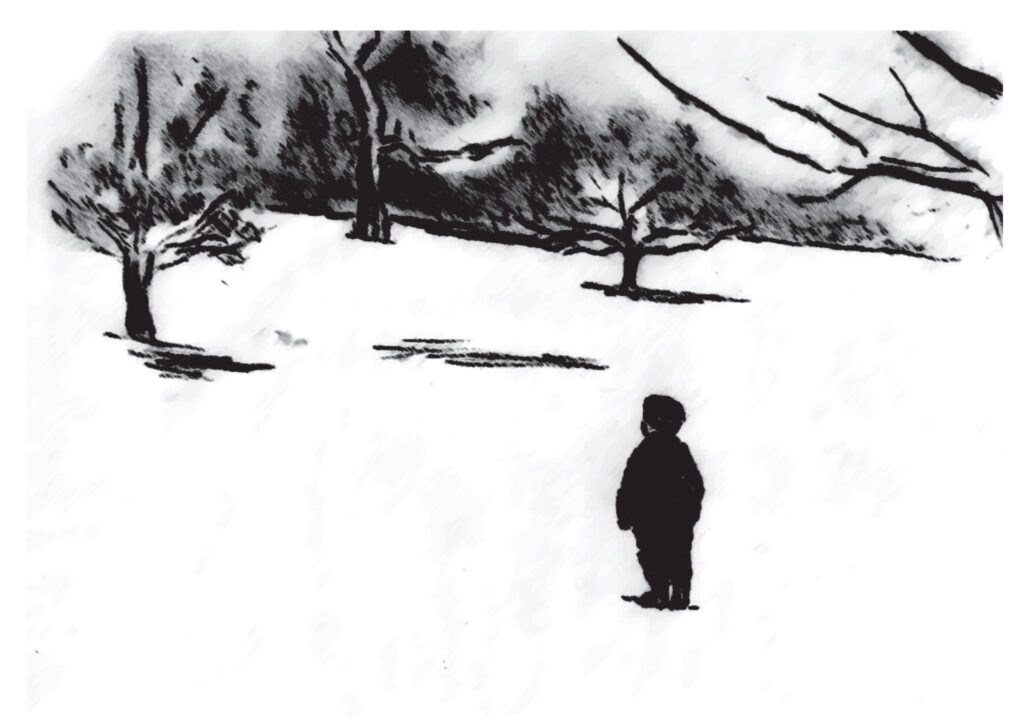
Sadly, Blake shows us how it doesn’t have to be this way at all. By contrast with humanity’s built institutions, Blake presents nature as a place of safety and succour. Indeed, the second stanza informs us that, far from being cold and miserable, the boy was happily marooned in the snow! In his own words: I was happy upon the heath and smiled among the winter’s snow. While it’s easy for us to automatically transfer associations of hardship onto the winter scene, we should resist the temptation to interpret snow in this way. The poem inverts the expected symbolism of winter’s cold and dark so that, instead, both snow and heath are protective spaces for the boy. Heath refers to an open expanse of wild countryside, like a field, hillside, or sparse woodland – it’s not the wild wood that poses a threat, even in the depths of winter, but human society. Patterns of alliteration in the second stanza’s opening lines (happy on the heath… smiling in the snow) soften the poem’s harsher sounds: in particular, aspirant H is created through the exhalation of air, like breathing, imbuing nature with life and giving her a warmth that the poem’s adults never show towards the boy. The visual symbolism of winter’s snow – a white, innocent purity, further contrasts with the boy’s black appearance; Blake is clear that his soot-covered sorrow is human-caused hardship, a result of the corruption of society. Left to fend for himself, the boy would likely be much cleaner, purer, and happier. In Blake’s poem, adult emotional coldness is harsher than the snow could ever be, something he conveys through contrast, particularly in the second stanza. In his natural state (on the heath), the boy was happy, smiled, and appeared content; yet just as the human world corrupts the natural innocence of childhood, so too does the positive, smiling diction of the poem become corrupted by images of death and woe.
Blake’s criticism is all the more cutting given that, excepting the first three lines, his condemnation of adult society comes from the perspective of the child chimney-sweep himself. While he is still young, remember this poem comes from Songs of Experience; the scales have long since fallen from his eyes and he sees the systems that oppress him more clearly than the adults in the poem, who seem selectively blind. The poem’s sing-song rhythms and rhyme scheme lull us into a false sense of security (the poem uses full rhymes with one exception – the half-rhyme heath/death makes the second stanza’s shift from happiness to woe even more jarring). More, Blake implies a calculated cruelty on the part of the adult world, locating a harsh moralism in their rationales and justifications. Tapping into Victorian ideals of morality (echoes of which still exist in idioms such as ‘children should be seen and not heard’) he employs the all-important word because to introduce a cause-effect chain into the poem’s logic. Because I was happy upon the heath, begins the second stanza, is the reason why the adult world treats him so severely. This idea is reiterated in the first line of the final verse: It’s because I am happy and dance and sing that adults ‘punish’ the child by inducting him into a life for which he is wholly unsuitable. As opposed to the child’s natural expression of happiness in verse two, we can now recognise this singing and dancing as ‘performed’ happiness. The word taught takes on a new, darker aspect, implying the processes of inducting children into chimney-sweeping is a wide-ranging, systemic form of education. Adults have taught the children happy-seeming behaviours as tricks and cover: for instance, the musical refrain ‘sweep, sweep’, purposefully distorted by Blake, alludes to the singing of children on the kerbside to attract the attention of passersby, people who indirectly enable the industry by bringing children into their homes for the purpose of chimney-cleaning. No doubt it was easier on the conscience for these well-to-do folk to believe (think) that child chimney-sweepers were happy and well-cared for. Yet Blake’s poem shows them sustaining an effort to remain purposefully ignorant in spite of clear evidence to the contrary (such as visibly filthy, soot-stained clothes). His judgment is that society prefers the appearance of child happiness, no matter how unconvincing, to the truth of their degradation. He sees a world committed to moral blindness: they think they have caused me no injury is surely meant to be acerbic. Any truth adults prefer to think is blatantly belied by the grim reality stated in his poem.
The poem’s final line argues that such self-deception is willingly entered into. Consisting of arguably the poem’s most devastating metaphor – almost a paradoxical or oxymoronic statement – Blake tells us that all the people of the land, from the boy’s lowly parents to the highest authorities (priest and king) conspire in an act of collective self-delusion, making up a heaven of our misery. In other words, they repeat the lie of a good and just society, refusing to admit how that society is built upon the misery of children like the speaker of this poem. At the end of the day, people prefer comforting lies to the unvarnished truth. The chimney stack was the mechanical revolution’s symbol of progress, wealth, and industrial power, a sign of affluence for wealthy families with large homes and the means to heat them. The power of Blake’s poetry lies in its simplicity; using everyday words and simple rhymes that anyone can understand, he blows away the noxious cover of deniability… like a puff of smoke vanishing into the winter sky.
Suggested poems for comparison:
- The Chimney-Sweeper by William Blake
Not the same poem! Four years before publishing Songs of Experience, Blake wrote his Songs of Innocence collection. Many of the poems across the two collections are mirrored: Blake said that only by reading both poems can readers see the full truth of the worlds and ideas he depicted.
- Childhood is the Kingdom Where Nobody Dies by Edna St Vincent Millay
Blake shows how childhood innocence is destroyed by society from the outside: in this gut-wrenching poem by a favourite poet, Millay shows how sometimes childhood innocence dies from the inside-out. In her poem, adults try to shield children from the realities of life… but the world and time cannot be concealed forever.
Additional Resources
If you are teaching or studying The Chimney-Sweeper at school or college, or if you simply enjoyed this analysis of the poem and would like to discover more, you might like to purchase our bespoke study bundle for this poem. It costs only £2.50 and includes:
- Study questions with guidance on how to answer in full paragraphs.
- A continuation exercise to help you practise analytical writing.
- An interactive and editable powerpoint, giving line-by-line analysis of all the poetic and technical features of the poem.
- An in-depth worksheet with a focus on explaining how tone, mood and atmosphere are crafted by the poet.
- A fun crossword quiz, perfect for a starter activity, revision or a recap – now with answers provided separately.
- A four-page activity booklet that can be printed and folded into a handout – ideal for self study or revision.
- 4 practice Essay Questions – and one complete Model Essay for you to use as a style guide.
And… discuss!
Did you enjoy this explanation of William Blake’s simple-but-powerful criticism of society? Do you agree with the idea that the adult speaker is detached from the poem’s subject? What made you feel most sympathy for the chimney-sweep himself? Why not share your ideas, ask a question, or leave a comment for others to read below.