Posted by
Jacob Polley digs deep to uncover the remains of a grand civilisation lost in time
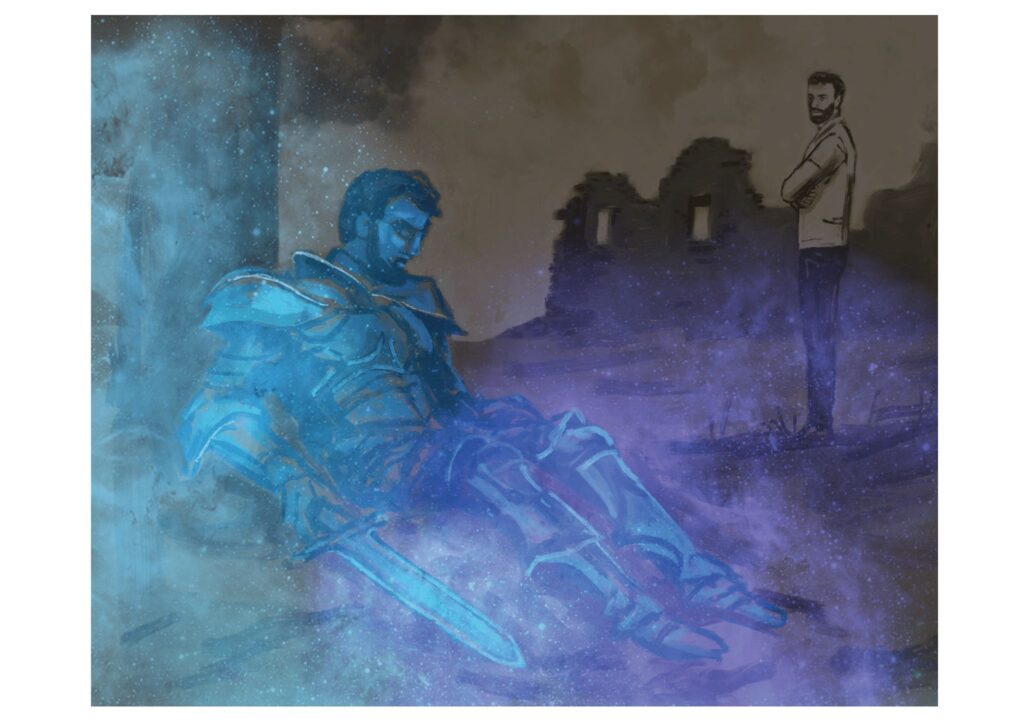
“Fluid boundaries between the seen and the unseen, the known and the unknown…”
Ben Wilkinson in his review of The Havocs by Jacob Polley
If, like me, you grew up in England’s Southwest, you’ll have no doubt spent many a wet weekend morning visiting drizzly English Heritage sites, Roman ruins, or Iron Age settlements. As a kid, I used to enjoy these trips not so much for their historical value as culinary opportunity; after a couple of hours mooching in the muddy courtyards and playing hide and seek around crumbling columns, my parents would usually take me for a cream tea in the café. But Jacob Polley has far keener vision than my teenage impatience granted me. Wandering the ruin of a crumbling castle complex, he sees beyond the now and peers over a whole span of time, through layers upon layers of history, back to the great hall’s very founding. He hears questions the dreary ruins ask: Who built these magnificent halls? Why? And what happened to those ancient and mysterious people? Without pretending he has answers, Polley’s poem speculates imaginatively, reconstructing a bright collage of history out of jumbled blocks and broken slate. Beginning in the present day, his words take us back to when the stones were raised, and forward again through abandonment and decline, unravelling time from the space it inhabits to give us a glimpse of the halls’ mysterious builders, those who dwelt in them, revellers, craftsmen, kings and courtiers, plague victims… until today only tourists and grazing cattle can glimpse the shadows of a grand civilisation whose stories are lost to time:
What walls and gables, wonders still of workmanship.
Whoever’s stronghold this was, havoc’s jumbled it
beyond all mending, uprooting towers, rusting together tools.
What was built by strange smiths, skilled in stone,
is burst, underdug, eaten down by age: weird bricks
litter this wasteground. And what of the wrights
and hammer-men, the mortar-mixer and heavers
of slab? A long time laid off, fast in the earth,
while their sons passed, and the sons of their sons
knew no like work. But these walls withstood
mosses and snows, the fall of kings, peace’s
indifferent wear by rain and rubbing kine.
Magogs raised them. Their wit matched their might.
Their great halls gawped, their tile floors gleamed
with muscle girls and monster fish. Here
springs were housed, and happiness found haven
among men making merry, their shadows merging,
Nimble as a change of mind, massive on the inner walls.
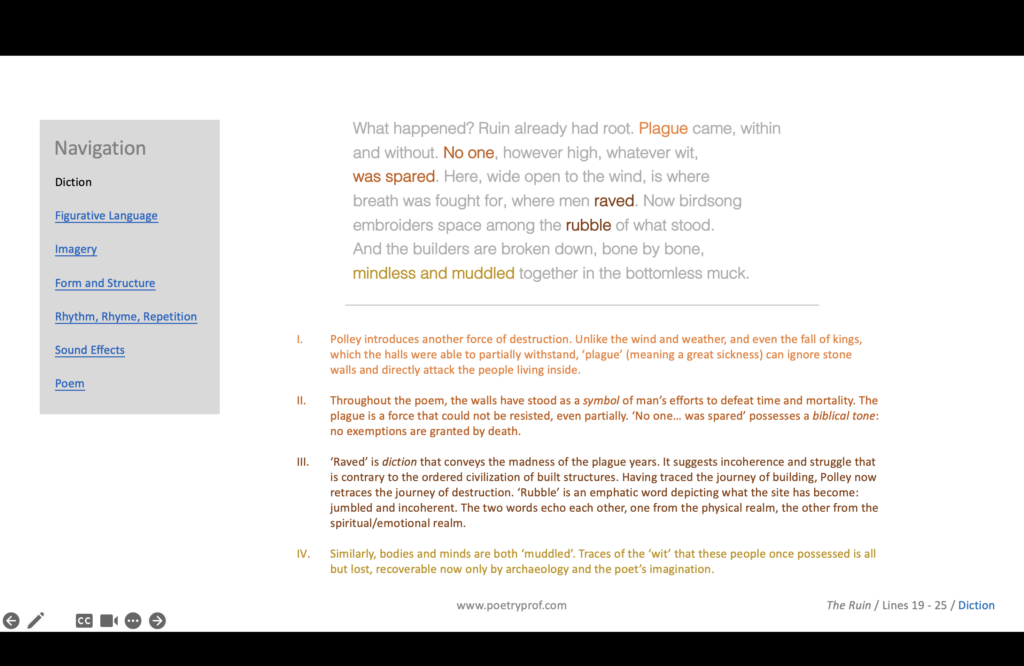
What happened? Ruin already had root. Plague came, within
and without. No one, however high, whatever wit,
was spared. Here, wide open to the wind, is where
breath was fought for, where men raved. Now birdsong
embroiders space among the rubble of what stood.
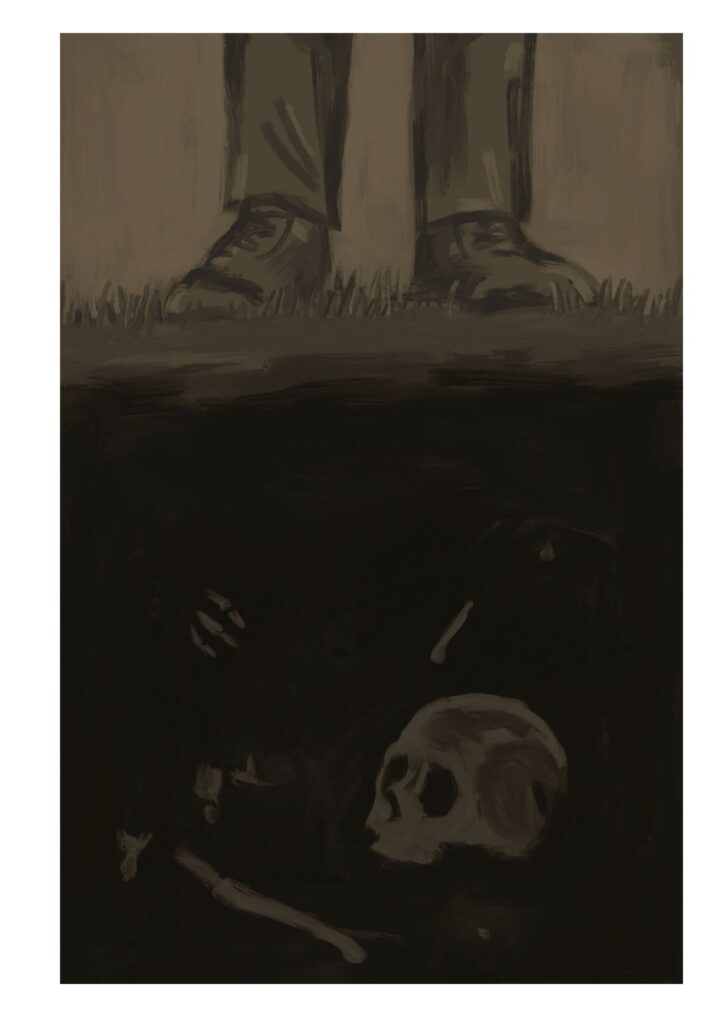
And the builders are broken down, bone by bone,
mindless and muddled together in the bottomless muck.
Half-recalled by these grim, rain-collecting courts,
by this unshattered span of arch, this brush of broken slate,
are those who twisted gold, empearled pins and gazed
on heaps of gems that beat and sparked. Houses were here.
Hot water sprang from wells and the walls held
vaults of steam and banked beds of embers, like precious stones.
Frost could get no grip. But all such days are gone.
Polley’s poem is reconstructed from the crumbled foundations of a poem found in The Exeter Book, a catalogue of 10th century Anglo-Saxon passages, poems, and riddles probably written down by a single scribe (maybe a monk) in around 970AD. He points us in this direction by subtitling his poem after the Anglo-Saxon. Just like the ruin he writes about, the source text is fragmented somewhat, certain passages worn away, faded, and lost to time. Surviving lines reflect on the ruins of a settlement after the fall of the Roman Empire and the Roman withdrawal from Britain. The settlement in question is probably Bath, a town in Somerset, but could be any similar historical site. Polley was born in Carlisle in England’s far north and has worked extensively around the country; Britain is fairly dotted with archaeological digs, ruins, and sites of this kind. Rather than a straightforward translation of the original text, Polley’s poem is more of a rebuilding or reworking. He follows the structure of the poem in The Exeter Book, adorning the skeletal framework with images from our own modern English and his own imagination. In other words, his poem enacts the same reconstruction of the past that the ruins allow for: where pieces are missing, unrecoverable, he uses imagination to fill the gaps. His offering to us is neither wholly fact nor wholly fiction, but part history, part archaeology, part speculation. His poem can be placed in a long tradition of ubi sunt poems. From Latin, ‘ubi sunt’ is a rhetorical question taken from the phrase ubi sunt qui ante nos fuerunt; ‘where are those who were before us?’ The theme was a common one in medieval poetry and there’s a feeling of ubi sunt in Beowulf, also featured in The Exeter Book and who’s flavour very much intermingles with Polley’s work. Questions are a feature of the poem. At various times Polley asks: what walls and gables… what was built by strange smiths… whoever’s stronghold… what of the wrights and hammer-men… what happened? His nods to ubi sunt do double duty. While some questions are punctuated as such, others are not marked, making them exclamatory. These moments convey astonishment at the ruin’s scope and quality; even in their ramshackle and broken-down condition the walls can still provoke wonder and no little admiration.
In reworking an Old English poem, Polley takes great care to preserve the alliterative tradition of the Anglo-Saxons. Where modern English poetry tends to organise itself around end-rhymes, Old English poetry was structured around head-rhyme: stresses and patterns of alliteration, formed when adjacent words, or words in close proximity, begin with the same sound. Head-rhyme is seen in texts throughout the Exeter Book, including its most famous poem Beowulf, composed of 3182 lines – all of which alliterate! You can see this feature in the opening of the Old English The Ruin which begins:
Wrætlic is þes wealstan, wyrde gebræcon;
burgstede burston, brosnað enta geweorc.
These lines are packed with head-rhyming W, B and G, what we now refer to as alliteration. When we read Polley’s poem, alliteration is impossible to miss. He arranges consonant sounds densely together: What walls... wonders still of workmanship, smiths skilled in stone, happiness found haven, mindless and muddled, and many more besides. Almost every line of The Ruin contains conspicuous alliteration, the defining formal characteristic of Old English poetry. But this isn’t just a simple case of mimicry. Through the evident purposeful craftsmanship and shaping of such alliterative poetry, Polley creates an analogy between the builders who work with stone and the poet who works with sound. Polley’s subject is the survival of ancient walls and gables, long-lost building skills traced in stone, fragments of the past carrying ancient history into the present. Preserving the sound system from the Anglo Saxon original demonstrates the same cultural continuity. Just as Roman ruins survive through the centuries, so the Anglo-Saxon form survives in a twenty-first century poem. Yes, Polley uses alliteration stylistically. At any given time the redoubtable strength of a stronghold’s foundation-stones echoes in alliterative W, or the blows of hammer-men come alive through plosive Bs, the sense of things being hammered together, ground down, or broken apart bone by bone. But more than simple stylistic adornment, alliteration acts out Polley’s central theme: some things can and do endure across time. Just as fragments of architecture preserves traces of vanished builders, the alliterative texture of Polley’s poem preserves traces of the vanished Anglo-Saxon poets from whom the words descend.
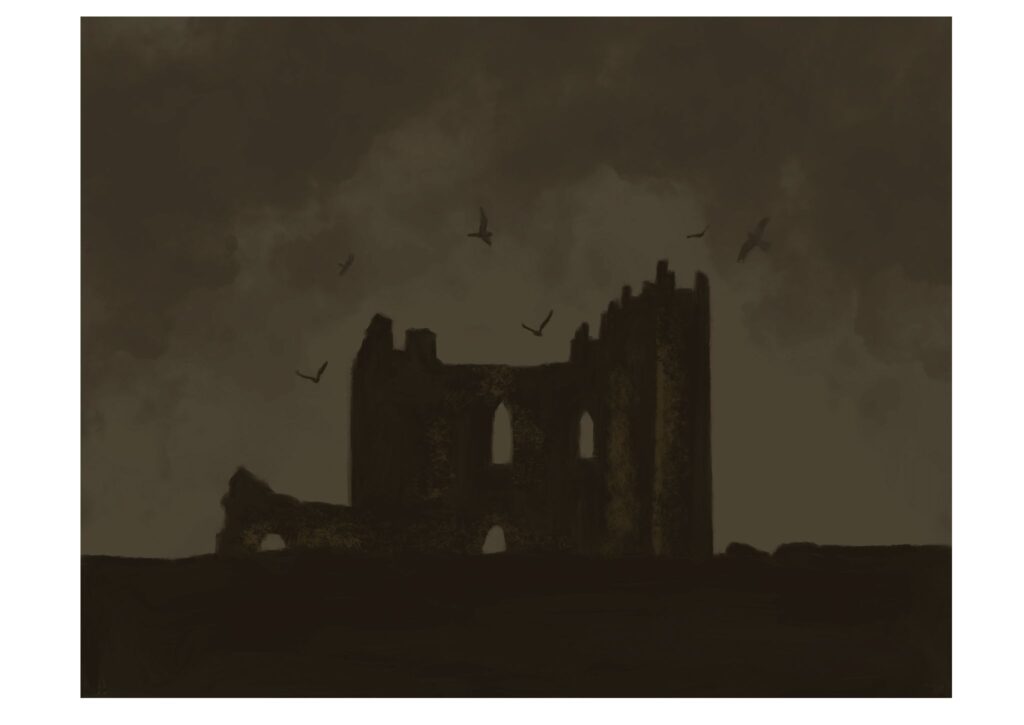
The Ruin, then, is not about the titular ruins so much as being a meditation on time itself. One of the grand achievements of this poem is how Polley uses his pen to perform a kind of word-archaeology, scraping back layers of time and holding his findings up to the light. It would be wrong to say the poem is only about the distant past; Polley shows us how time is not binary but layered. The speaker roams between the present and multiple pasts that all existed in the same space he now stands in. We travel between a ruined now and the city’s time of flourishing, memories of plague, an even farther distant lost time of myth, and long centuries of decay and abandonment. Time itself is personified as a kind of havoc, a word meaning ‘widespread destruction’. Havoc’s jumbled it shows the effect of cumulative centuries subjecting the ruins to all kinds of wear and tear. At some points havoc acts like a huge catastrophe; words like burst suggest an explosive force of nature or an infernal war machine crashing against the stronghold walls, and uprooting implies an incredible power tearing at the fortress foundations as if pulling an enormous tree out of the ground. But more often, havoc plays out slowly and insidiously, the poem explicitly recognises that time is indifferent to periods of war and peace and continues to nibble away at the building’s structural integrity regardless. Images like eaten down by age pretends time is an implacable creature consuming the ruins bite-by-bite; underdug implies an insidious weakening of the stronghold’s foundations. Tactile imagery is used to express gradual erosion by rain and rubbing kine, ‘kine’ being an archaic word for cattle that have grazed on this ground ever since its abandonment, each beast shaving another few molecules from the stone surfaces with their shaggy pelts as they brush past. The forces of destruction conflict against the builders’ craftsmanship in a metaphorical tug of war between civilisation and chaos: where human builders sought to bring order to the ancient world, time and havoc pull in the opposite direction. Nowhere is the victory of time in this age-old conflict more clearly symbolised than by the image of rusting tools together. As symbols of human ingenuity, different tools once had distinct shapes and purpose. Now we see how havoc-time has fused them together into an indecipherable, petrified lump.
Symbolising the pinnacle of an ancient civilisation’s achievement, the ruined halls quickly come to represent the human attempt to build things that are permanent, that can resist or even defeat havoc and time. The poem begins by aligning our gaze with the speaker’s as he fixates on the walls and gables of the ruin, all that is left of a once-magnificent stronghold. This label implies durability and defence during war time, the buildings as a retreat from chaos. Gables is an example of a specific architectural diction (meaning a part of a roof that projects over the top of a supporting wall) that Polley uses to point out the concrete remains of this once-imposing structure. There’s something inherently symbolic about walls that are built as supports or to secure things in their proper places, either in or out of the castle. Walls are often straight, and high, easily implying the attempt to impose some kind of spatial order onto a chaotic world. And these are not just any old crumbling walls. In the first line the speaker wonders at their workmanship, implying no little craft has gone into their building. Even after centuries of decay, the walls still pack a visual punch for the sightseer. Whoever they were, the poem is peppered with the recognition of the builder’s ancient craftsmanship: workmanship, skilled in stone, their wit matched their might all pay tribute to the strength, intelligence and grace imbued into the intricate stonework. When accomplished with such craft, the act of building is aligned with ideas of elegance, high culture, and civilisation, things that human societies often aspire towards. In this way, by opposing all those images of un-making with equally powerful images of making, Polley essays the argument that havoc – representing chaos, disorder, and a return to savagery – is an opponent worth trying to defeat.
An interesting nuance of Polley’s destructive forces is his distinction between time and nature. Whereas time tends only towards loss and decay, nature cycles between acts of destruction and creation. It’s true that rain and kine, both forces of nature, play their part in the erosion of the archaeological site. Frost attacks buildings and mosses grow over fallen walls. But, unlike time, which remorselessly grinds away at human achievement, nature occasionally operates differently, almost becoming a participant in the battle against time. This can be seen most evidently in the beautiful line: birdsong embroiders space among the rubble of what once stood. As if continuing the legacy of human builders and stone-smiths, nature takes over and, through personification, embroiders the air with its delicate traceries. Civilisation and nature aren’t opposed in the poem, so much as nature inherits the space humans leave behind when civilisations fall. A parallel image is one of rain-collecting courts where, in the present day, pooled water replaces the people that once convened there. Later, when Polley imagines how hot water sprang from wells he’s showing nature cooperating with humans to help life flourish in a stern place of frost and stone. Therefore, where time is almost purely an antagonistic force working against human endeavour, nature is a more ambiguous one that doesn’t obliterate as much as continue the work of human builders after its own fashion.
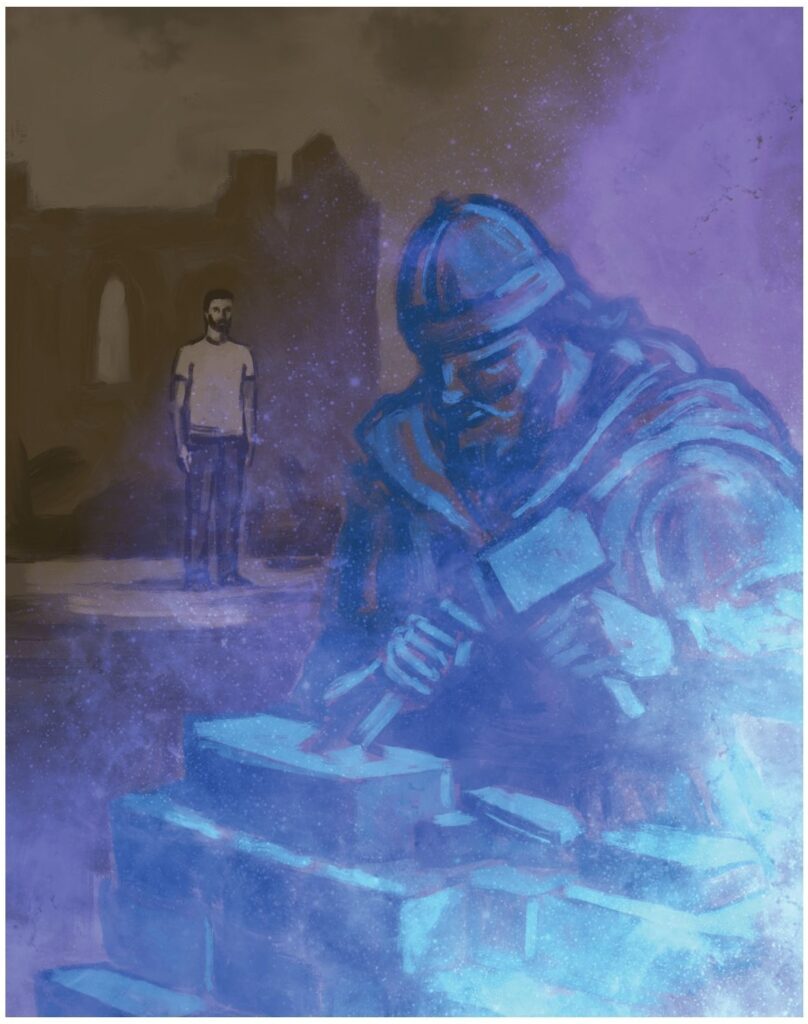
Just as Polley’s speaker uses material fragments to unlock secrets of the past, each detail of the poem seems to house another truth that rewards the contemplative reader. Take those rusted tools that we previously noticed. While the ruin stands as proof of physical or material decay, they represent cultural loss and the loss of intangible knowledge as well. The presence of tools implies knowledge of engineering techniques, for instance; their rusting symbolises how these techniques are forgotten when the people who made use of them are gone. We’ve already noticed the word wit, which means the builders used more than simple brute strength to wrest stone out of the ground. Wit implies intelligence in the putting of strength to efficient use. But how exactly they solved the engineering problems of their time we can’t say. Polley frequently uses words from a lexical field of confusion (weird bricks, strange smiths, whatever, whoever and simply what) to imply that the cultural knowledge ancient people possessed is now lost in the mists of time. This tendency is exemplified in the wry phrase: the sons of their sons knew no like work. Disguised in the modern parlance of being laid off (as in ‘to be fired from a job’), what Polley’s really doing is smuggling the little word knew into the poem to suggest that the original builders used knowledge, skills, and craftsmanship that later generations no longer ‘know’ how to perform. Another glimpse of this theme can be seen in the way Polley wonders at who the ancient builders may have been. Individual identities, names and faces, have been lost and forgotten. All that’s left are ruined stones, so the people can only be identified as wrights and hammer-men, mortar-mixers and heavers of slab, names that both celebrate their achievements yet at the same time simplify their lives down to roles on a building project. Archaic diction reminds us that these jobs don’t exist in the speaker’s world anymore; the list of names carries a dirge-like tone sounding a roll-call of the dead and gone. While material remains can point to lost intangibles like vanished culture and ancient wisdom, Polley implies that not even the deepest contemplation can entirely reproduce all that’s been lost.
Everything so far suggests that in the battle between human civilisation and time there can be only one victor and the progression of the poem seems to be headed in only one direction: down into the ground. A magnificent stronghold collapses into towers which crumble into jumbled bricks which finally scatter across a barren and empty wasteland, this last word implying the almost complete vanishing of civilisation’s traces. The people who built this place are passed out of living memory, their own descendants (sons of their sons) have forgotten who they were, any remains locked fast in the earth beyond easy recovery. At the poem’s lowest point, Polley tries and fails to picture the erstwhile residents, admitting that the builders are broken down, bone by bone, mindless and muddled together in the bottomless muck. At this point it feels as if recovery must be impossible. Yet… the walls remain. Battered, yes. In a terrible state of disrepair, certainly. And yet they still stand. Pivoting around a strong But that unmistakably alters the logic and direction of the poem, Polley complicates his own theme by admitting: But these walls withstood mosses and snows, the fall of kings… While time can erase history, destroy knowledge, and erode physical evidence, its victory is not total. Withstood gives the walls a special power, the word implying an ongoing resistance against decay, a hero’s refusal to fully accept defeat. While jumbled into pieces, the ruins nevertheless endure. Words like bricks, slab, slate, and stone are all monosyllabic and dense. Heavy consonance (B or T, for instance) allow the fragmentary pieces to hold some weight still – roll that word slab around in your mouth to feel the very substance of it. There’s meaning too in the expressive these walls, as if the speaker’s gesturing to the actual stone standing in front of him. At one point an unshattered span of arch points to a piece of the old castle that’s more substantial and lasting. The message comes through loud and clear: time can erase people, ruin places, and even destroy entire cultures and empires… but it can’t fully and completely scrub away all traces of the things those people made. The door of history never completely swings shut, and even a faint brush of colour on a piece of broken slate can be the key that unlocks the past again.
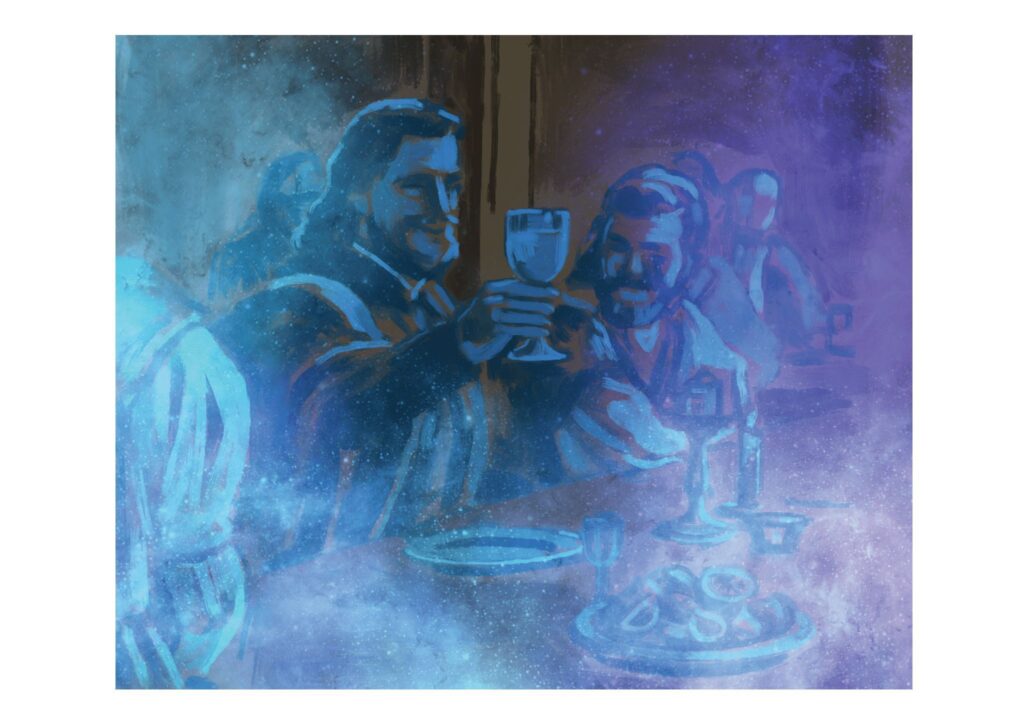
From this revelation, the poet is able to cross the span of time that divides the present from the past and return to an era when the great walls were first raised. In an incredibly bravura sequence, he brings the past back to life, repopulating the poem with people long dead and returning colour and vitality to a space that seemed utterly drab. Suddenly the shrunken ruins expand back into great halls that gawped. A word that normally describes an open-mouthed stare, Polley encourages us to imagine the scale of the cavernous spaces that used to awe and inspire visitors through a personification that mirrors his own sense of amazement. Their tile floors gleamed uses bright visual imagery to replace a rusting world of greying bricks with the shining light of newly polished surfaces. Water, a potent symbol of life and renewal, gushes from wells dug deep into the ground, the verb sprang conveying suddenly released energy and vigour. A vein of colour runs through sequences reimagining the past: gleamed, gold, empearled, and the extended description heaps of gems that beat and sparkled not only beautify the scene, but give the lifeless stones a pulse that animates them into living entities. Imagery is purposefully sensory: where time has dulled the site of the ruins, the poet’s imagination makes it shine again. The hard architectural diction of the poem’s opening salvo (walls, gables, towers, bricks, stone, mortar, slab) softens into words that carry emotion, such as happiness and men making merry. The stronghold transforms into a haven, a description that moves the structure away from a utilitarian defensive shell to something more like a ‘sanctuary’ or ‘community’. Conspicuous contrast creates the impression of life returning anew: where ruin has left interiors wide open to the wind, Polley imagines spaces enclosed once more by houses and walls that held vaults of steam; what was broken down gets raised back up; what was grim and grey gets polished to a shining gleam; what was forgotten is half-recalled.
The poem’s time-travelling sequences are simply extraordinary. Using questions put to slivers of architecture as a jumping off point, Polley takes us on a total immersion, three-dimensional, virtual reality journey to the past. It feels like we’re visiting a fleshed-out living-and-breathing culture. For example, whoever these people were, they fetishised the bodily form. From heavers of slab to might to muscle girls and monster fish, Polley lingers on muscular details of strength and physicality. By imagining not only the tiled floors but the monster fish decorations painted upon them, he supplies memories of a lost civilisation’s own lost and mythological worlds! It may seem an obvious point to make, but when we look back at ancient peoples we have to remember that they didn’t see themselves as ancient, but as completely modern and up to date. The builders were not mere inhabitants of ‘the past’. As we do, they looked backwards through art and storytelling towards their own barely remembered legends. In recognising this, Polley creates a past-within-the-past (when a playwright puts a play-inside-a-play this is called mise-en-abyme, and I wonder if it’s a term that could be applied here as well) that creates layers upon layers of historical consciousness lapping up around us as we read. We get to experience time at various different ‘scales’: individual human lives like the hammer-men working on the wall; generational time that encompasses their sons… and the sons of their sons; historical time that passes with the fall of kings; even the long cyclical nature of seasonal time as mosses grow and snows fall upon the site during those long centuries of abandonment. Now we get to feel the barrier of mythic time which even history cannot cross intact. Yet through all these aeons, the ruin endures. It exists in geological time; at this level, from the point of view of stone hewn from the ground, the fall of kings – great and monumental happenings by human reckoning – carries no more or less meaning than mosses and snows; the equivalence between the fall of kings and snows that also ‘fall’ is implied by the juxtaposition of these two forces on the same line.
This playing with temporal layers is evident in the name Polley gives his lost civilisation: Magogs. I think this choice of word (diction) is super interesting. A biblical name, King Gog was an enemy of God and ‘Magog’ were the lands over which he ruled. Later, Magog became a more generalised name for ‘enemy peoples’ and acquired connotations of the threatening outsider, chaos and conflict. Over subsequent centuries, the word was used to describe different peoples at the edges of the Christian world (for instance, the Vikings were called ‘Magogs’ by peoples they raided). A parallel in the Qu’ranic tradition is Ya’juj and Ma’juj who were separated from human people by Dhul-Qarnayn, a Qu’ranic leader, when he built a great barrier of iron between them to keep the Ma’Juj (Magogs) out. A very interesting detail of this story is Dhul-Qarnayn explicitly saying the barrier will be levelled when God’s promised time arrives. In this poem, too, we are reading about a magnificent ‘wall’ that time will eventually destroy! And into that story the poet places the legendary Magogs, making them the wall-builders (the inverse of their role in Dhul-Qarnayn’s story). While I wouldn’t argue with any certainty that this is an intentional allusion to the Qu’ranic tradition, the name unarguably carries some interesting historical baggage. Magogs can be thought of as outsiders, destroyers, invaders, or inhabitants of distant lands – perhaps like the Romans would have seemed to the Anglo-Saxon inhabitants of the British Isles? Over time, the invaders settle on the land they conquered and become builders. In terms of Polley’s reconstruction of the past, he uses the word declaratively: Magogs raised them. But there’s some artful sleight of hand being played here. The word has an incredibly indeterminate history, shifting meaning over time and place and depending on who’s speaking about who. It’s a small departure from the original version of The Ruins in The Exeter Book, where they are described as being “the work of giants.” In the manner of folk stories and legends, myth is recruited to fill the holes time pokes in historical certainty. Magogs are a convenient substitute for “While I don’t know who built these walls, they must have been a magnificent people capable of extraordinary feats.” Magogs are in language what the ruins are in archaeology: ancient, inherited, carrying tattered remnants of biblical, geographical, and historical meanings accumulated across time, but who’s true faces have long since been forgotten. The word represents exactly the poem’s central concern: how ruined remnants preserve fragments of the past that imperfectly thwart the ravages of time.
The poem closes with two images that render this conclusion beautifully tactile for the reader. Temporarily returning to the imaginative, reconstructed world, when Polley imagines hot water evaporating into vaults of steam, misty visual imagery evokes a dreamlike, ghostly scene suggesting the past can only be remembered obscurely, a pale superimposition over the emptiness of the present (an earlier image of shadows similarly implies how the past can only be recalled imperfectly, silhouettes outlined on the keep’s walls). He closes his poem with a more muted image, banked beds of embers, that symbolises the poem entire. A banked fire is one that has been covered in ashes. The flames are smothered, but underneath the heat is still trapped. That exactly symbolises what the ruins are: embers of the past.
Reading The Ruins in the here and now, all you need is the spark of imagination to make history live again.
Suggested poems for comparison:
- The House That Jack Built by Jacob Polley
From his 2017 collection Jackself, this poem traces the life of a stand of trees across thousands of years after they are felled and repeatedly formed by successive generations into ships, shrines, forts, relics, parts of homes, and other objects. Like the stones that outlast their builders in The Ruins, the trees’ wood survives in new forms – and even regrows – long after those who first carved that wood pass into history. Another wonderful poem.
- Ozymandias by Percy Bysshe Shelley
A perfect companion piece to Polley’s poem, in Shelley’s famous poem a traveller encounters the remnants of a statue that’s crumbled in the desert, the only surviving fragments of a once-mighty empire now buried in the sand. No human achievement, no matter how mighty, can outlast time, although fragments allow us to see something of the past.
- The Archaeologist by Hester Knibbe
Knibbe shows us how material remains can help us imagine lost lives. Both her and Polley reconstruct past worlds for us to immerse in; here an archaeologist excavating a ruined temple finds an altar that becomes a gateway to the past. Feel with your hands and feet back along these countless steps… he tells us.
Additional Resources
If you are teaching or studying The Ruin at school or college, or if you simply enjoyed this analysis of the poem and would like to discover more, you might like to purchase our bespoke study bundle for this poem. It costs only £2.50 and includes:
- Study questions with guidance on how to answer in full paragraphs.
- A continuation exercise to help you practise analytical writing.
- An interactive and editable powerpoint, giving line-by-line analysis of all the poetic and technical features of the poem.
- An in-depth worksheet with a focus on explaining how Polley crafts figurative imagery in the poem.
- A fun crossword quiz, perfect for a starter activity, revision or a recap, with answers provided separately.
- A four-page activity booklet that can be printed and folded into a handout – ideal for self study or revision.
- 4 practice Essay Questions – and one complete Model Essay for you to use as a style guide.
And… discuss!
Did you enjoy this explanation of Jacob Polley’s ‘rebuilding’ of an old Anglo-Saxon text? What associations did his incredible imagery suggest to you? Can you find any more ‘layers of time’ buried in the poem’s complex archaeology? Why not share your ideas, ask a question, or leave a comment for others to read below.