Posted by
 Alexander Pope examines our place in the grand scheme of things
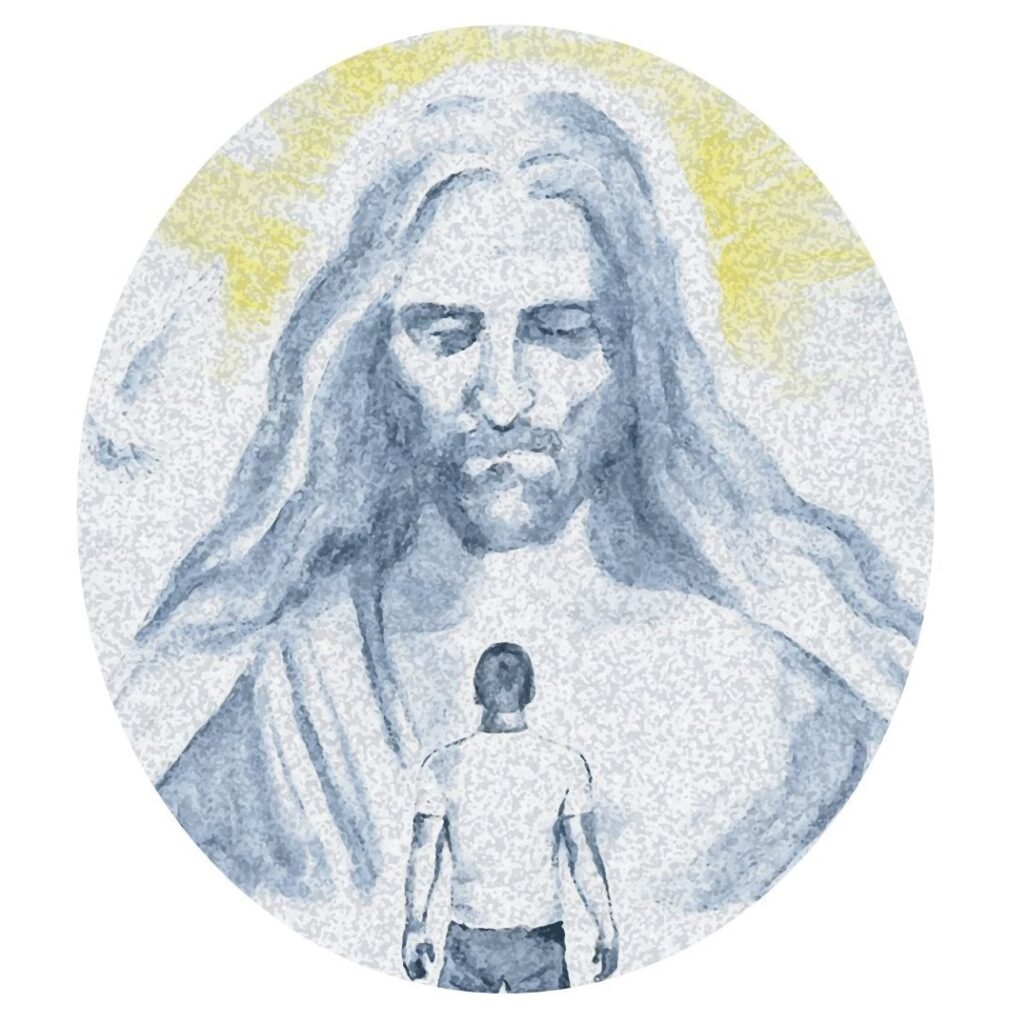
“Didactic and wide-reaching… an aesthetic and philosophical argument for the existence of order in the world…”
Poetry Foundation, about Pope’s An Essay on Man
You may be familiar with the idiom ‘in the grand scheme of things’ used when we want to look at the big picture or rationalise something that’s happening to us. The phrase hints at a belief in fate, that there is a ‘grand scheme’ behind the chaos of creation, that each one of us is a single player on a crowded stage. In 1579, Diego de Valades, a Mexican engraver living in Italy, illustrated The Great Chain of Being, a codified strata of all things created by God in their correct place in the universe. This wonderful engraving represents all of existence as a hierarchy of levels: God, as creator, is at the very top with his angels, made entirely of spiritual matter, sitting one level below him. Hell is at the bottom. Above Hell, one link up the chain, sits a layer of base elements; inanimate and having no spiritual essence they sit low on the Chain of Being. Climbing upwards, the next layers represent the natural environments of the world – land, sea, and air – and their inhabitants; animals, fish, birds. As lesser beings, they are animate but have no spirituality. Between these creatures and the angels is humankind’s place on the Great Chain. Humans were thought to have some spirituality, raising them above animals but at the same time we remain separate from angels, beings of pure spirit. Described in today’s poem as a middle state, this is more than a simple allusion to mankind’s position on the Great Chain. Writer Alexander Pope had, at one point, considered The Design as an alternative title, one that would more clearly express his aim of revealing the Great Chain of Being for his readers. Finally settling for An Essay on Man, Pope, now considered a titan of English poetry, sets out to explain humanity’s place in God’s grand scheme:
Know then thyself, presume not God to scan;
The proper study of mankind is man.
Placed on this isthmus of a middle state,
A being darkly wise, and rudely great:
With too much knowledge for the sceptic side,
With too much weakness for the stoic’s pride,
He hangs between; in doubt to act or rest,
In doubt to deem himself a god or beast,
In doubt his mind or body to prefer,
Born but to die, and reasoning but to err;
Alike in ignorance, his reason such,
Whether he thinks too little or too much:
Chaos of thought and passion, all confused;
Still by himself abused or disabused;
Created half to rise and half to fall,
Great lord of all things, but a prey to all;
Sole judge of truth, in endless error hurled:
The glory, jest, and riddle of the world!
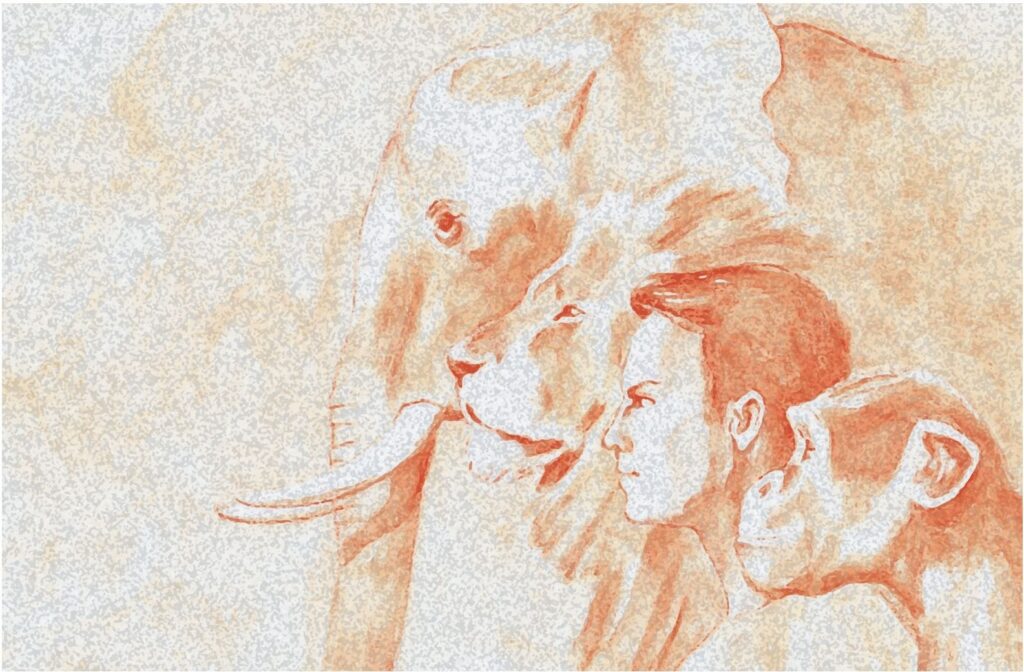
The lines you’ve just read are, in fact, extracted from a much longer work published in 1734. Pope’s An Essay on Man is written in four epistles (a poem or other literary work written in a series of letters) each exploring a certain aspect of God’s plan for mankind in the universe. The first epistle concerns man’s relationship with nature. Skipping ahead, the third and fourth epistles describe human societies and man’s pursuit of happiness respectively. The second (of which the poem is an extract) explores man’s place in the Great Chain of Being and argues that he is unique of all God’s creatures on earth. He hangs between is a phrase that essentially sums up Pope’s argument: he’s neither spiritual enough to be heavenly (like angels) yet has faculties of reason that distinguish him from animals. Grappling with this dichotomy in line four, Pope presents two oxymorons: darkly wise and rudely great. Oxymorons are awkward little metaphors pairing contrasting words to form contradictions or even paradoxes. For example, to be wise means to have much knowledge and clarity of thought, but Pope pairs wise with the word darkly, admitting there are yet many mysteries of the universe hidden from man’s understanding. Similarly, man thinks of himself as great; humans build cities, create art, philosophise and discourse – yet, side-by-side with great sits the word rudely, meaning ‘poorly formed’. Pope admits we are made of the same base matter as mere animals and that our aspirations to greatness are often clumsy (our cities are crowded, our artworks simulations of true beauty, our philosophies incomplete and ridden with contradictions). In the same vein, you might interpret darkly to mean that we don’t always use our wisdom wisely: we not only create but destroy, often make war on each other and, in trying to improve our own lives, ruin the world in the process.
This kind of duality runs through the entire poem. For example, Pope examines the contrast between our physical and mental capacities. According to de Valades’ illustration, we inhabit the third rung down on the Great Chain between angels in heaven and animals on earth. Physically we resemble animals. After all, we are made of the same base matter as animals and find ourselves subject to the same rules of mortality as all God’s other creatures; ultimately, we are born but to die. By contrast, higher beings such as angels, who inhabit a higher rung on the Great Chain, live eternally. Further, if measured purely by physical capacities, humans are not distinguished among beasts. One-on-one with a lion or tiger, a single human being will probably end up as prey, something Pope is not shy to admit! Nevertheless, humankind as a collective bends nature any which way, felling forests, diverting rivers, domesticating animals for food and work. So looked at another way, mankind seems the Lord of all things. Pope presents these two ideas side by side on the same line, Lord of all things, but prey to all, in a juxtaposition that acknowledges the inherent paradox of humanity: physically, we are base creatures, alike to animals in that we are born, grow, eat, age, and die. Yet our capacities for thought, invention, and adaptation far exceed the denizens of the animal kingdom. Thus, the tension between our physical limitations and unique mental abilities helps explain our position on the Great Chain.
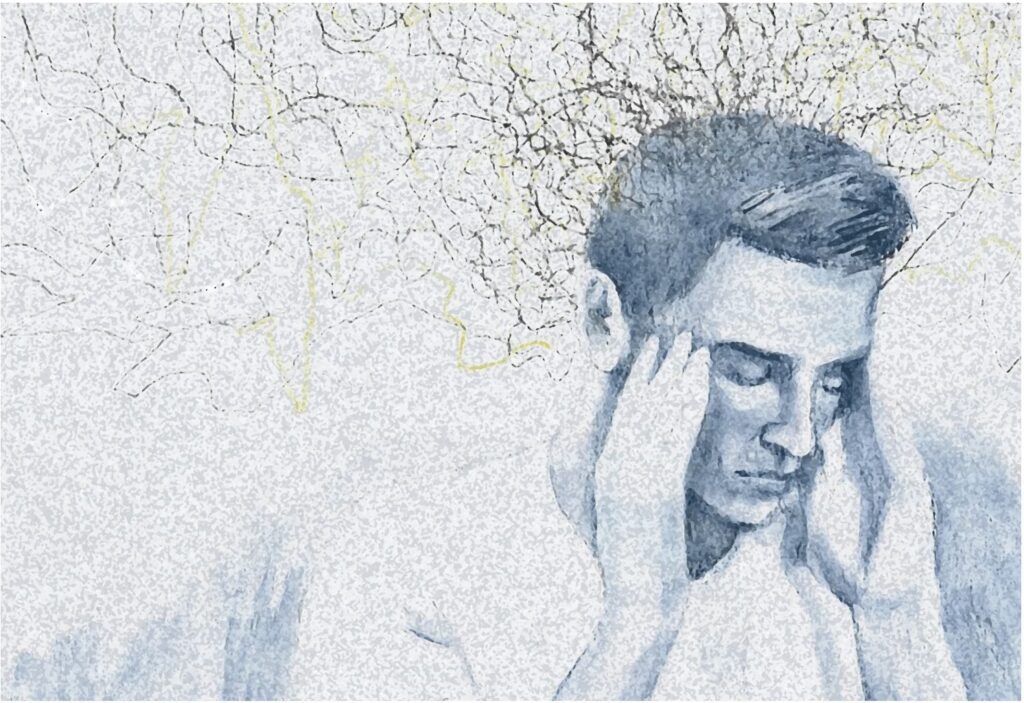
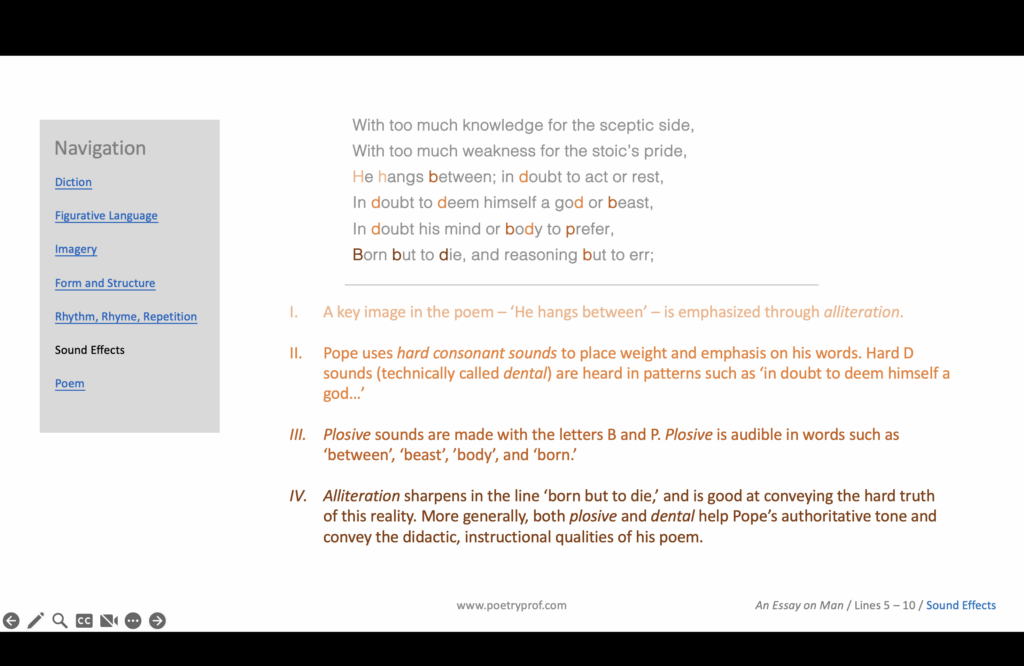
The acknowledgement that we can master nature yet cannot master our own thoughts, passions, and emotions gives rise to one of the poem’s central ironies. We are creatures uniquely capable of abstract thought and reason elevates us above mere beasts, yet our reasoning abilities are curtailed by limitations. Pope’s of the opinion that, while we may be wise at times, we often don’t know how to think properly and can be overwhelmed by the whirlwind of our thoughts and emotions. This idea comes to the fore in the lines: whether he thinks too little or too much, chaos of thought and passion, all confused… in which mankind finds it hard to distinguish higher level thoughts from more basic instincts. Elsewhere in the poem, Pope uses the word err or error to point out that we make lots of mistakes, and, especially in the line to reason but to err, seems to imply that mistakes are inevitable. The whole poem is couched in a persistent diction of confusion, where a lexical field of doubt includes confused, ignorance, error, and riddle, miring us in uncertainty and chaos. At one point, Pope uses anaphora, which is the repetition of words at the beginning of lines of poetry, to hammer home how mankind is suspended in a state of partial understanding: in doubt… in doubt… in doubt… For all our impressive mental abilities, nevertheless we are still groping in the dark when it comes to understanding ourselves, our purpose, and our place in the universe. At this point, Pope sharpens the sounds of his language, increasing the density of hard consonant sounds such as dental D (in doubt to deem himself a god) and blends in plosive Bs and Ps (beast, body, prefer) as well. The strongly alliterative phrase born but to die brings these effects to a head, where the acceptance of mortality may be a hard lesson, but is one Pope believes we must accept.
In this regard, Pope’s poem conflicts somewhat with a widening tradition of English Renaissance literature seeking to push the boundaries of human knowledge and achievement. He was writing his Essay on Man between the years 1732 and 1734, a late-Renaissance period in which the Enlightenment energy that had swept much of England and Europe for the past four-hundred-or-so years was beginning to flag. The Renaissance, a period of learning and progress in science, culture, and the arts was a ‘golden age’ of discovery as ideas from the East, along with the rediscovery of ancient Roman and Egyptian texts, found their way back into scholars’ hands. People eagerly pored over philosophical and scientific ideas, and the bounds of human knowledge and ability seemed to expand infinitely. Classical culture was revitalised, and solutions to mortal problems of disease, warfare, and hunger seemed within easy reach. Known as an Augustan poet, Pope himself was inspired by classical literature: Ovid, Horace, Homer. Yet he cautions against the presumption that our elevated knowledge and reasoning abilities allows us to see from an elevated perspective. He uses persistent contrasts, oppositions, juxtapositions, and parallelisms to balance out human achievement with human shortcomings. Nowhere can this be seen more clearly than when Pope reinforces another anaphora (with too much… ) with antithetical parallelism (knowledge and weakness are opposing or antithetical qualities):
With too much knowledge for the sceptic side,
With too much weakness for the stoic’s pride,
With a tip of his hat to humanity’s classical inheritance (too much knowledge…) Pope immediately reminds us of our weakness, words sitting one atop the other on adjacent lines like mirror images. Other parallelisms nestle together even more closely on the same line (for example, Born to die, and reasoning but to err), using binary oppositions (born opposes die, reasoning opposes err) to express our tenuous existence as heightened-but-still-limited creatures. A corollary effect of all the contrasts in the poem is to create a sense of balance in Pope’s view of humanity. While he values reason more highly as it elevates us above animals, he doesn’t overly denigrate emotion or passion, instead admits that we are flawed and fallible creatures, with sceptic sides and stoic sides, with knowledge and weakness intermingled. Nowhere is this more pronounced than when Pope juxtaposes glory and jest in a manner accepting of both the highs to which we ascend and the lows to which we sometimes plunge.
Much of Pope’s worldview certainly derived from his own religious faith. As a devout Catholic (he even forfeited the right to formal education in Protestant-aligned England) Pope believed in the underlying order of the universe as designed by God; our middle state is intentional. By contrast, other Renaissance writers such as Christopher Marlowe, who had adapted Goethe’s tragedy Faust for the stage, giving the line “the wages of sin is death? That’s hard” to his antihero Doctor Faustus, questioned why we should blindly accept religious dogma when we have the faculties to think for ourselves. However, Pope was no apostate. In the biographical entry for Alexander Pope at Poetry Foundation, An Essay on Man is described as “an aesthetic and philosophical argument for the existence of order in the world, contending that we know the world to be unified because God created it.” The first epistle of An Essay on Man ends with the assertion: “Whatever is, is right.” The first lines of our given extract plainly and directly instruct us not to question God and focus our limited attention spans on understanding more of ourselves: Know then thyself, presume not God to scan. The poem is didactic: Pope is not encouraging his readers to think for themselves, rather he wants us to accept the philosophies of his Essay. His first words are spoken like a stern teacher who brooks no dissent with his forthright opinions: Know then thyself is given added weight through strong alliteration making Pope’s voice resound with weight and authority. The root of the word ‘presumption’ is presume, a word Pope deploys to caution against lifting our gazes too high. He uses the word scan as a poet might: scansion is the art of discerning a poem’s rhythm and meter and his intention is to scan the nature of mankind to discover our underlying trends and patterns; as he so clearly states: the proper study of mankind is man. In the full-length version of his Essay, Pope spends time cautioning readers against excessive pride, a word that appears in line six of this extract. In Pope’s opinion, pride is the sin that tempts us into arrogantly assuming we can find our own way in the world, heedless of God’s plan. While God’s plan is not clear (the poem pointedly ends with the word riddle) Pope doesn’t doubt that there is a plan. Ultimately, his writing accepts that we cannot understand the true complexity of the wider universe – and nor should we try.
Ironically, Pope chose heroic meter in which to write his poem. Heroic meter is the name given to lines of iambic pentameter arranged in rhyming couplets. Pope was known in his time as the master of heroic couplets and, at times, it may feel as if such perfect mastery of form intuitively implies mankind’s potential for glory, perhaps conveying a certain pride in the poet’s skill as well. Certainly, the form of the poem runs counter to the ideas of confusion, chaos, and ignorance insofar as it is rigorously organised, rhythmic, and ordered. In this way, Pope’s poetic creation mimics the underlying order of God’s much more complex act of creation, an ordered universe that we might see if not for our inferior vision. Pope himself justified his use of rhyming couplets by explaining that the poem’s form mimics man’s position in the Great Chain (suspended somewhere between base matter and spiritual essence and possessing qualities of both) in its blend of philosophical substance with beauty, insight, and the pleasure of reading, Rhythmically, the opposing qualities of stressed-unstressed syllables, the de-dum de-dum rhythm of iambic lines, are an effective way of carrying the other dualities of the poem as well. This pattern of ebb-and-flow, up-and-down comes through especially strongly as the poem nears its end. The arrogance of titles such as Great Lord of all and Sole judge of truth are deliberately undermined through juxtaposition with but a prey to all and in endless error hurled, this latter hyperbole (a term for when writers deliberately take things to extremes; endless is hyperbolic) implying that, for all our learning and progress, we will never be in control of our own lives and fates. The grammar of this line works wonders as mankind is robbed of agency by simple syntax. In the passive tense of endless error hurled lies a pattern you’ll see throughout the poem as we are intermittently created, abused or disabused, placed and hurled. In all these moments, we are the passive manipulanda of an external force, unpossessing of free will, putty in the hands of a higher power who moulds us as easily as we manipulate creatures and elements lower down the Great Chain.
Suggested poems for comparison:
- An Essay on Criticism by Alexander Pope
Before his Essay on Man, Pope wrote An Essay on Criticism in which you can see similar themes of logic vs emotion, reason vs passion unfold. Written when he was only 21, this poetical essay nevertheless demonstrates his mastery of heroic meter equally well.
- Sonnet 29 by Edna St Vincent Millay
In this beautiful, melancholy sonnet, Millay recounts the devastation caused when our emotions run out of control and our hearts win out over our heads. Pope would have approved.
Additional Resources
If you are teaching or studying An Essay on Man at school or college, or if you simply enjoyed this analysis of the poem and would like to discover more, you might like to purchase our bespoke study bundle for this poem. It costs only £2.50 and includes:
- Study questions with guidance on how to answer in full paragraphs.
- A continuation exercise to help you practise analytical writing.
- An interactive and editable powerpoint, giving line-by-line analysis of all the poetic and technical features of the poem.
- An in-depth worksheet with a focus on explaining contrast and juxtaposition.
- A fun crossword quiz, perfect for a starter activity, revision or a recap – now with answers provided separately.
- A four-page activity booklet that can be printed and folded into a handout – ideal for self study or revision.
- 4 practice Essay Questions – and one complete Model Essay for you to use as a style guide.
And… discuss!
Did you enjoy this breakdown of Alexander Pope’s poetical essay? Do you think his exhortations hold up in the present day? Do you know anything about the Great Chain of Being or other historical belief systems? Why not share your ideas, ask a question, or leave a comment for others to read below.