Posted by
 Kevin Halligan’s as stuck as a bug in a rut
“Halligan’s quietly amusing and observant poems cover a range of sentiments and subjects, from the urban quotidian to the positively scary.”
Peter Reading, poet and critic
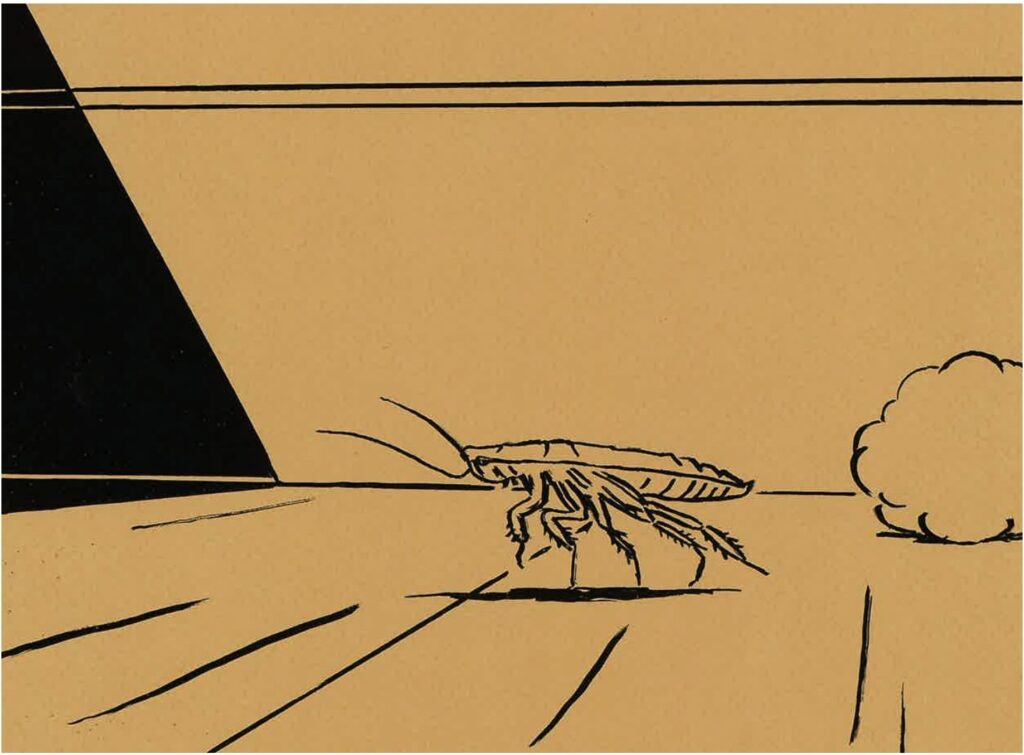
The sonnet is one of the most well-known literary shapes. Named for the Italian term sonnetto, meaning ‘little song’, sonnets are a closed form, meaning that they must follow a particular structure, rhythm, rhyme scheme, and line count. For example, a sonnet’s most distinctive feature is having fourteen lines. But that doesn’t mean all sonnets are exactly the same. Like any form, the sonnet is flexible. So, while in English it’s most common to write sonnets in lines of iambic pentameter, ten syllables arranged in weak-strong pairs, at one point in time sonnets in French used lines of twelve syllables (called alexandrines). Historically, sonnets have evolved through forms such as Petrarchan (with an ABBA rhyme scheme and octave-sestet structure) to Shakespearean (who preferred ABAB and three quatrains followed by a closing couplet) and beyond. Dig deep enough and you’ll discover that even the fourteen-line requirement is not strictly compulsory: a ‘stretched sonnet’, for instance, has sixteen lines while a ‘curtal’, a modification devised by Gerard Manley Hopkins, has ten-and-a-half! All this is a long-winded way of getting to Kevin Halligan’s The Cockroach. While this wonderful little poem is indeed a sonnet, Halligan twists it distinctively his own way. In the past, the sonnet was associated with some of the grandest and most philosophical of subjects. Way back in the fourteen-hundreds, Italian sonneteer Petrarch, for whom the Italian form was named, wrote 317 sonnets all about his unrequited love for a woman called Laura. Plenty of Shakespeare’s sonnets were dedicated to grand themes like beauty, time, youth, love, and death. In the eighteenth and nineteenth centuries Romantic poets turned to the sonnet form as a way of elevating nature in their search for wonder and sensual pleasures that the increasingly modern, consumer-driven world could no longer provide. Perversely, Halligan throws centuries of tradition out of the window in choosing not the beauty of a flower, or a perfect summer’s day, or even the pangs of unrequited love, but a distinctly un-elevated and anti-romantic subject to fix his eye upon: a lowly cockroach, scuttling in confused rings, scratching his itchy back, or dodging bits of dirt and dust on the floor:
I watched a giant cockroach start to pace
Skirting a ball of dust that rode the floor.
At first he seemed quite satisfied to trace
A path between the wainscot and the door,
But soon he turned to jog in crooked rings,
Circling the rusty table leg and back
And flipping right over to scratch his wings –
As if the victim of a mild attack
Of restlessness that worsened over time.
After a while he climbed an open shelf
And stopped. He looked uncertain where to go.
Was this due payment for some vicious crime
A previous life had led to? I don’t know,
Except I thought I recognised myself.
As a symbol for exploring human experience in poetry, the poem’s subject may be a surprising choice. Where sonnets traditionally aim high, you can’t get much lower than a scuttling cockroach, an insect associated with burrowing through rubbish, crawling along sewer pipes, uncleanliness and disease. However, the reversal of expectation forces readers to engage with the dark side of the human condition too. After all, disgust, fear, even squeamishness are all things people feel from time to time, and this poem flips the perspective by having the speaker’s detached observations of the cockroach suddenly rebound onto himself at the end. At this moment, Halligan’s scuttling bug becomes a symbol of self-doubt… like the insect frozen on the shelf edge, the speaker is stuck in a doom spiral of bleak thinking and can’t seem to find a way out. It looks like the pathway to the door is straightforward, but some mental, emotional, psychic or spiritual kink makes the next step feel impossible to take.
Not that you’d necessarily get this from the opening lines, which are optimistic enough. The poem starts with the speaker observing a cockroach crawling in the crevice of floor and wall (wainscot refers to wooden panelling that sometimes clads the bottom of interior walls, like an old-fashioned skirting board). The roach dodges a ball of dust on his way to the door, as if he has a purpose or goal (path) in mind; doors are handy symbols for thresholds or passageways, a way out of the bare room the insect seems trapped in. The speaker even reports that he seemed quite satisfied, as if life is playing out, if not exactly happily, then according to expectation. There’s a certain vim and vigour in the language of the opening few lines, created by frequent verbs (pace, trace, jog, skirting, rode), a comfortable rhyme scheme (pace/trace, floor/door) and even phrases like start to pace that gives the bug a fussy, officious aspect, like a puffed-up little man striding up and down the room with his hands clasped behind his back (perhaps memories of Pinocchio’s Jiminy Cricket are affecting my imagination here). Yet there’s also a feeling of reluctance held just below the surface of these lines as if the speaker is holding himself back from full engagement with his subject matter. Clues lie in diction: I watched positions the speaker as a passive observer, detached from what he sees and unable to move towards his goals. The words pace and trace belie their own energy, actually suggesting a forwards-and-backwards movement that can be associated with nervousness or indecision. And skirting is a word that, in a different setting, can be used to suggest avoidance (as one skirts a problem or obstacle rather than tackling it head on). Soon enough, the forced optimism and satisfied aspect of the opening quatrain turns out to be a mere smokescreen, and the speaker’s angst and anxiety start to make themselves more keenly felt.
We don’t have to wait long for the fragile equilibrium to be disrupted. Marked by a decisive connective, But soon… from the fifth line onwards any apparent satisfaction begins to shift into darker territory. This shift is both physical and tonal: the speaker sees how the cockroach turns back on himself, losing his way and transforming a straightforward stride into a hesitant spiral that ends up taking him nowhere. Instead of completing his journey to the door, the insect turned to jog in crooked rings, circling a… table leg before quite dramatically flipping himself onto his back. At the same time, the sonnet’s language takes its own dark turn: crooked introduces a broken, jagged note into the poem’s diction, breaking the smooth line of wainscot to door. Scratch suggests irritation and discomfort, and victim implies the cockroach has lost control of events, positioning him, like the sonnet’s speaker, as passive (the simile as if the victim… removes any control the bug might have over his own life; a victim is someone to whom things happen, rather than someone with agency over what is going to happen next). The sonnet’s discomfort escalates until we reach the final word of the second quatrain: attack. Despite the qualifier mild, this actually sounds pretty serious, as if he’s experiencing a debilitating fit or seizure. In just a few lines, we’ve moved from seemed quite satisfied to victim of a mild attack! Alongside and contributing to this tonal shift is a concurrent shift in the poem’s prevailing sound patterns: words like wainscot, jog, crooked, circling, leg, scratch, back, and attack all contain guttural consonance. Formed by ‘clicking’ the back of the throat to make the letters G, hard C, and K, gutturals contain a cracked, broken quality of sound that perfectly matches the growing distress of these lines.
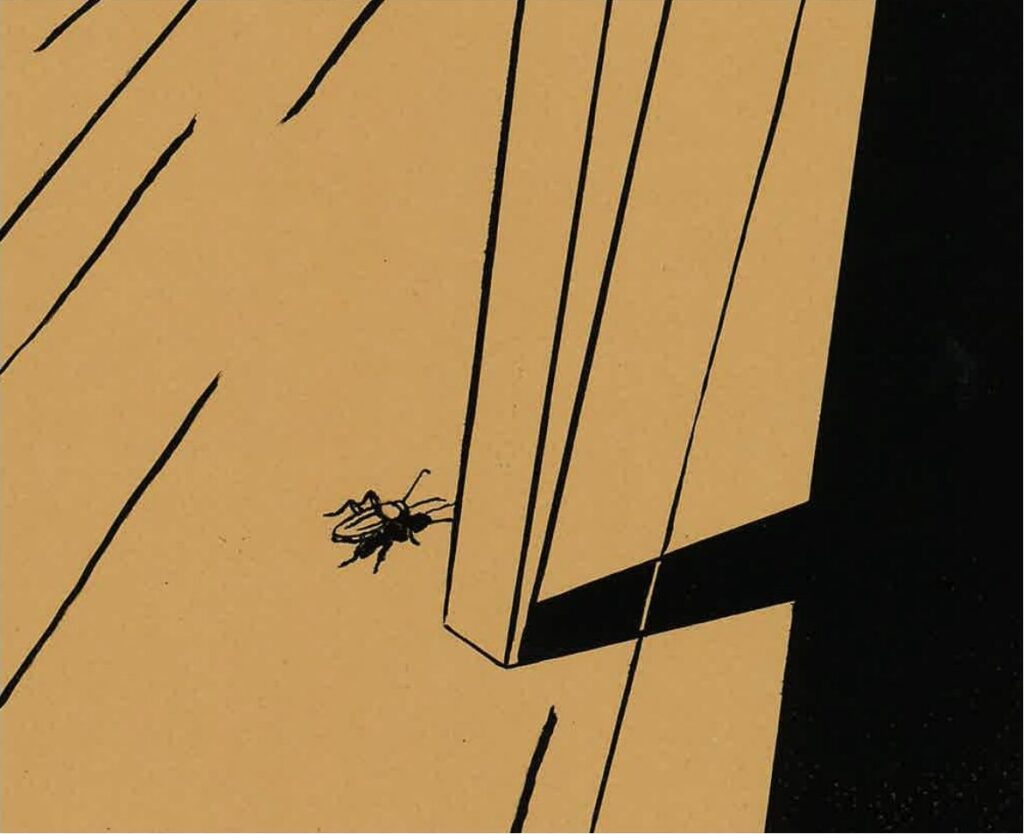
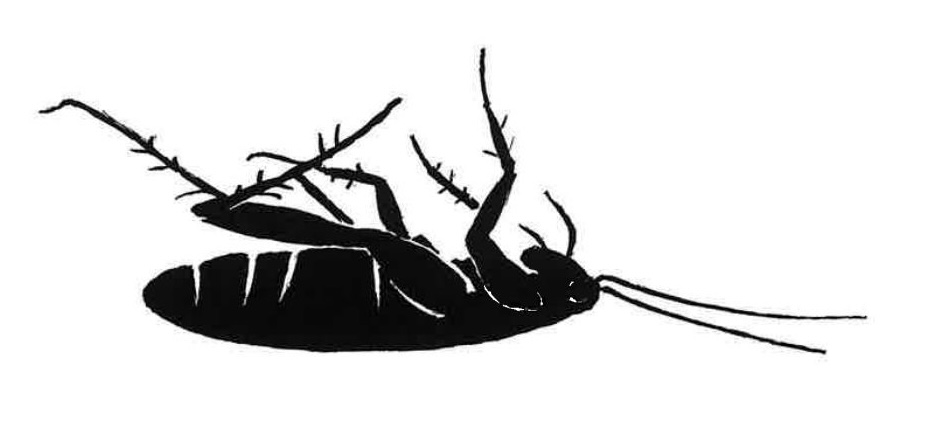
We’ve already discussed how the sonnet is a closed form, and it’s here, in the middle of the poem, that the effects of closed form start to make themselves truly felt. A sonnet’s iambic pentameter asks for regularity, and the similar line lengths and unfaltering weak-strong rhythm soon starts to feel restrictive, like the walls of the room are pressing in on its occupants. Even the alternate rhyme scheme, that felt quite comfortable in the opening lines, takes on a repetitive aspect. Just like that infamous water torture, where a single drop is made to fall onto the forehead over and over again until the sensation becomes unbearable, there’s a feeling of building pressure and growing anxiety in the cockroach’s pacing and tracing that transmits itself into the speaker’s reportage. The moment of flipping right over can be understood as either a psychological breaking, or a desperate attempt to wrench himself out of the pattern that he’s trapped in. There’s a moment of hope when he suddenly breaks the horizontal planes of the room and climbed the vertical axis up to an open shelf. This moment has the potential to feel like a release: unlike the floor, bounded by stern wainscotting that hemmed him in, the shelf beckons enticingly, its openness symbolising take-off, dreams of flight, or limitless possibilities. In a traditional sonnet, this might be the moment the speaker gazes yearningly into a cloudless sky! But in this anti-romantic version of a sonnet, the cockroach becomes marooned. Perhaps the sudden possibility of being able to choose any direction is overwhelming; even though the speaker says the insect has wings, he doesn’t fly away. Instead he freezes absolutely: And stopped is marked with punctuation that creates caesura – a break in the middle of the line – to convey the impression of the insect paralysed in place, antennae waving helplessly in the air, with absolutely no clue where to go or what to do next.
The hesitancy in the cockroach’s behaviour is mirrored in the hesitancy of the speaker’s diction, which feels curiously flat and disengaged even as he describes what he sees. As we’ve already noticed, the poem’s confident opening flatters to deceive and, to be honest, the language hardly seems to get going; phrases like start to and at first reiterating each other to create a halting feeling like a false start. Words like seemed and thought suggest uncertainty, like the speaker’s not sure how to interpret the cockroach’s body language, and (as we noted withmild attack) he frequently qualifies his descriptions with but… as if… quite…except… such as in the example quite satisfied, which is a curiously downbeat and unconvincing phrase; the contrary impression formed is of the speaker feeling oddly unsatisfied! Towards the end of the poem, there’s a flicker of curiosity when the speaker asks a question: was this due payment for some vicious crime? But even here, the language is strangely cold and pessimistic, revealing a transactional worldview (payment) that parlays understanding only in terms of cause-and-effect, crime and punishment, or due process. Just like when he used the word victim, this line has the speaker robbing himself of agency by imagining an unknowable, invisible higher power that is responsible for everything that happens. The allusion to reincarnation implies the cause to this effect is hidden in an unknowable past, beyond understanding or solution. Moreover, the question is an intellectual one verging on the philosophical, but it betrays an emotional shortcoming. Despite the appearance of empathy with the bug, he doesn’t attempt to help him or set him back on his way. And it’s not necessarily a lack of emotional capacity; just as the cockroach has wings but chooses not to use them even after he climbs to the perfect take-off point, the speaker (presumably) has emotions but doesn’t engage them. At the end of the day, perhaps the bug is still too alien to consider helping, possibly reflecting the speaker’s experiences of how other people struggle to relate to him.
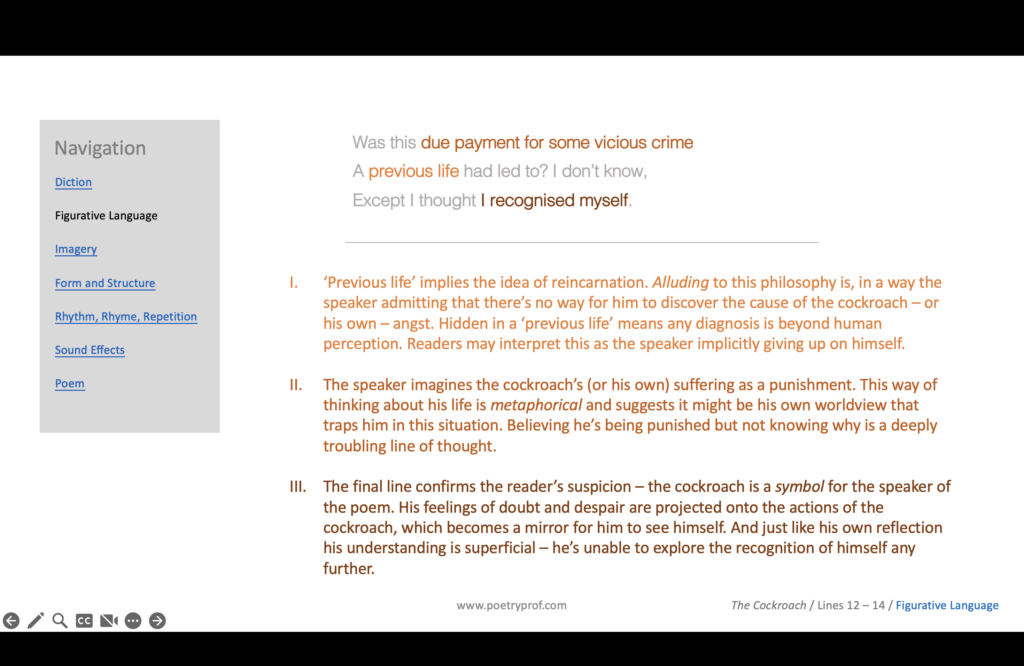
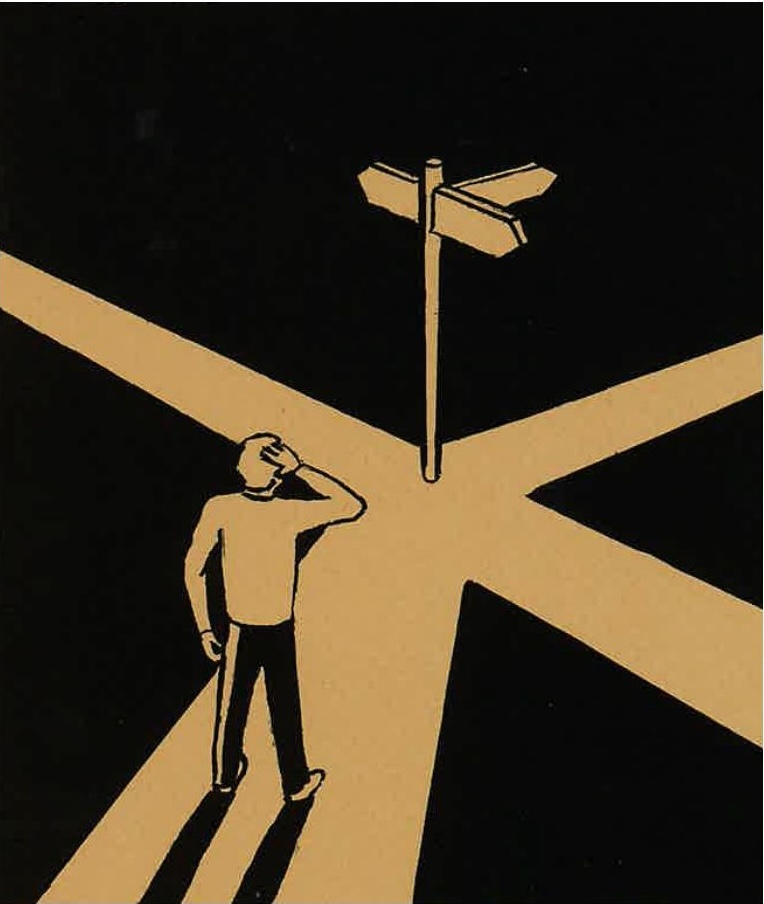
A sonnet’s turn, also called the volta, is the point in any sonnet where something changes: perhaps the writer flips the perspective, introduces a counter-argument or concession, crafts a shift in tone, or even just delivers an unexpected twist like a punchline to a joke that’s been carefully set up. In truth, by the time the sonnet ends with the admission I thought I recognised myself, most readers probably had an inkling that the cockroach is an extended metaphor for self-doubt. Stuck in a rut of anxiety, trapped between the wainscot and the door, the cockroach is a mirror of the speaker who feels unable to solve even the most straightforward of life’s problems. Introduced as a giant in the first line – an exaggeration that might as well shout out “this cockroach is a symbol for a person!” – the poem’s twist, such as it is, is foreshadowed by persistent personification. For example, the speaker projects emotions onto the cockroach, such as satisfied and restlessness, granting him an interior complexity that insects (probably) don’t possess. Through this device, and with the hindsight of the poem’s final line, descriptions of the bug’s actions and emotions reflect back on the speaker in miniature, showing him to be a man crippled by self-doubt. False confidence and bravado of the opening lines falls away as the insect starts second-guessing himself, backtracking his previous path, and retracing his steps in the manner of somebody who might be lost. After the insect stops, the speaker imagines him paralysed by doubt, reporting: He looked uncertain where to go, again projecting his own feelings onto something that, in reality, is not capable of experiencing emotional dilemmas. Some of the poem’s physical descriptions (especially jog) could be used for human actions as readily as a bug’s, and even the suitably insectile scratch of wings is undercut by the supposition of him being victim of a mild attack of restlessness, rather than scratching and scuttling being presented as natural buggy behaviours. This turn (or volta), which in traditional sonnets sometimes feels revelatory, hits more like a damp anti-climax. The speaker asks that profound question about life… but answers it with a shrugged I don’t know. It feels like he’s given up. Like the cockroach stuck on the shelf, an unseen but heavily-felt psychological or spiritual burden prevents him from taking back control of his circumstances. The return to and repetition of I in the final couple of lines (a word we haven’t seen since line 1) shows he’s trying to introspect… but he fails to come to any conclusions beyond a shallow recognition of myself in the unfortunate insect.
An obvious literary touchstone for The Cockroach is Franz Kafka’s Metamorphosis which, like Halligan’s sonnet, uses the extended metaphor of human-as-insect to ask questions about existence and the meaning of life. In both works, people live aimlessly and lack guidance or support. In Kafka’s novella, Gregor’s transformation externalises his fear of uselessness. Trapped in a dead-end job, nevertheless his first reaction upon discovering his new insect body is to worry about missing work! There’s no reason given for the absurd transformation. One morning, Gregor simply wakes up a cockroach, symbolising the worthlessness of human lives in a world where people are easily replaceable (don’t turn up at work and your boss will quickly find someone else to do your job). Halligan’s speaker evinces the same symptoms of existential despair. In comparing himself to a commonly despised insect, he inadvertently suggests low self-esteem, as if he’s at the very bottom of life’s food chain. In Metamorphosis, Gregor’s family are mostly unsympathetic; in a similar way we might feel like Halligan’s speaker could do with a quick pep-talk. But at this moment of crisis he’s alone with his thoughts and no-one’s there to help him. His projection of aimlessness onto the random wanderings of a bug implies a profound lack of faith in himself and his ability to get his life ‘back on track’ by recovering from whatever ails him. Visual imagery creates circle shapes in the mind’s eye, representing how his mind is stuck in patterns of thought that lead nowhere: skirting means to go round the long way, pace and trace suggests going over the same ground repeatedly, crooked rings and circling the rusty table leg and back very straightforwardly show the cockroach going round in circles, ending up right back where he started. Even the action of flipping right over is another type of rotation, and the idea of reincarnation brought up by musings on a previous life imagines human existence as a grand circle of repeating time, where experiences of the present relate to the past in a way that we cannot perceive or understand. While time does pass (over time… after a while…) there’s no concurrent sense of forward motion in the speaker’s words or actions, especially when the poem dramatically stops in the middle of line eleven. The poem continues for another few lines, but once the external action of the poem ends, the speaker’s internal commentary only takes us back to the start: recognised myself reflects the words I watched as in a distorted mirror, creating a loop composition that circles the poem back to where it began. Paralysed by some kind of existential doubt, the poem’s speaker admits he feels as aimless, useless, and irresolute as the poor insect who can’t manage to navigate himself to the door that’s right in front of him.
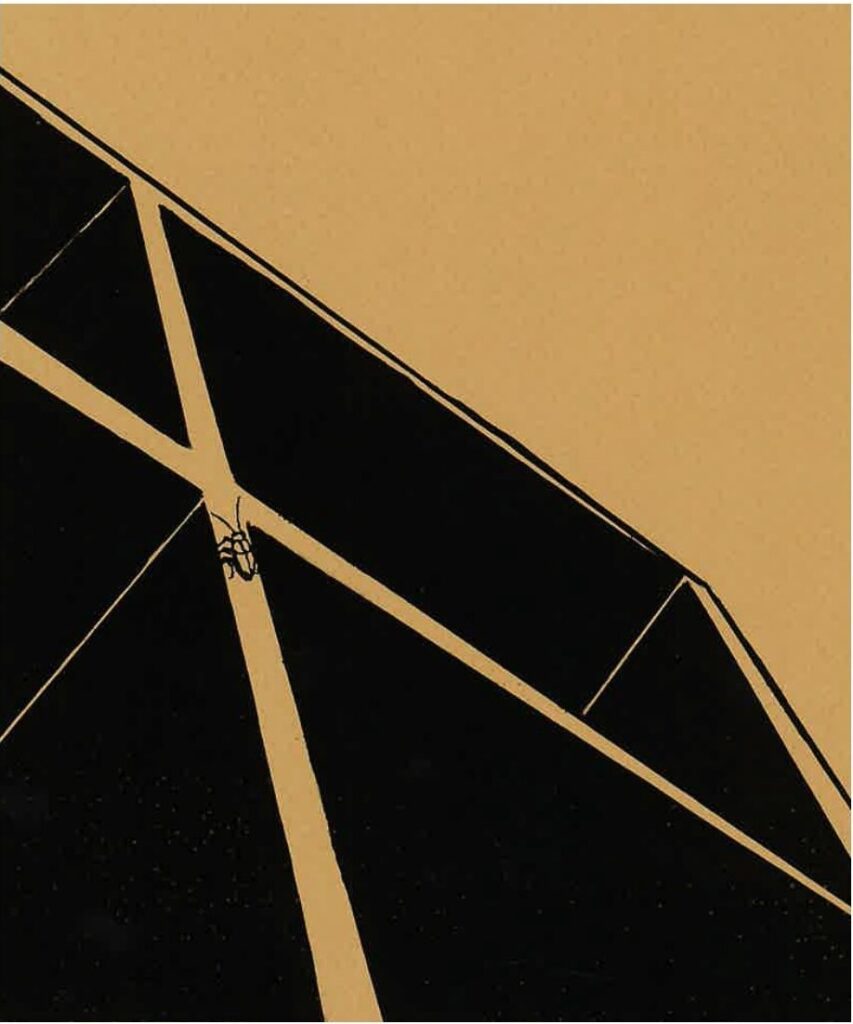
The poem’s over-riding sense of futility extends to its setting as well, implying a world where all is infected with the same bizarre apathy as the speaker. Glimpsed only in tiny details, we are nevertheless given the impression of a bare and empty world that feels like it’s suffering from a conspicuous lack of care and attention. The floor is covered in balls of dust as if nobody has bothered to sweep up for a long while. The peculiar description rode the floor animates the dust with the same pallid and weak motivation that infuses the cockroach and the speaker, as if the tiny particles are being carried by something that is itself incapable of movement. The image brings to mind dust motes suspended in light, floating aimlessly, or shivering in a static field that lets them drift only so far before pulling them back to a fixed point in space and time. The table leg is rusty, neglected and in want of polishing, while the phrase open shelf makes the room appear spartan and empty, unlived in so the shelves don’t need to be stocked. Details are few but the impression of neglect is strong, so the atmosphere takes on the same hopeless aspect as the cockroach and reflects melancholy and hopelessness in the manner of pathetic fallacy.
Thinking symbolically, if the cockroach reflects the speaker, the room they’re in can be understood as a microcosm of his world. It feels empty, neglected, lonely, and marked by apathy; after all, dust and rust can be fixed by a quick spring clean and polish, but that would need more motivation and energy than it seems people round here can muster. The door offers the little guy a way out – so why doesn’t he take it? The apathy of the room seeps into those trapped inside, man and insect both, infecting them with a strange paralysis and preventing them from taking effective or decisive action. It’s emptiness maybe hints at a lack of wider support structures. When all one needs is a nudge in the right direction, not getting it can make a seemingly innocuous obstacle spiral out of all reasonable proportion.
Suggested poems for comparison:
- The Mosquito by D.H. Lawrence
Halligan isn’t the only poet to focus on lowly and reviled insects in poetry. Famously, D.H. Lawrence wrote The Mosquito, an encounter between a human and insect, to reflect on existence. Like Halligan, there’s no lofty romantic description here; there’s even a bit of irritation (anyone who’s been kept awake at night by a single mosquito will sympathise!)
- The Fly by Miruslav Holub
This wonderful Polish poem compares the reproductive cycle of flies with human mortality by focusing on, not a great battle playing out in the background, but flies who lay their eggs on trees round the battlefield’s edge – and the corpses of the men and horses who died so brutally. A very clever juxtaposition.
Additional Resources
If you are teaching or studying The Cockroach at school or college, or if you simply enjoyed this analysis of the poem and would like to discover more, you might like to purchase our bespoke study bundle for this poem. It costs only £2.50 and includes:
- Study questions with guidance on how to answer in full paragraphs.
- A continuation exercise to help you practise analytical writing.
- An interactive and editable powerpoint, giving line-by-line analysis of all the poetic and technical features of the poem.
- An in-depth worksheet with a focus on explaining how speaker and voice are crafted in the poem.
- A fun crossword quiz, perfect for a starter activity, revision or a recap – now with answers provided separately.
- A four-page activity booklet that can be printed and folded into a handout – ideal for self study or revision.
- 4 practice Essay Questions – and one complete Model Essay for you to use as a style guide.
And… discuss!
Did you enjoy this explanation of Kevin Halligan’s anti-sonnet? At which point did you realise the cockroach was a reflection of the speaker’s psyche? Did the poem make you sympathise with a commonly despised creature? Why not share your ideas, ask a question, or leave a comment for others to read below.